
MPC Wallet vs Multisig Wallet: What Really Differs
MPC Wallet vs Multisig Wallet: What Actually Differs for a Solo Holder
I spent a whole evening reading vendor blogs and came away thinking these two things were the same product with two names. They are not.
If you’re comparing an MPC wallet vs multisig wallet for your own crypto, here’s the honest, non-enterprise version: one splits a single key so it never fully exists, the other is a contract that collects several signatures on-chain. That difference decides who can fail on you. I’ll make the case for each side, then tell you where I actually landed as one person with a hardware wallet and no CS degree.
No forecasts here. Just the trust surface of each model, and how I reason about it.
The one confusion to clear before anything else
Most of the internet treats MPC and multisig as synonyms. They both aim at the same goal — no single person holding one key that can move everything. But they get there through completely different machinery, and the machinery is the whole point.
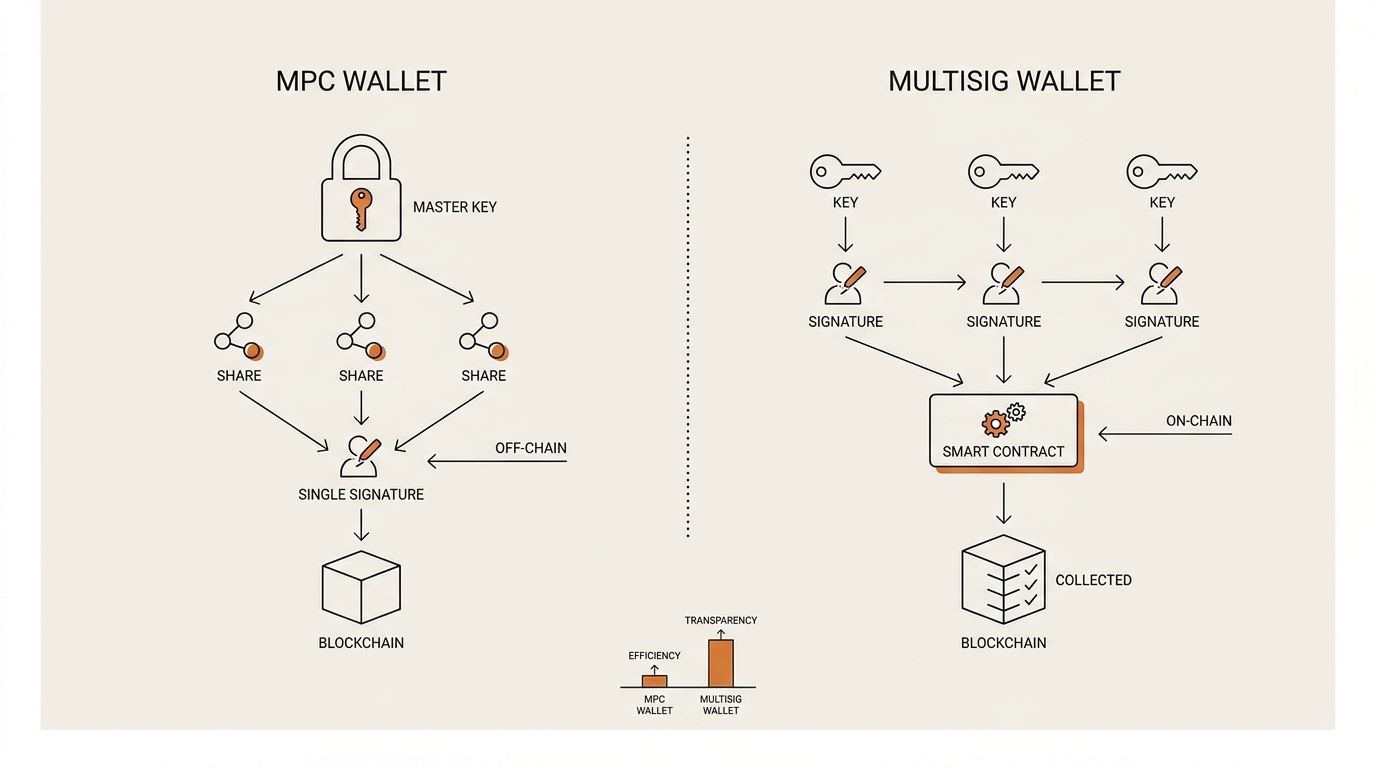
An MPC wallet uses multi-party computation, specifically a threshold signature scheme (TSS). Picture one private key that gets mathematically cut into shares, say two-of-three. Those shares live with different parties. When you sign, the shares run a joint computation and produce one ordinary signature. The full key is never assembled in one place, not even for a millisecond. On-chain, it looks like any single account signed. Nobody watching the chain sees a policy at all.
A multisig wallet is the opposite in structure. It’s a smart contract sitting on-chain — Safe (formerly Gnosis Safe) is the one most people mean. The contract holds a rule: require, say, two-of-three distinct signatures from separate keys. Each signer signs their own transaction, the contract verifies them, and the rule is enforced by code that everyone can read. The policy is public.
So the crisp version, which I wish someone had handed me on hour one:
An MPC wallet is cryptography that splits one key into shares and produces a single on-chain signature, enforced off-chain and invisible on the chain. A multisig wallet is an on-chain smart contract that collects multiple distinct signatures from separate keys and enforces the rule publicly. Same goal — no single key holder — completely different trust surface.
Same destination. Different vehicle. And you don’t trust a plane the way you trust a car.
The case for the multisig wallet
Start with what multisig gets right, because it’s the model I understand best and the one most people underrate for personal use.
It’s legible. The rule lives on-chain as contract code. Two-of-three means two-of-three, and anyone — including future you at 2am — can open a block explorer and read exactly who the signers are and what threshold applies. There’s no vendor dashboard interpreting the policy for you. The chain is the source of truth. For a non-developer, that legibility is worth more than it sounds. I can verify my own setup without trusting a company’s description of it.
It’s self-sovereign by default. A self-hosted Safe doesn’t require anyone to hold a share on your behalf. You control all three keys — one on your laptop, one on a hardware wallet, one on a phone, say. No provider sits in the middle. If you want to understand how a multisig is really just a programmable account, I walked through that in my piece on smart-contract wallets and account abstraction — a multisig Safe is a smart-contract account.
It fails in the open. If a key is compromised, the attacker still needs to clear the threshold. One stolen key out of three does nothing on its own. And because the policy is on-chain, you can audit exactly what happened after the fact.
Safe’s own writeup on MPC vs multisig makes this transparency argument hard — which you’d expect, since Safe makes the multisig. Read it for the mechanics, discount the conclusion. It sells one side. I’ll come back to that bias.
The catch with multisig is friction. Every signature is verified on-chain, so gas costs more than a single-signer transaction. It’s chain-specific — a Safe on Ethereum isn’t a Safe on Solana; you deploy per chain. And coordinating multiple signers for a routine transfer is genuinely more clicks. For an institution with a signing desk, that’s fine. For me moving lunch money, it’s a tax.
The case for the MPC wallet
Now the other side, and I want to be fair here because MPC solves real problems that multisig doesn’t.
It’s chain-agnostic. Because the output is just a normal ECDSA or Schnorr signature, an MPC wallet works anywhere that accepts one — Ethereum, Bitcoin, Solana, the lot. No separate contract deployment per chain. If you hold assets across five networks, one MPC setup covers all of them. Multisig can’t offer that without five deployments.
It’s cheap on-chain and quiet. The signing coordination happens off-chain. The chain only ever sees a single signature, so you pay single-signer gas. No policy is published, which some people prefer for privacy — nobody browsing the chain can see that your funds sit behind a two-of-three rule.
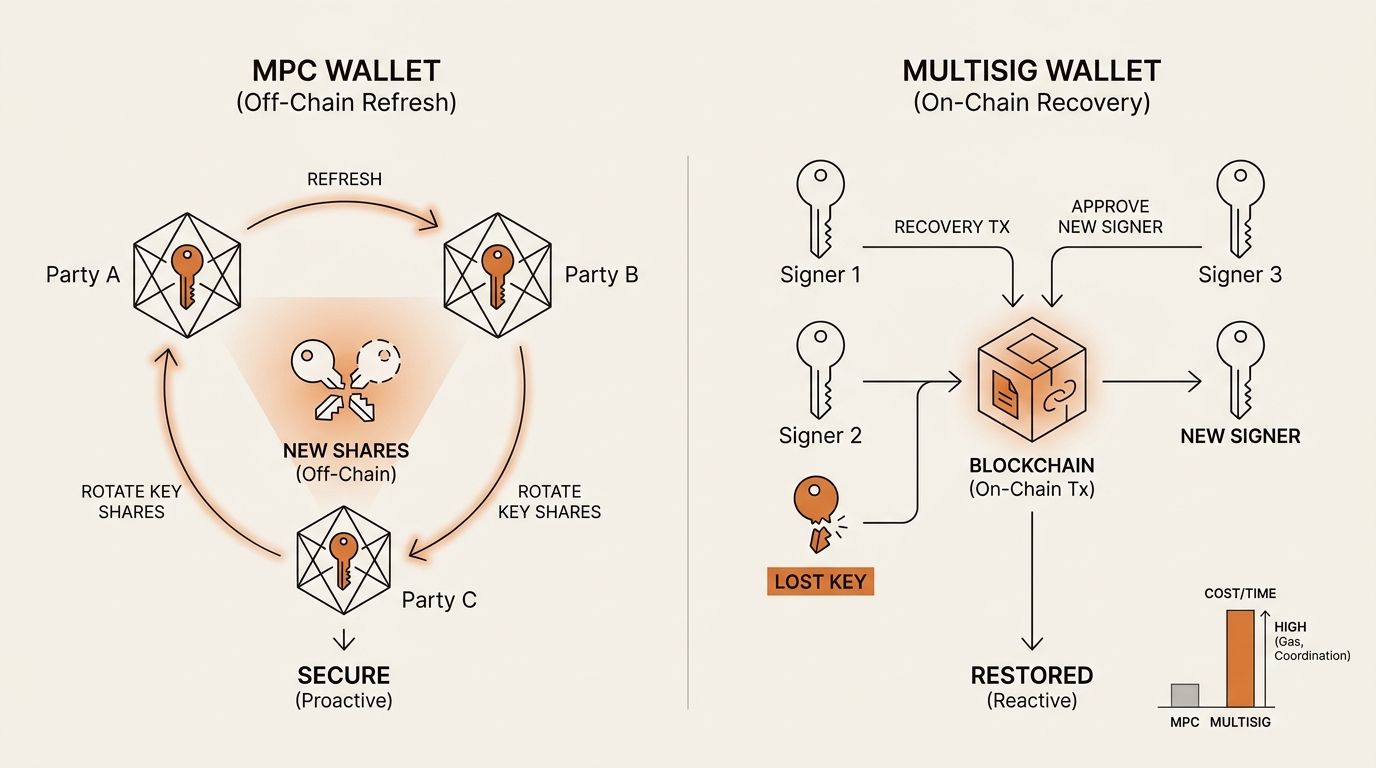
Recovery is where MPC genuinely shines. Shares can be refreshed off-chain without moving funds or migrating to a new address. Lost a share? Many MPC setups let you rotate the remaining shares into a fresh set, or use social/passkey recovery, without an on-chain transaction. With a self-hosted multisig, recovering a lost signer usually means the remaining key holders cooperating to move funds to a new setup — more manual, more gas. Fireblocks, which makes MPC infrastructure, argues this UX point well in its MPC vs multi-sig writeup. Same warning as Safe: it sells its side. Take the mechanics, leave the verdict.
The head fact I keep repeating to myself: an MPC scheme never reconstructs the full key. That matters because of a second confusion I’ll clear in a minute — MPC is not the same as splitting a key into backup pieces you later glue together.
Where I was wrong about the MPC wallet
Here’s the beat the vendor blogs won’t give you, because it cuts against their pitch.
For a while I assumed “MPC” meant “more decentralized, therefore safer.” Threshold cryptography sounds like the trustless, no-single-point-of-failure dream. So I mentally filed MPC above multisig on some safety ladder.
That was wrong, and the reason is boring: most MPC products you can actually sign up for are hosted. In a hosted setup, the provider holds one of the shares. You hold one, maybe a backup holds another, and the company holds the last. That’s not less counterparty dependence than a self-hosted multisig — it’s more. A self-hosted Safe has no company in the loop at all. A hosted MPC wallet has a company that co-signs every transaction with you.
So the safety story flipped in my head. MPC’s real edge for a solo person is UX and recovery, not some magic reduction in trust. The trust didn’t vanish. It moved to the provider holding a share. And a provider can go dark, freeze accounts, get acquired, or get breached. That’s a failure mode a self-hosted multisig simply doesn’t have.
The second thing I got wrong: I conflated MPC with Shamir Secret Sharing. They feel similar — both split a secret across parties. But SSS reconstructs the full private key in one place at signing time, which opens a window, however brief, where the whole key exists and can be stolen. MPC-TSS never reconstructs the key at all; the signature is computed jointly from the shares. Yehuda Lindell, a cryptographer who works on this, has a clear writeup on why SSS and MPC differ. Vendors blur these two constantly. Don’t let them.
For the neutral primary on the underlying math — no product attached — the Wikipedia entry on threshold cryptosystems is the least biased place to start.
The side-by-side, without the sales pitch
I built this table for myself after the confused evening. It’s the whole debate compressed into what actually changes for a holder.
| Dimension | MPC wallet (TSS) | Multisig wallet (Safe) |
|---|---|---|
| Enforcement | Off-chain cryptography | On-chain smart contract |
| On-chain footprint | Invisible — looks like one account | Public policy, fully auditable |
| Signatures produced | One combined signature | Multiple distinct signatures |
| Chain support | Chain-agnostic (any ECDSA/Schnorr chain) | Chain-specific (deploy per chain) |
| Gas cost | Low (single-signer) | Higher (verifies each signature) |
| Recovery | Off-chain share refresh, social/passkey | Cooperating key holders, on-chain |
| Full key ever assembled? | No | No (each key is separate to begin with) |
| Typical trust dependency | Often a hosted provider holds a share | Self-hosted: nobody in the middle |
| Best-fit for | Multi-chain holders, recovery-first UX | Legibility-first, self-sovereign holders |
Read the “typical trust dependency” row twice. That’s the one the comparison charts usually skip, and it’s the one that decides who can fail on you.
Where I actually land, as one person
So: multisig or MPC for me? Neither, exactly — and that’s the honest answer the SERP is missing.
Every top result treats this as an enterprise custody-desk decision. A signing desk with five approvers and eight-figure balances genuinely needs to choose between MPC and multisig, and the trade-offs above are their daily bread. But I’m one person. My question isn’t “which custody vendor is smartest.” It’s “does any of this matter for me, or should I just run a hardware wallet well?”
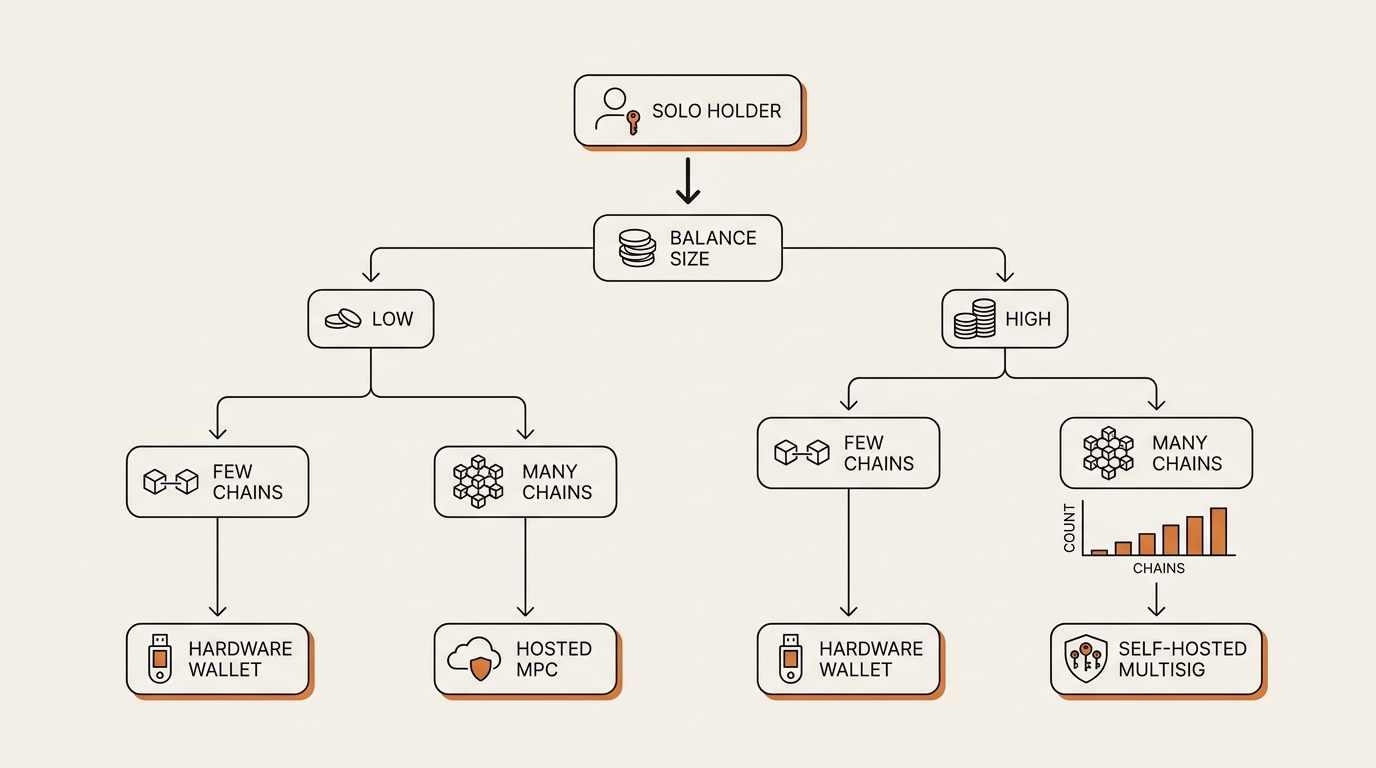
For most solo holders, the answer is: run the hardware wallet well first. A single hardware wallet with a clean seed backup already removes the single biggest risk — a hot key on a compromised laptop. I laid out the exact setup in my hardware wallet self-custody checklist, and it does more for the average person than any threshold scheme. If you want the layer beneath that — how much even belongs online — my hot vs cold wallet breakdown is the foundation this whole debate sits on.
When does the debate actually reach a solo person? When one hardware key becomes a single point of failure you can’t accept — a larger balance, or a fear of losing the one device. Then a self-hosted multisig (two hardware keys plus a phone, two-of-three) buys you redundancy without handing a share to a company. I reach for that before a hosted MPC setup, because I’d rather coordinate my own keys than depend on a provider co-signing.
Hosted MPC earns its place when you need painless multi-chain coverage and recovery you don’t have to think about — and you’re willing to accept a company in the loop. That’s a real trade, not a wrong one. It’s just a different trade than “safer.”
There’s one more frontier where threshold models stop being optional: automated signers. If you ever let software move funds, splitting signing authority stops being a nicety. I got into that in wallet security for AI agents, where a single compromised key is a much sharper problem.
Where this framing falls short
I’m reasoning as a solo holder, so I’ve been dismissive of the enterprise case. For a team, the multisig-vs-MPC choice is real and my “just use a hardware wallet” shortcut doesn’t apply — you can’t hand a shared treasury to one device in one drawer.
I’ve also treated “hosted MPC” as the default MPC experience. Self-hosted MPC exists, and it removes the provider-holds-a-share problem I leaned on. It’s rarer and harder to set up for a non-developer, so I skipped it, but it’s a fair rebuttal to my counterparty argument. And I haven’t run a production MPC setup myself — my confidence is about the structure of the trade-off, not a stress test of any specific product.
FAQ
Is an MPC wallet a multisig? No. They share a goal — no single key holder — but the mechanism differs. MPC uses cryptography to split one key into shares that jointly make one signature. A multisig wallet is an on-chain contract that collects several distinct signatures. Different machinery, different trust surface.
What is the difference between an MPC wallet and a multisig wallet? MPC enforces its rule off-chain and produces a single, invisible on-chain signature. A multisig wallet enforces its rule on-chain through public contract code and produces multiple signatures. MPC is chain-agnostic and cheaper on gas; multisig is auditable and self-sovereign by default.
Is MPC safer than multisig? Not strictly — they face different threats. A multisig wallet is transparent and provider-free when self-hosted. A hosted MPC setup often has a company holding a share, adding counterparty risk. MPC’s real edge is recovery and multi-chain UX, not a guarantee of being safer.
Which is better for one person, MPC or multisig? For most solo holders, neither beats a well-run hardware wallet first. If you need redundancy beyond one device, a self-hosted multisig avoids handing a share to a company. Choose hosted MPC only when painless multi-chain recovery is worth a provider in the loop.
Is MPC the same as Shamir Secret Sharing? No. Shamir Secret Sharing reconstructs the full private key in one place to sign, creating a brief window where the whole key exists. MPC threshold signatures never reconstruct the key at all — the signature is computed jointly from shares, so the full key is never assembled anywhere.
Is a multisig wallet a smart contract? On EVM chains, yes. A Safe multisig is an on-chain smart contract that holds your signing policy and enforces it in code. That’s why it ties directly to account abstraction — a multisig Safe is a smart-contract account, not a plain key.
The reframe
MPC vs multisig isn’t a question about which one is “safer.” Ask it that way and every vendor blog has already answered it for you — in their own favor.
It’s a question about who you’re trusting instead of yourself. A self-hosted multisig trusts your own coordination across your own keys. A hosted MPC wallet trusts a company to co-sign and to still be around next year. A hardware wallet trusts you to guard one seed. None of those is trustless. They just relocate the trust to different hands, and your job is to pick the hands you can actually watch.
Next in this Crypto Mental Models series, I want to open a block explorer and trace a real Safe transaction end to end — watch the multiple signatures land on-chain, so the abstract “policy in code” becomes something you can see with your own eyes.
seonjae — Korean office worker documenting his transition into AI systems, agents, and vibe coding — without a CS background. Shipping in public.
One Comment