
How Shared Sequencers Work: What I Got Wrong
How Shared Sequencers Work: What I Got Wrong
For months I thought the sequencer was plumbing. A boring pipe. The kind of component you never have to think about, like the DNS behind a website you use every day.
I was wrong, and the way I was wrong is the whole point of this post. Once I understood how shared sequencers work, I also understood why most explainers quietly mislead you: they blur two words that mean completely different things. This is my correction log — the misconceptions I carried, why each one broke, and the one question I now ask before I believe anyone who says a shared sequencer “decentralizes” an L2.
I’m a non-developer. I use a couple of Layer 2 rollups, I’ve read the same glossary pages you have, and I fell into every trap below. Here’s the ladder I climbed out.
First, what a sequencer actually does
Before “shared,” you need “sequencer.” Skipping this is where I started fumbling.
A rollup is a Layer 2 chain that processes transactions off Ethereum, then posts the results back to Ethereum for settlement. Ethereum’s own Layer 2 scaling docs walk through this if you want the neutral baseline. The rollup does the fast, cheap execution. Ethereum does the slow, expensive final settlement.
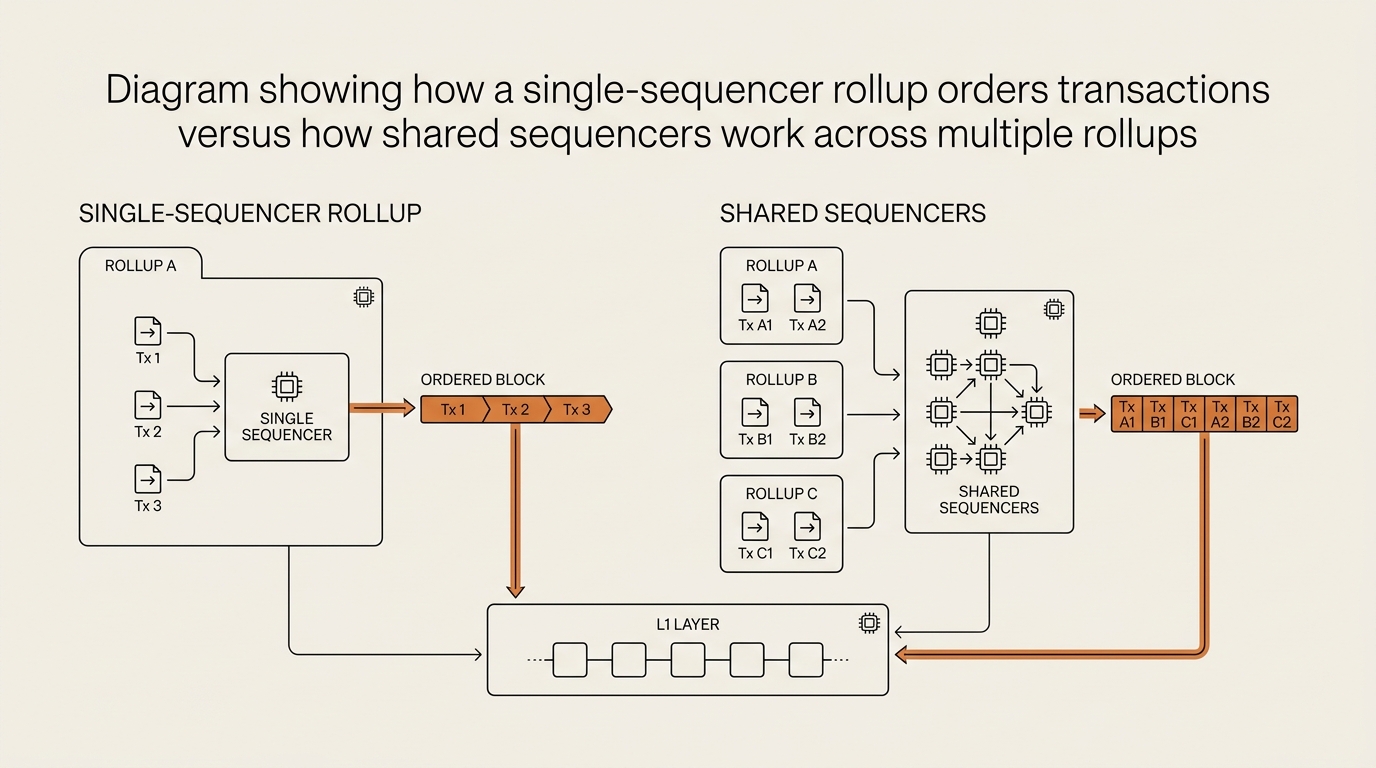
The sequencer is the component inside that rollup that receives your transactions and decides their order. It takes the raw stream of “Alice swaps, Bob deposits, Carol bridges,” puts them in a line, and produces the blocks. On almost every major rollup today — Arbitrum, Optimism, Base — that sequencer is a single server run by the team behind the chain.
That was my first surprise. The part I’d dismissed as plumbing is the part with the most power. Whoever orders transactions can, in principle, delay yours, front-run it, or (in the worst case) halt the chain. When you read “Arbitrum’s sequencer went down,” that outage was the sequencer. One machine, one operator, one point of failure.
So the sequencer isn’t background pipework. It’s the traffic controller. Hold that image.
What “shared” changes
Here’s the leap. If every rollup runs its own private sequencer, you get a fragmented map: dozens of separate traffic controllers, each blind to the others, each a single point of failure.
Shared sequencing flips that. Instead of each rollup ordering its own transactions in isolation, multiple rollups plug into one ordering layer. That network receives transactions destined for Rollup A, Rollup B, and Rollup C, orders them together, and hands each rollup back its slice.
The plain-language version I use: a shared sequencer is a shared traffic controller for many toll roads. Each toll road (each rollup) still collects its own fees and runs its own lanes. But one controller now sequences the cars entering all of them, and can coordinate cars that need to cross between roads.
Here’s the featured definition I wish a glossary had given me up front:
A shared sequencer is a network that orders transactions for multiple rollups at once instead of each rollup running its own sequencer. Because it sees several chains’ transactions together, it can order them jointly — enabling coordinated actions across rollups that isolated sequencers can’t offer, such as bundling two dependent transactions on two different chains.
That last clause — coordinated actions across rollups — is the promised payoff. It has a name I badly misunderstood, so let’s take it slowly.
Atomic composability, minus the magic
I read “atomic composability” and pictured chains that just talk. Rollup A and Rollup B become one happy interoperable blob. Wrong, and dangerously so.
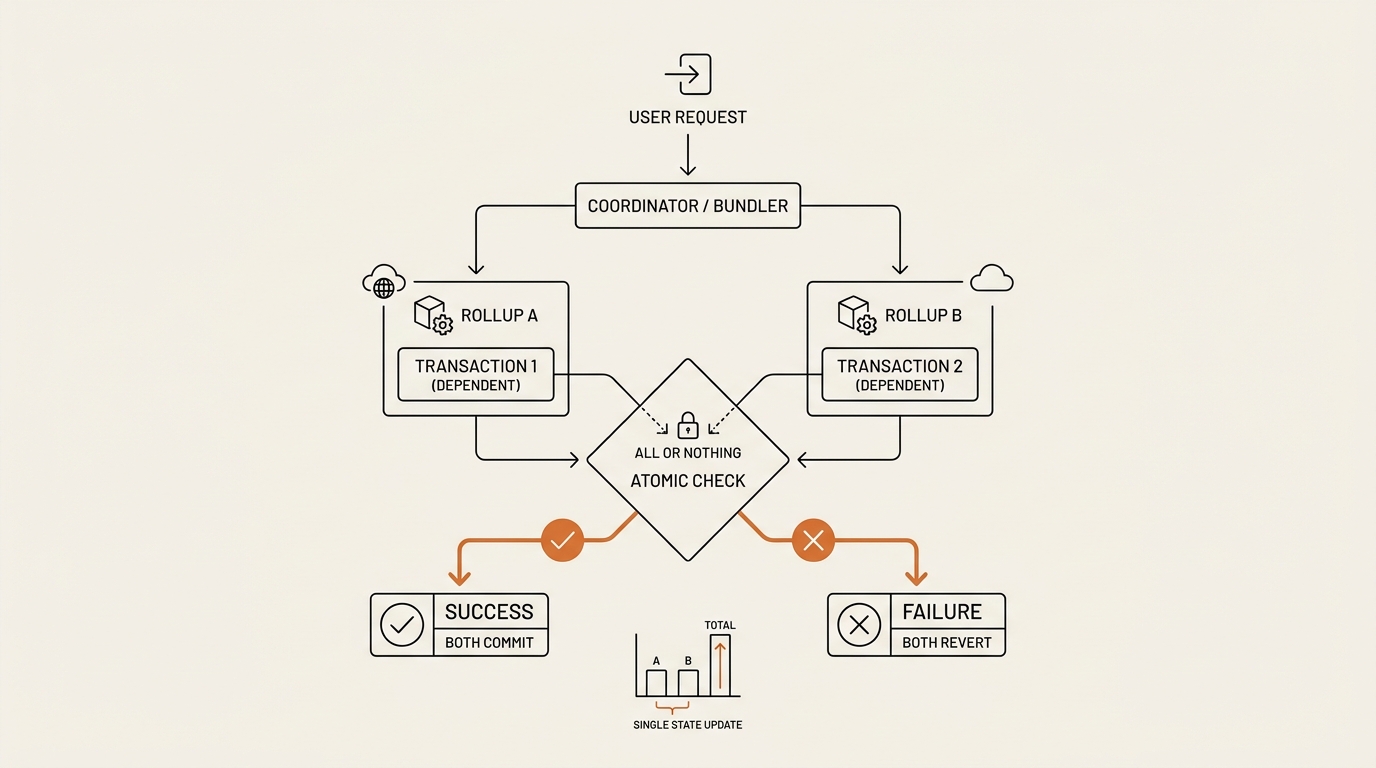
Atomic composability is narrower and more conditional. “Atomic” means all-or-nothing: a bundle of transactions either all succeed or all fail, with no half-executed middle state. When the shared layer orders transactions for two rollups together, it can guarantee that a transaction on Rollup A lands only if a paired transaction on Rollup B also lands.
Why does that matter to someone who just uses a couple of L2s? Think of a swap that sources liquidity from two different rollups, or a move where you borrow on one chain and immediately repay on another. Today those cross-chain steps are risky — one leg can land while the other fails, and you’re stranded mid-move. Atomic bundling closes that gap. Espresso Systems, one of the teams building this, lays out the mechanism in their shared sequencing writeup.
But notice the fine print I glossed over. The network only orders. It does not execute. Each rollup still runs its own execution and keeps its own state. Ordering and execution stay separate. So “the chains talk” is wrong — the chains still don’t know each other. A shared referee just guarantees the order they act in. That distinction saved me from over-trusting the whole idea.
The mistake at the center of everything: “shared” is not “decentralized”
This is the misconception that most vendor explainers lean on, and the one I want you to leave with.
I assumed “shared” obviously meant “more decentralized.” More chains cooperating, power spread out, single points of failure gone. It sounded right. It was the reason I got interested in the first place.
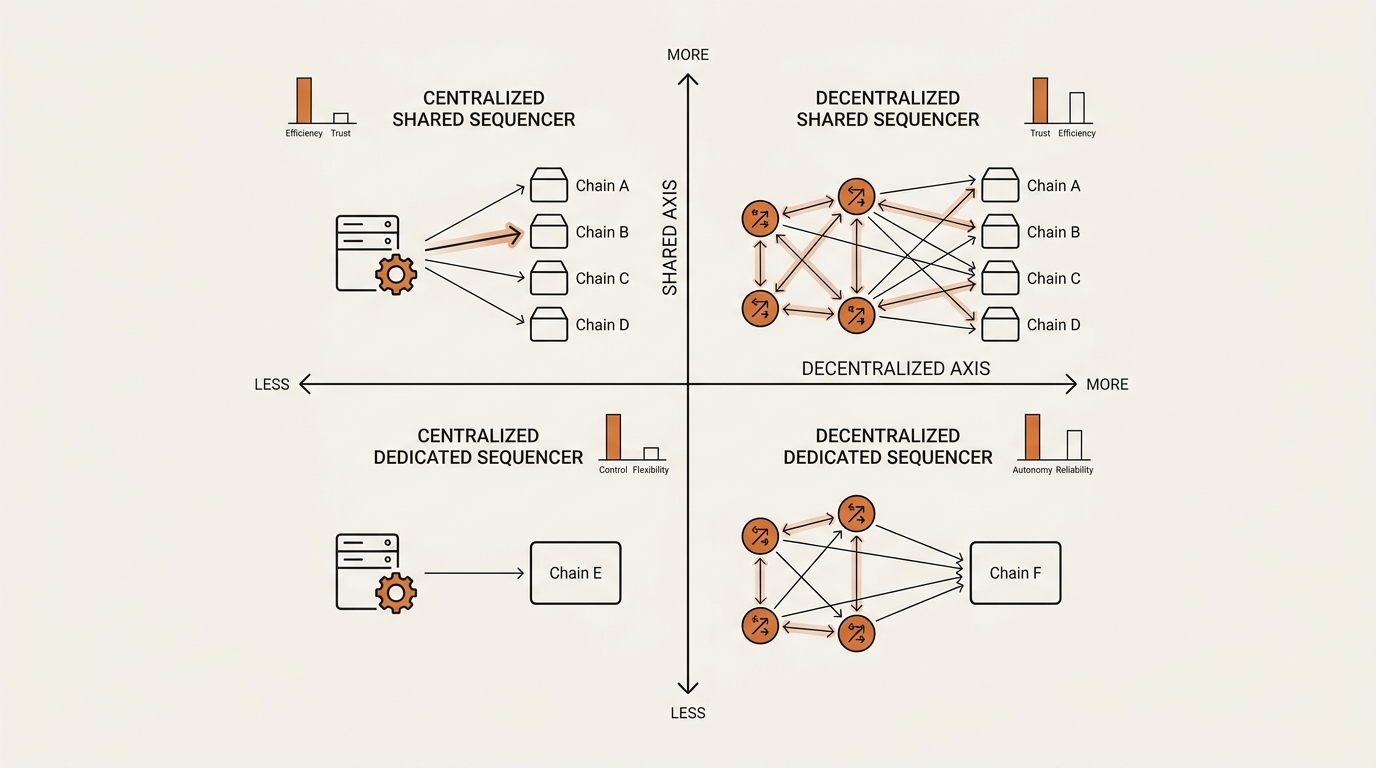
Then I hit the counterargument, and it broke the assumption cleanly. “Shared” and “decentralized” are two different axes. They can move independently.
- Shared answers: how many rollups use this ordering layer? One, or many?
- Decentralized answers: how many independent operators run that ordering layer, and can any single one censor or halt it?
You can have a shared network that is still centralized — one company runs it, and now it orders transactions for ten rollups instead of one. That’s more concentration, not less. You can also have a single rollup’s sequencer that’s been decentralized across a validator set. Sharing doesn’t create decentralization. Decentralization is a separate engineering job — a validator set, consensus, slashing, censorship resistance — that a shared network may or may not have done.
Here’s the table I drew for myself to stop conflating them:
| One operator (centralized) | Many operators (decentralized) | |
|---|---|---|
| One rollup uses it | Today’s default: Arbitrum, Optimism, Base — one team’s server orders one chain | A single rollup that decentralized its own sequencer set |
| Many rollups use it (shared) | A shared network run by one company — one chokepoint now orders many chains | The actual goal: a permissionless operator set ordering many rollups together |
The bottom-right cell is the dream. The bottom-left cell is the trap. And a lot of writing about this design quietly points at the bottom-left while describing the bottom-right.
Where I was wrong: the decentralization mirage
So here’s my honest correction, the spine of this whole post.
I’d been treating “shared sequencer” as a synonym for “decentralized L2.” When I finally read the skeptical research — the kind buried in academic papers, not vendor blogs — the mirage dissolved. The SoK paper on decentralized sequencers for rollups lays out the tradeoffs plainly, and one of them stopped me cold.
If you take N rollups that each had their own single point of failure, and you route them all through one shared layer, you haven’t removed N single points of failure. You’ve potentially merged them into one bigger, cross-chain chokepoint. If that shared layer is run by a small operator set — or worse, one company in a pre-decentralization phase — an outage or a censoring actor no longer takes down one rollup. It takes down all of them at once. The blast radius grew.
That reframed everything. Sharing an ordering layer is a coordination win and a systemic risk question at the same time. Whether it’s a net gain depends entirely on whether the shared layer itself got decentralized — the second axis, the one the marketing skips.
The second thing I got wrong sits right next to it: I assumed this setup removes MEV. MEV is the value someone can extract by reordering or inserting transactions — the front-running, the sandwich. I figured a neutral shared referee would erase it.
It doesn’t. It relocates it. When one sequencer can see and order transactions across many rollups at once, it gains a new, juicier vantage point: cross-domain MEV, the value extractable by coordinating reorderings across chains rather than within one. A shared layer can be designed to fair-order and reduce some of this, but “removes MEV” is the wrong mental model. It moves the extraction point. I first met this idea in the same DeFi-ordering rabbit hole I fell into writing about how intent-based DEXs shift trust to solvers — same lesson, different layer: trust doesn’t vanish, it moves.
The 2026 reality check no glossary carries
Here’s the mistake that embarrasses me most, because it was pure laziness. I read a 2023 pitch and assumed it had shipped.
It mostly hasn’t. This is the single fact that separates an honest read of shared sequencing from every glossary page, so I’ll state it plainly and neutrally:
- Astria, one of the two names everyone cited for shared sequencing, shut down in December 2025. The team wound the project down. If you read a 2024 explainer listing Astria as a live shared sequencer, that snapshot has expired.
- Espresso Systems shipped an early mainnet, but its fully permissionless mainnet is targeted for late 2026 — not done, targeted. The permissionless part, where anyone can run a sequencer node, is the part that would actually address the decentralization axis. It’s ahead of us, not behind us.
I’m describing architecture and status, not making a call on any project or token. The point isn’t “this failed” or “this will win.” The point is timing. The idea of shared sequencing is genuinely promising and still mostly a work in progress. Treating a 2023 whitepaper as today’s deployed reality is how I ended up over-trusting the whole category.
If you take one operational habit from this post: when you read about how this network works, check the date and check the status word. “Launched” and “targeted” and “wound down” are very different tenses, and glossary pages love to write them all in the present.
Where this mental model falls short
I don’t want to swing from over-trust to over-skepticism, so here’s the honest limitation.
The decentralization-mirage critique can itself be overstated. A shared network run by a small, staked, slashable operator set — even before full permissionlessness — can be more robust than a single company’s private server. “Merged chokepoint” is the worst case, not the default case. The design details decide it.
And the coordination benefit is real. Atomic cross-rollup bundles genuinely solve a problem that fragmentation created. If the L2 world keeps splintering into dozens of rollups, some shared ordering layer becomes almost necessary just to make them usable together. My framework tells you what to check, not whether to be against it. Frameworks, not forecasts — I’m giving you the axis to measure, not a verdict.
The framework also can’t tell you which specific network will get the decentralization job done. That’s an engineering and adoption question that plays out over years. What it can do is stop you from clapping for “shared” when you meant to ask about “decentralized.”
The one question I now ask
When someone tells me a shared sequencer “decentralizes” an L2, I stopped nodding. I ask one thing: which axis do you mean?
Do you mean many rollups now use one ordering layer? That’s the shared axis. It buys coordination and atomic composability, and it raises a systemic-risk question.
Or do you mean many independent operators now run that layer, so no single party can censor or halt it? That’s the decentralized axis. That’s the one that actually reduces single points of failure — and it’s the one that, in mid-2026, is still largely a target rather than a shipped fact.
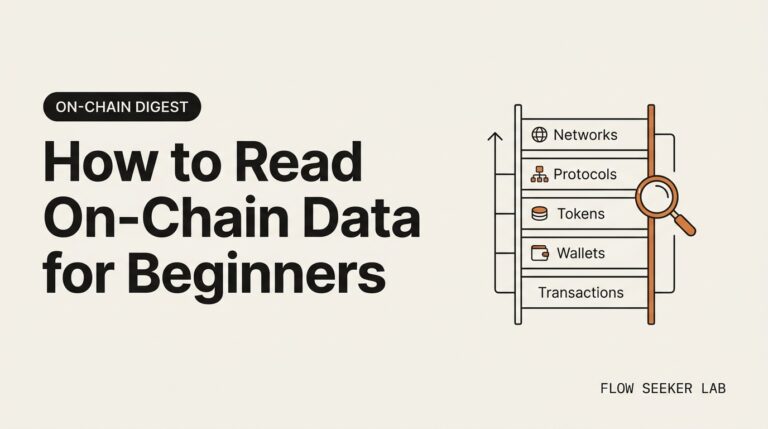
Two axes. Ask which one. That’s the whole framework, and it’s the thing every glossary page I read left out. If you want to see transaction ordering and settlement with your own eyes instead of taking anyone’s word for it, the next step is learning how to read on-chain data as a beginner on a block explorer. It’s the same “un-hide the trust stack” habit I use for how DeFi vaults work.
FAQ
What is a sequencer in a rollup? A sequencer is the component in a rollup that receives your transactions and decides their order before the results settle back to Ethereum. On most major L2s today it’s a single server run by the chain’s team, which makes it both the most powerful and least decentralized part of the system.
What is the difference between a shared sequencer and a centralized sequencer? They answer different questions. “Centralized versus decentralized” is about how many operators run the sequencer. “Shared versus dedicated” is about how many rollups use it. The design can still be centralized if one company runs the shared network — sharing and decentralizing are separate axes.
Do shared sequencers actually decentralize L2s? Not automatically. Sharing an ordering layer across many rollups is a coordination change, not a decentralization change. Decentralization requires a permissionless operator set, consensus, and slashing — a separate job. A shared network run by one company is more concentration, not less.
What is atomic composability? Atomic composability means a bundle of transactions across multiple rollups either all succeed or all fail together, with no half-executed state. The shared layer enables it by ordering the dependent transactions jointly, so a transaction on one rollup lands only if its paired transaction on another rollup also lands.
Do shared sequencers remove MEV? No. They relocate it. A sequencer that orders transactions across many rollups at once gains a new vantage point for cross-domain MEV — value extracted by coordinating reorderings across chains. A shared layer can be designed to fair-order and reduce some extraction, but “removes MEV” is the wrong model.
Are shared sequencers live yet? Partly, and it’s early. Astria, a prominent shared-sequencing project, shut down in December 2025. Espresso Systems shipped an early mainnet, but its fully permissionless mainnet is targeted for late 2026. Treat 2023-era pitches as promises, not deployed reality, and always check the status word.
Written by seonjae — Korean office worker documenting his transition into AI systems, agents, and vibe coding — without a CS background. Shipping in public.
This is part of the Crypto Mental Models series. Next up: I take this same “un-hide the trust stack” habit onto a block explorer and trace where a rollup’s transactions actually settle on Ethereum — sequencing, but with a live example you can follow click by click.
2 Comments