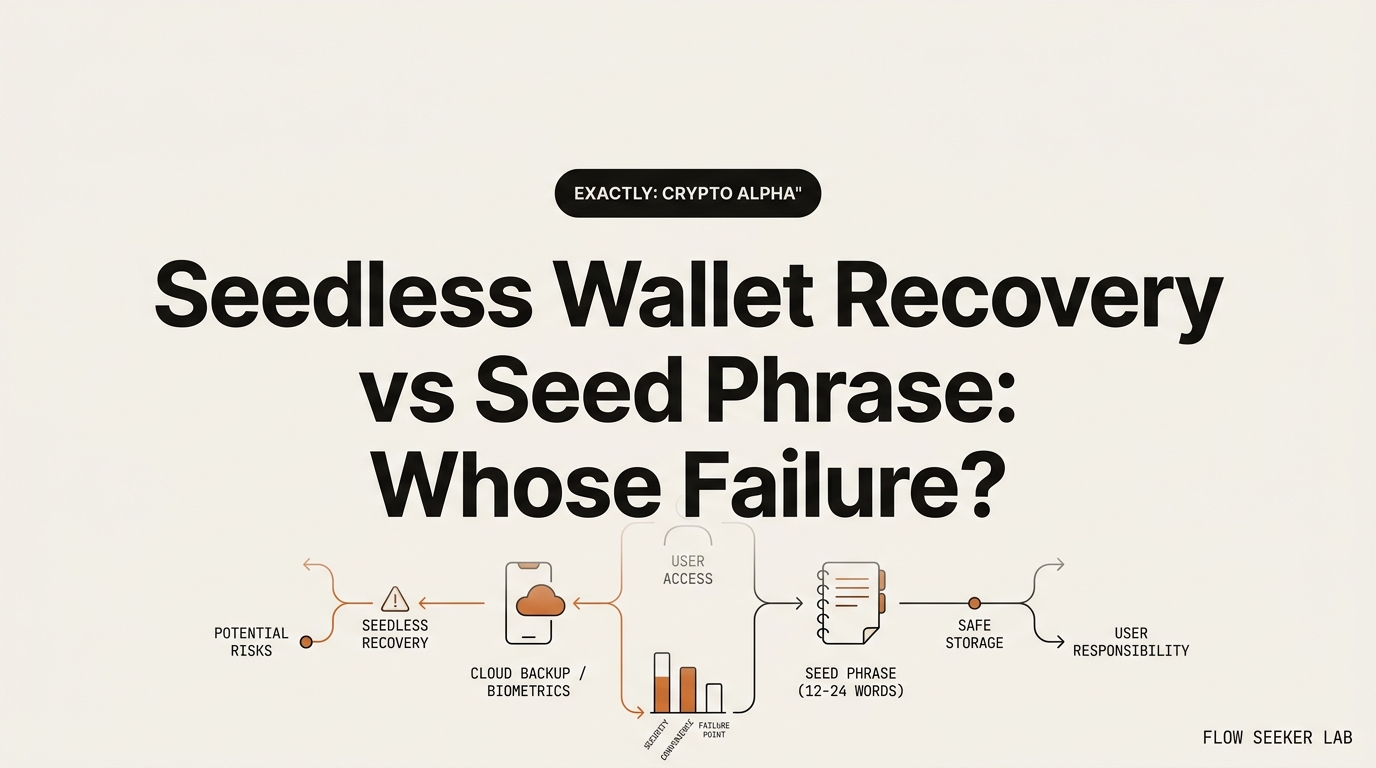
Seedless Wallet Recovery vs Seed Phrase: Whose Failure?
Seedless Wallet Recovery vs Seed Phrase: Whose Failure Can You Survive?
I lost sleep over a drawer once. Not money — a drawer with 24 words on paper.
If you have ever stared at a metal plate wondering whether a house fire would erase your savings, the seedless wallet recovery vs seed phrase question is really one question: whose failure can I survive? This is not a “which is safer” post. It is the internal memo I wrote before deciding, split by how much money sits in each wallet.
Here is my honest through-line first. Seedless wallet recovery does not delete your private key. It relocates who holds the pieces. A seed phrase puts 100% of that risk on you. So the decision is not good versus bad. It is which failure mode you can live through.
The one fact both marketing sides bury
Every wallet vendor sells you a story. Seed-phrase people say “true ownership.” Seedless people say “no more scary words.” Both skip the same fact.
The key never disappears. A crypto wallet is math wrapped around a secret number. To move funds, something must reproduce a valid signature from that secret. There is no version where the secret stops existing.
So when a wallet says “no seed phrase,” read it as “the secret got split and handed to someone else to hold.” That is the whole game. Seedless wallet recovery is not key deletion. It is key relocation.
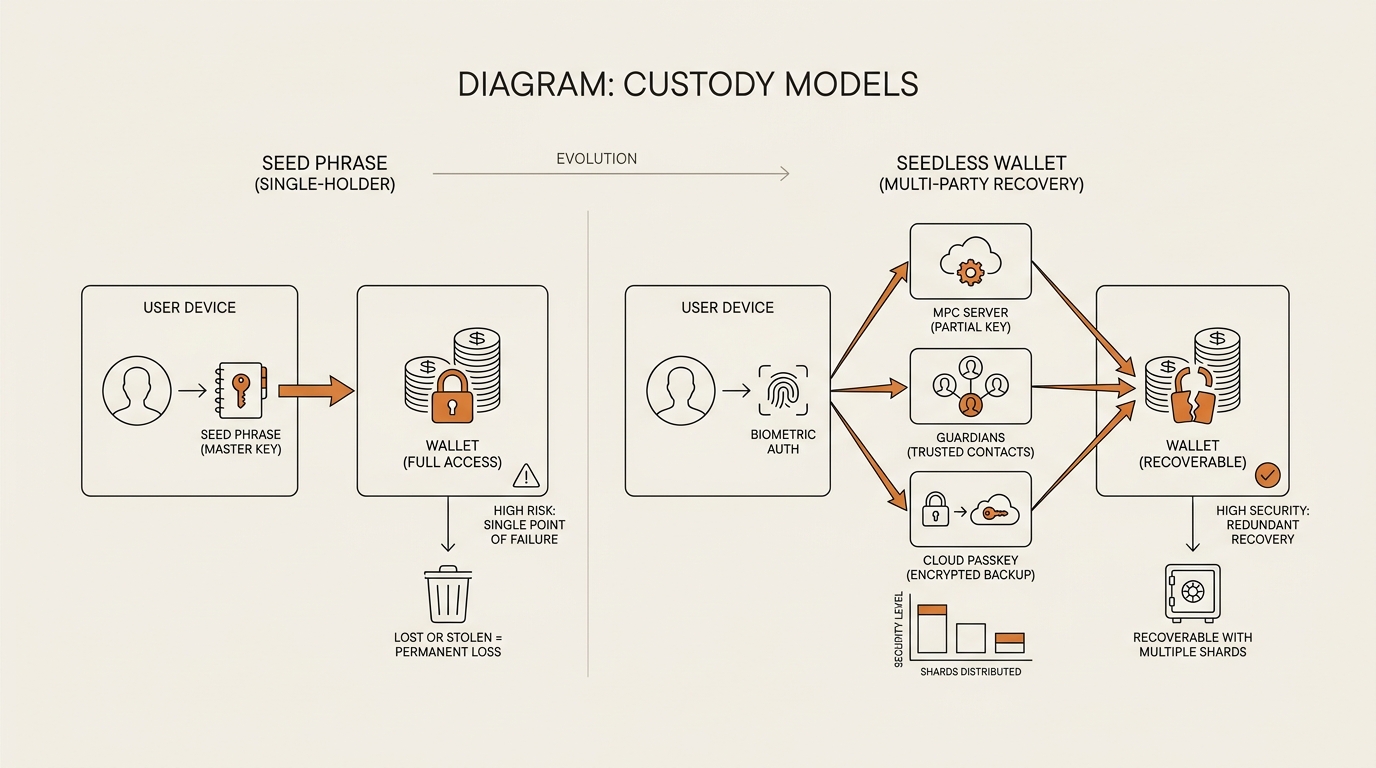
A seed phrase concentrates the secret in one place: your memory, your paper, your metal plate. One backup, one owner, one point of failure — you. Seedless recovery spreads shards of that secret across parties: an MPC server, guardian friends, a cloud keychain, a startup’s infrastructure. You do not remove the trade-off. You choose whose drawer catches fire instead of yours.
I am a Korean office worker, not a security researcher. I do not read Solidity for fun. But I have watched enough friends lock themselves out of accounts to know the real risk is rarely a hacker. It is you, tired, three years from now, unable to find a piece of paper.
What “no seed phrase” actually means under the hood
You do not need the math. You need to know who ends up holding the pieces, because that is the party who can fail you or betray you.
There are three main flavors of seedless wallet recovery, and they each move the shards to a different owner.
MPC (multi-party computation). The secret is generated as split shares from the start — often 2-of-3 — and never assembled in one spot. This is how MPC splits your key instead of a seed phrase: one share on your phone, one on a provider’s server, maybe one in your cloud backup. To sign, the shares cooperate without ever meeting. Web3Auth, Privy, and Coinbase’s embedded flows sit in this family. The math behind splitting a secret into recoverable pieces is Shamir’s Secret Sharing and its threshold cousins — an old, neutral idea, not a startup invention.
Social recovery. The wallet is a smart contract, and a set of “guardians” — friends, other devices, an institution — can vote to reset who controls it. Lose your phone, and enough guardians approve a new signer. Vitalik Buterin laid out the case for this in his post on why we need wide adoption of social recovery wallets. Argent and Soul Wallet are examples of this approach, built on social recovery in smart contract wallets.
Passkey / cloud. A passkey (WebAuthn) becomes the signer, and recovery leans on your device biometrics plus a synced cloud keychain — Apple’s iCloud, Google’s, or the vendor’s. Coinbase Smart Wallet is passkey-native here. The key rides your platform account.
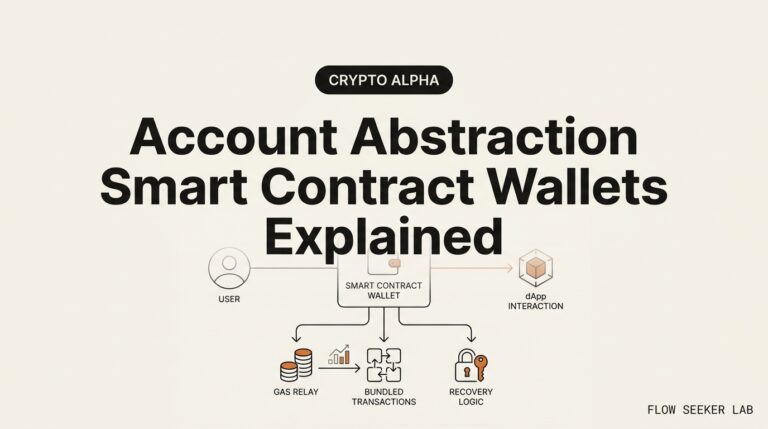
All three run on account abstraction — the shift that lets a wallet be programmable logic instead of a bare keypair. If you want the standards layer, Ethereum.org’s write-up on account abstraction is the clean primary source.
Notice what changed. In every case, seedless wallet recovery answers “how do I get back in” by adding a party who holds a shard. That party is the new question.
The recovery-model failure grid I actually use
I stopped comparing “features.” Features are marketing. I compare failure modes, because the failure is what wakes you up at 3 a.m. Here is the grid I built for myself.
| Recovery model | Who holds the shard | How it fails you | Best-fit money bucket |
|---|---|---|---|
| Seed phrase (12–24 words) | You alone — paper, metal, memory | You lose it, it burns, someone finds it, you never test the restore | Long-term cold savings you rarely touch |
| MPC (threshold shares) | You + a provider server (+ cloud) | Provider shuts down, changes terms, or its recovery flow gets phished | Spending money and active app use |
| Social recovery (guardians) | A quorum of friends/devices you chose | Guardians lose their own keys, ghost you, or collude | Medium savings you’d want help recovering |
| Passkey / cloud | Your device + a cloud platform account | Dead device with no synced backup, or platform account lockout | Small hot balances, day-to-day |
Read the grid as failure choices, not scores. The seed phrase row has the cleanest sovereignty and the harshest failure: no undo, no support line, no guardian. The seedless rows soften the failure but hand a shard to someone whose incentives are not yours.
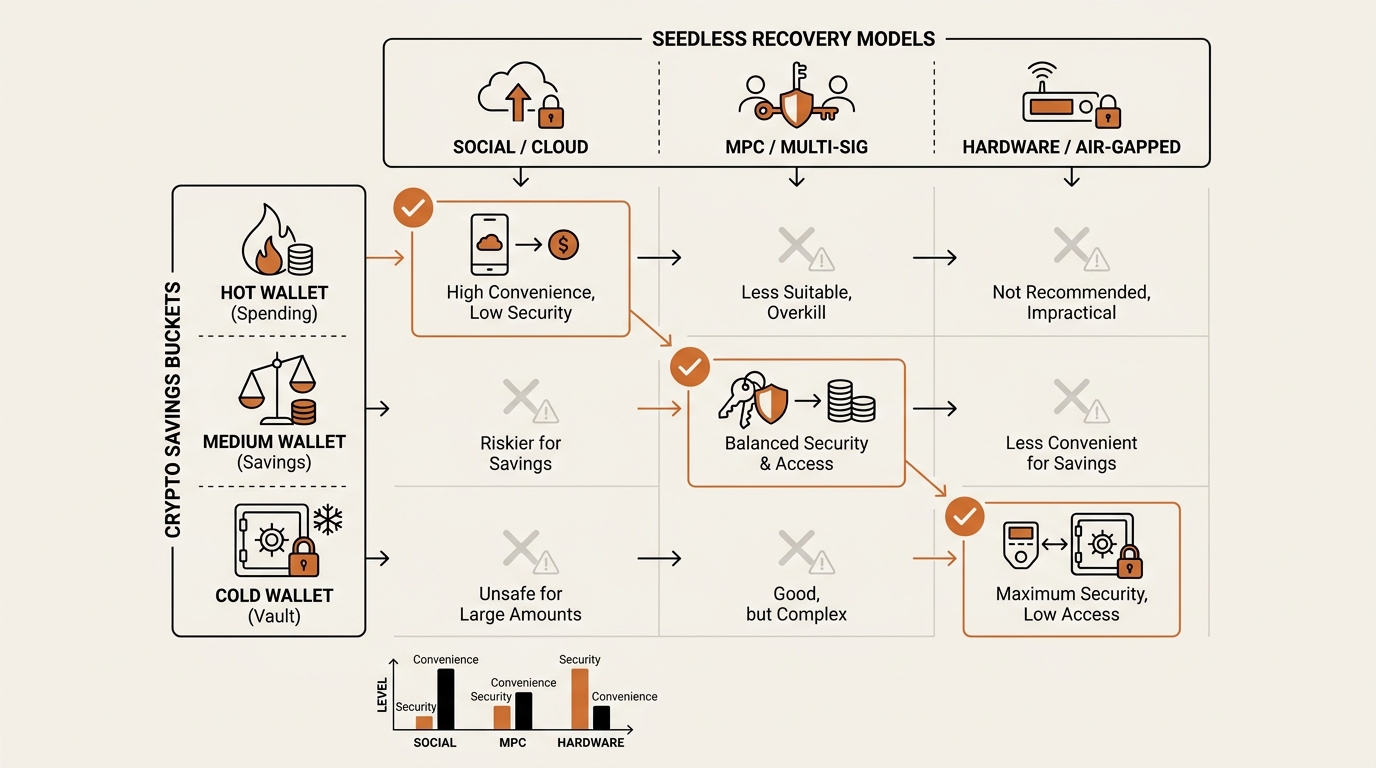
The trap in every vendor comparison is a single “safest” verdict. There is no safest model. There is only the failure you can operate through under pressure — dead phone at an airport, a friend who moved abroad, a provider that pivoted to a new product.
The decision, split by money bucket
This is the core of the memo. I do not pick one recovery model. I split my crypto into three buckets and match each to the failure I can survive for that amount. Vitalik describes running a similar split himself, and this framing is what finally made the decision calm.
Bucket 1 — hot, spending money. Small amounts I move weekly. Here I want zero friction and I accept convenience risk. A passkey or MPC wallet is fine. If the provider vanishes, I lose lunch money, not my savings. Seedless wallet recovery earns its keep here because the downside is capped and the upside is I actually use the thing.
Bucket 2 — medium savings. Money I would grieve but survive losing. This is where social recovery fits. I want a safety net if I lose a device, but I am not ready to bet the balance on remembering 24 words. Guardians give me a human undo button — as long as I pick guardians who will still hold their keys in three years. That “as long as” is doing heavy lifting, and I will come back to it.
Bucket 3 — long-term cold. The savings I touch twice a year. Here I want no company between me and my coins. A seed phrase on metal, paired with a hardware device, is the right harsh trade. I accept full responsibility because the whole point is that nobody can freeze, phish, or sunset me. Pair it with a real seed phrase backup and self-custody checklist, including the restore test most people skip.
The pattern: convenience rises as the money shrinks, sovereignty rises as the money grows. Seedless wallet recovery is not the enemy of self-custody. It is a tool you point at the buckets where the human failure mode is worse than the counterparty one.
I keep this on one sheet. If I cannot say which bucket a wallet is for, I have not made the decision yet — I have just downloaded an app.
Where I was wrong about seed phrases
For two years I treated a seed phrase as the responsible-adult answer and seedless recovery as a shortcut for people who could not be bothered. I was wrong twice.
First, I overrated my own discipline. I told myself I had a “system.” My system was a piece of paper in a drawer and a photo I swore I would delete. I never tested a restore — not once. A backup you have never restored is a rumor, not a backup. The most dangerous wallet I owned was the one I felt safest about.
Second, I underrated how quietly a seed phrase fails. There is no alert, no error, no support ticket. You just try to recover, mistype a word or find damp paper, and the money is gone. It is a single point of failure with a friendly face. I had confused “I control it” with “it is safe.”
Then I actually tried a seedless wallet recovery flow, and it broke in ways I had not imagined. So the correction was not “seedless is better.” It was “I was scoring the wrong thing — I was scoring ownership, not survivability.”
What broke: three seedless failures I watched or hit
Seedless is not a free lunch. Every model moved my problem somewhere new, and here is where each one actually cracked.
The guardian who lost his own key. I set up a social-recovery test wallet and named a friend as a guardian. Six months later he wiped his phone and never re-added the recovery app. My “2-of-3” quietly became “1-of-3.” One more dropout and my safety net would have been the thing I needed rescuing from. Guardians are only as reliable as the least organized person you trust — which, honestly, might be me.
The passkey trapped on a dead phone. I moved a small hot balance to a passkey wallet and skipped the cloud-sync step because a privacy setting looked scary. Then that phone died. The passkey lived only on the dead device. No sync, no recovery. It was recoverable in theory and gone in practice. Convenience had hidden the one backup I actually needed.
The provider I could not fully see. I used an MPC wallet from a young startup for a few weeks. It worked. But I could not answer a basic question: if this Series-A company folds, does an open, documented export exist, or do my funds ride on their servers staying up? Some providers publish a self-export path; this one buried it. I moved out. Not because it was malicious — because I could not verify the exit.
The lesson across all three: seedless recovery relocates the failure, and if you do not go find the new failure, it finds you. The safest model is the one you can operate correctly under pressure, and pressure is exactly when you have not read the docs.
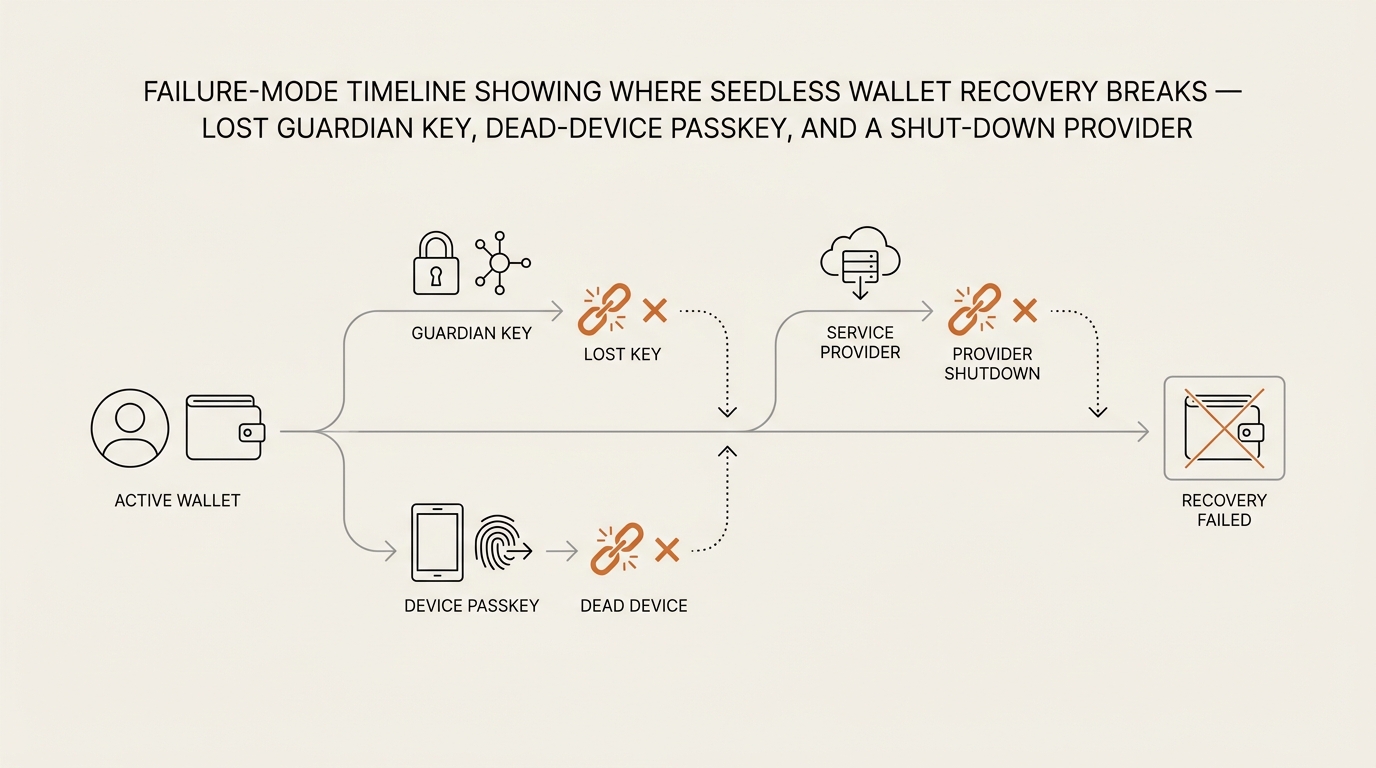
Put those three side by side and a pattern shows up. None of them was a hack. Each was an ordinary human or business event — a friend wiping a phone, a device dying, a startup pivoting. That is the quiet truth about recovery: the thing that gets you is almost never a genius attacker. It is boredom, moving house, a company running out of runway. So when I judge a model now, I am not asking whether it can be broken by a mastermind. I am asking whether it survives an average, forgetful Tuesday.
A five-minute pressure test before you trust any model
Before I move real money into any wallet — seed or seedless — I run this out loud. If I cannot answer, it does not get the money.
- Who holds the pieces of my key right now, and how many are there?
- If I lose my main device today, what are the exact steps to get back in?
- What happens to my funds if the company behind this disappears next year?
- Have I actually tested the recovery — restored on a spare device — not just imagined it?
- Which money bucket is this wallet for, and can I survive its worst failure for that amount?
Question four is the one everyone fails, me included. The others are research. That one is a rehearsal, and recovery is a fire drill you only get to run before the fire.
FAQ
Is a seedless wallet safer than a seed phrase? Not universally. Seedless wallet recovery removes the “I lost the paper” failure but adds a “the party holding my shard fails or gets phished” failure. Safer depends on which mistake you are likelier to make — losing a backup, or trusting a provider you cannot fully verify.
What happens to my crypto if the seedless wallet company shuts down? It depends entirely on whether the provider gives you an export path. Good ones publish a way to reconstruct or export your key without them. Before trusting one, confirm that exit exists. If your funds only move while their servers run, that is the failure to plan for.
Can you recover a crypto wallet without a seed phrase? Yes — that is the whole point of seedless designs. Recovery runs through the parties holding your shards: an MPC provider, guardian approvals in a smart contract wallet, or a passkey synced to your cloud. There is still a secret; you just recover it through others instead of typing words.
What is MPC (multi-party computation) in a crypto wallet? MPC splits your key into shares held by different parties, and they cooperate to sign without the full key ever assembling in one place. It is one way to get seedless wallet recovery. The failure mode moves from “lost paper” to “a share-holder disappears or is compromised.”
What is social recovery and who are the guardians? Social recovery lets a chosen quorum — friends, extra devices, or an institution — approve resetting control of your wallet if you lose access. Guardians are the people or devices in that quorum. The risk is guardians losing their own keys, ghosting you, or, in rare cases, colluding.
Do seedless wallets still have a private key? Yes. The key is never truly removed — it is split, relocated, or wrapped in a smart contract. “Seedless” describes how you back it up and recover it, not the disappearance of the secret. Anyone claiming the key is gone is describing marketing, not cryptography.
The reframe
Stop asking which model is safest. That question has no answer because both keep the same secret alive; they only move who guards the pieces.
Ask instead: for this pile of money, whose failure can I live through — mine, a friend’s, or a company’s? Seedless wallet recovery vs seed phrase was never a contest between safe and reckless. It is a sorting job, one bucket at a time, and the single wrong move is refusing to sort.
Next in this Crypto Safety series, I want to trace a real seedless recovery on a block explorer — watch, step by step, how a smart contract wallet actually swaps in a new signer when guardians approve. Seeing the mechanism beats trusting the pitch.
seonjae — Korean office worker documenting his transition into AI systems, agents, and vibe coding — without a CS background. Shipping in public.