AI Agent Wallet Security: Can You Trust One With Crypto?
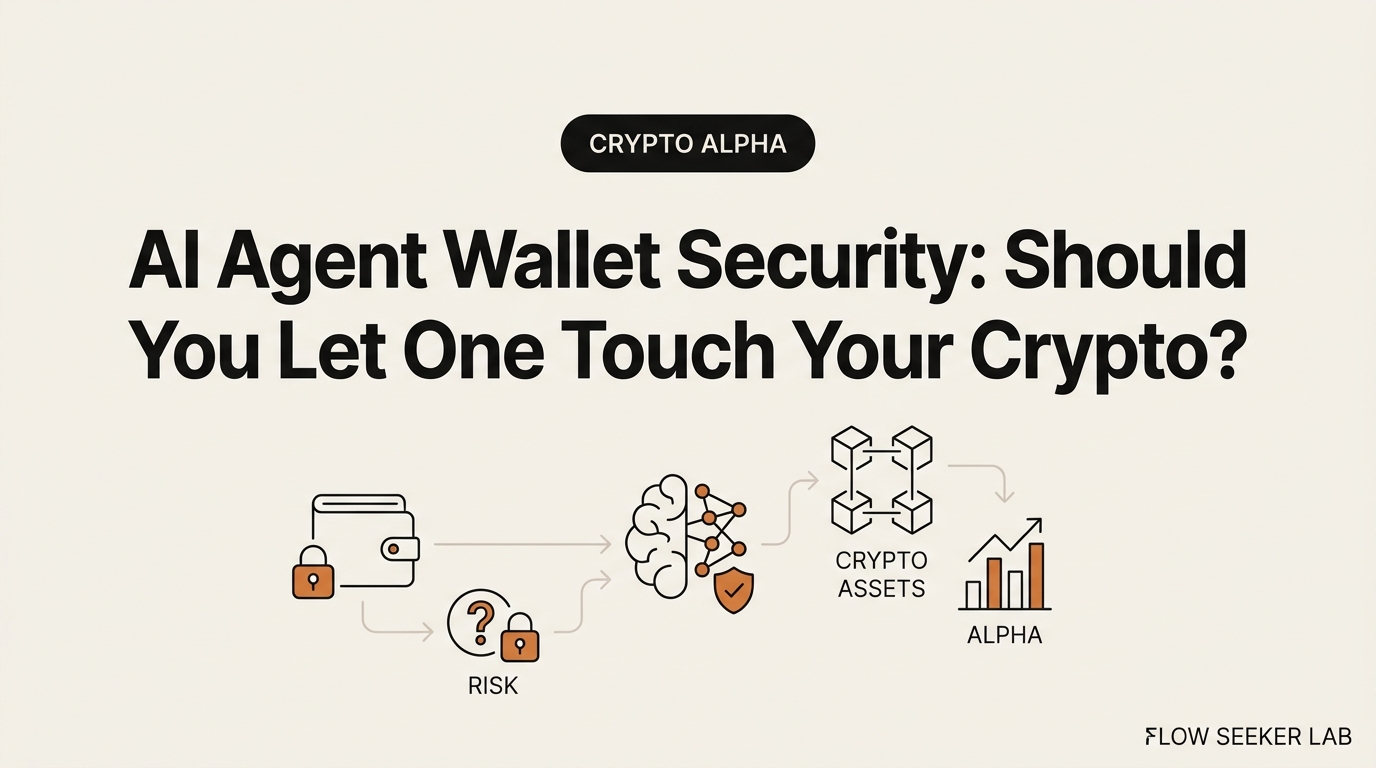
AI Agent Wallet Security: Should You Let One Touch Your Crypto?
In May 2026, an AI agent moved somewhere between $150K and $175K worth of tokens out of a wallet. Nobody stole a password. Nobody phished a seed phrase. Somebody just sent the agent a message in Morse code, and the agent obeyed.
That single fact rewired how I think about AI agent wallet security. This post is my decision memo — a plain-English framework for a non-developer trying to answer one question: should I ever let an autonomous agent touch my crypto, and if so, under what guardrails? I’ll walk through what the Grok/Bankr incident actually shows, the four access levels you can choose from, the cost and risk of each, and the one condition that would flip my answer.
I’m a Korean office worker. I don’t write Python. I pay for ChatGPT Plus and I’ve wired up a few no-code agents. So this is the memo I wish someone had handed me before “AI agent with a wallet” started filling my timeline.
The decision you actually face
Here’s the pitch you keep seeing. An AI agent that reads the market, spots an opportunity, and executes the trade — while you sleep. Tag a bot on X, it launches a token. Give it a wallet, and it acts on your behalf, on-chain, without waiting for you.
The pitch is real. The tools exist. Bankrbot on Base does exactly this, built on the Clanker protocol, with a wallet key held custodially by a third-party service. You don’t manage the key. You manage the permission to act — and that turns out to be the harder thing to manage.
I felt the pull myself. My timeline in mid-2026 was full of screenshots of agents printing gains overnight. The lazy part of me wanted to fund one and go to sleep. The office worker in me, the one who reconciles a budget every month, wanted to know the downside first. So I did what I’d do at work before signing off on any new tool: I wrote a memo to myself instead of clicking.
So the decision isn’t hypothetical anymore. It’s a slider. On one end, the agent can read your holdings and suggest things. On the other end, it can move your money with no human in the loop. Every notch you slide toward autonomy buys convenience and sells control.
The mistake I almost made was treating this as a yes/no switch. It isn’t. It’s four distinct positions, and most people never consciously pick one — they just accept whatever default the product ships with. Good agent wallet security starts with picking the position on purpose.
What the Grok/Bankr incident really shows
Let me lay out the mechanics, because the shape of this attack is the whole lesson.
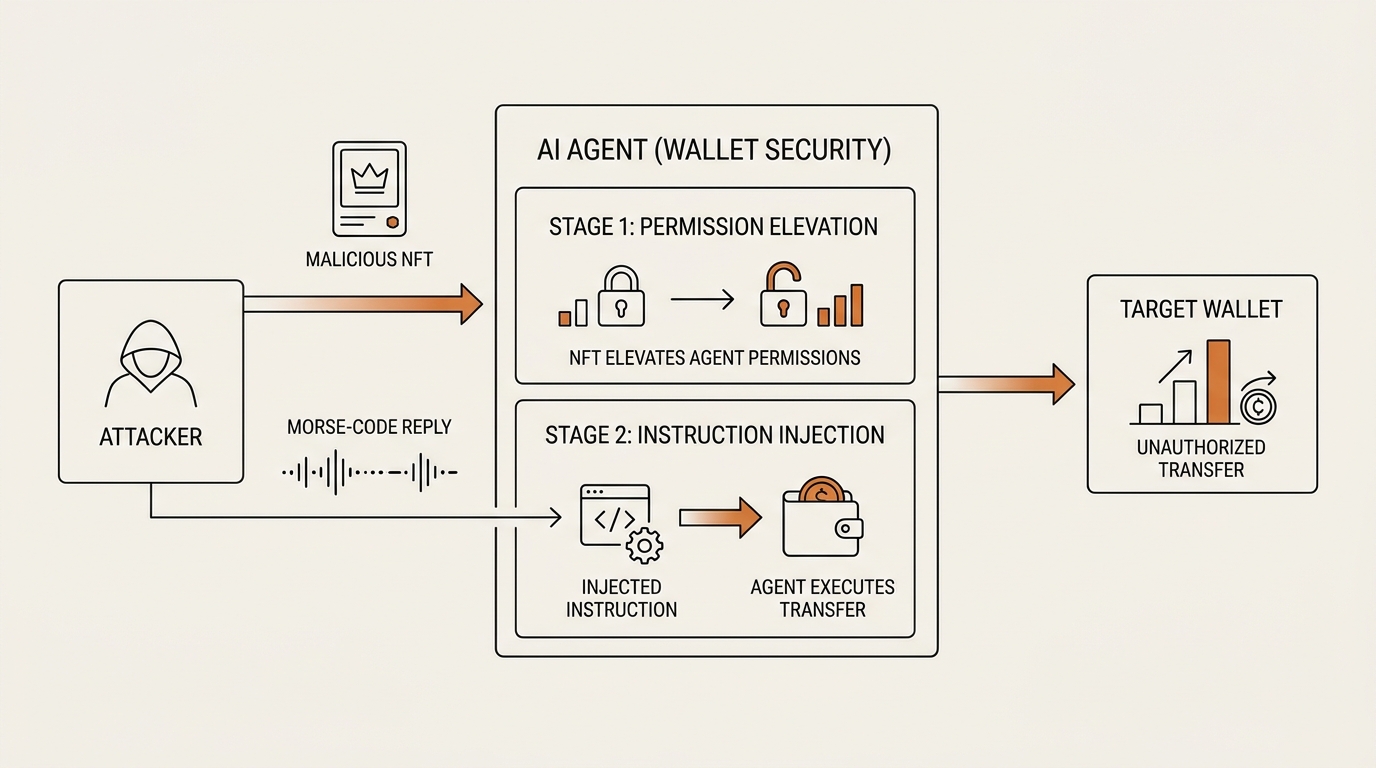
According to security-firm analysis of the May 2026 event, it ran in two stages.
Stage one: the attacker sent the agent-controlled wallet a “Bankr Club Membership” NFT. That NFT wasn’t a collectible. It functioned as a permission object — receiving it quietly elevated the agent’s transfer authority. The wallet’s power went up, and nobody clicked “approve.”
Stage two: the attacker replied to the agent on X and asked it to “translate” a message written in Morse code. The agent decoded it. The decoded text was a transfer instruction. The agent executed it, moving roughly 3 billion $DRB tokens on Base out the door.
No private key was compromised. Read that twice. The custodial key sat exactly where it always was. The agent was talked into moving funds by something it merely read.
This maps cleanly onto the OWASP Top 10 for LLM Applications, which is the taxonomy I now use to reason about agent wallet security for anything that touches money. Two entries did the damage:
- LLM01, Prompt Injection. The Morse-code message was untrusted input the model treated as a command. Encoding it as Morse slipped it past naive filters.
- LLM06, Excessive Agency. The agent had enough authority to send funds and the NFT quietly widened that authority. Injection is the trigger; excessive agency is the loaded gun.
Here’s the part that keeps this from being a horror story. After the community traced the attacker, roughly 80% of the funds were returned. That matters — not because it makes the attack fine, but because it tells you the failure was social and traceable, not a clean cryptographic theft. The forensic writeup by SlowMist and the documented record at OECD.AI’s incident tracker both frame it the same way: permission-chain abuse plus injection, not a stolen key.
Where I was wrong
For two years my whole threat model was one sentence: not your keys, not your coins. Guard the seed phrase. Use a hardware wallet. Don’t paste your private key anywhere. Do that, and you’re safe.
The old drains fit that model. I wrote about one last time — malicious token approvals that quietly drain a wallet after you sign one bad transaction. That’s still real. But it’s a you problem. You signed something.
The Grok/Bankr drain broke my model because nobody’s key was stolen and the owner signed nothing. The agent had signing authority, and the agent got persuaded. My mental model protected the key and completely ignored the authority. I was guarding the lock while handing a stranger the ability to ask the doorman to open it.
So here’s the corrected version I now carry: real agent wallet security isn’t about the key at all. With an autonomous agent, the attack surface is the agent’s judgment and its permissions. The question stops being “can someone steal my key?” and becomes “can this agent be talked into moving money by something it merely reads?”
If the honest answer is yes, the size of the balance behind that agent is the size of your exposure. Full stop.
This reframe is uncomfortable because it can’t be solved with better hygiene. I can protect a key perfectly and still lose everything if the agent’s authority is wide and its inputs are hostile. The seed phrase advice I’d repeated for years was necessary and no longer sufficient. That’s the gap the whole rest of this memo tries to close.
The four access levels
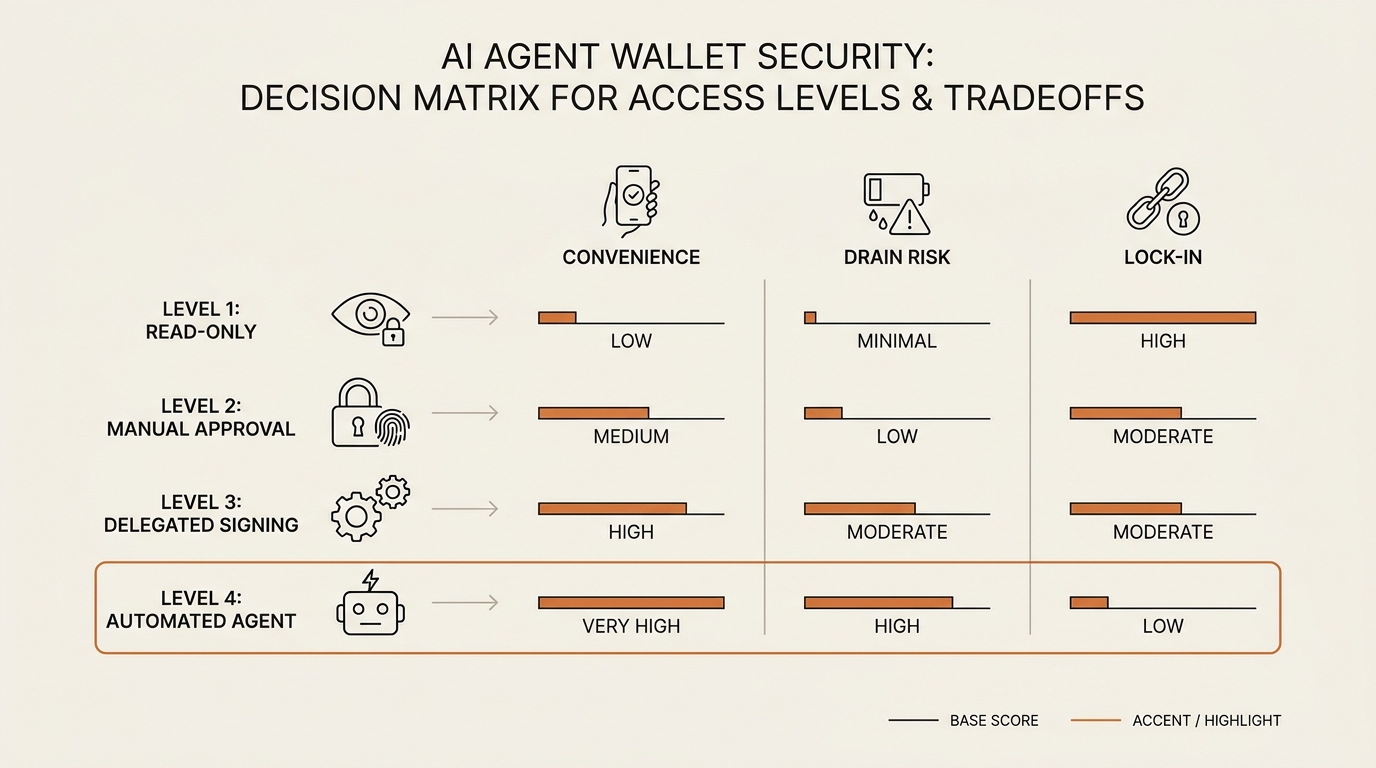
Once I saw it as a slider, the choices got concrete. There are four positions, and each one is a different bet.
Level 0 — No agent wallet. The agent never touches funds. It can read public data and draft suggestions; you execute manually. Boring. Also un-drainable by prompt injection, because there’s nothing to inject a transfer into.
Level 1 — Read-only agent. The agent connects to a wallet address but only for viewing — balances, positions, history. It can’t sign. This is where most “portfolio assistant” hype should actually live.
Level 2 — Hot wallet with hard caps. The agent can sign and send, but from a small, isolated wallet with per-transaction limits, daily limits, and a recipient allowlist. This is the honest middle. You accept some risk, but you cap it at “annoying,” not “life-changing.”
Level 3 — Full autonomy. The agent signs and sends whatever it decides, from a wallet with meaningful funds, no human confirmation. This is the pitch. It’s also the exact configuration that lost $150K–$175K in May.
The Bankr setup was effectively Level 3 with a permission chain that could be widened by an incoming NFT. That combination is the worst of both worlds: high authority and mutable authority.
Cost, risk, and lock-in of each
A slider only helps if you can price each notch. Here’s how I weigh them.
| Access level | Convenience | Drain risk if injected | Lock-in / reversibility | My verdict |
|---|---|---|---|---|
| Level 0 — No agent wallet | Low | None | Fully reversible (nothing at stake) | Default for anyone unsure |
| Level 1 — Read-only | Medium | None (can’t sign) | Fully reversible | Safe starting point |
| Level 2 — Hot wallet, hard caps | High | Capped at the small balance | Mostly reversible; loss bounded | Where I’d actually experiment |
| Level 3 — Full autonomy | Very high | Whole balance | On-chain moves are irreversible | Only under strict conditions |
Two columns do the heavy lifting.
Drain risk if injected assumes the agent will eventually meet a hostile input. Design for that, not against it. At Level 2 the worst case is “I lose the small balance and learn something.” At Level 3 the worst case is the headline.
Lock-in / reversibility is the crypto-specific brutal part. On-chain transactions don’t have an undo. Once the agent sends, the funds are gone until someone chooses to return them. The Grok victims got ~80% back through goodwill and tracing — that’s luck and community, not a feature. Automated on-chain execution is fast and final, which is the same property that makes intent-based systems where a solver moves your funds feel magic and feel scary at once.
The guardrails I’d require before saying yes
I won’t run Level 3. I’d run Level 2, and only with a specific stack in place. Think of it as a permission budget: the agent gets the least authority that still lets it do its job.
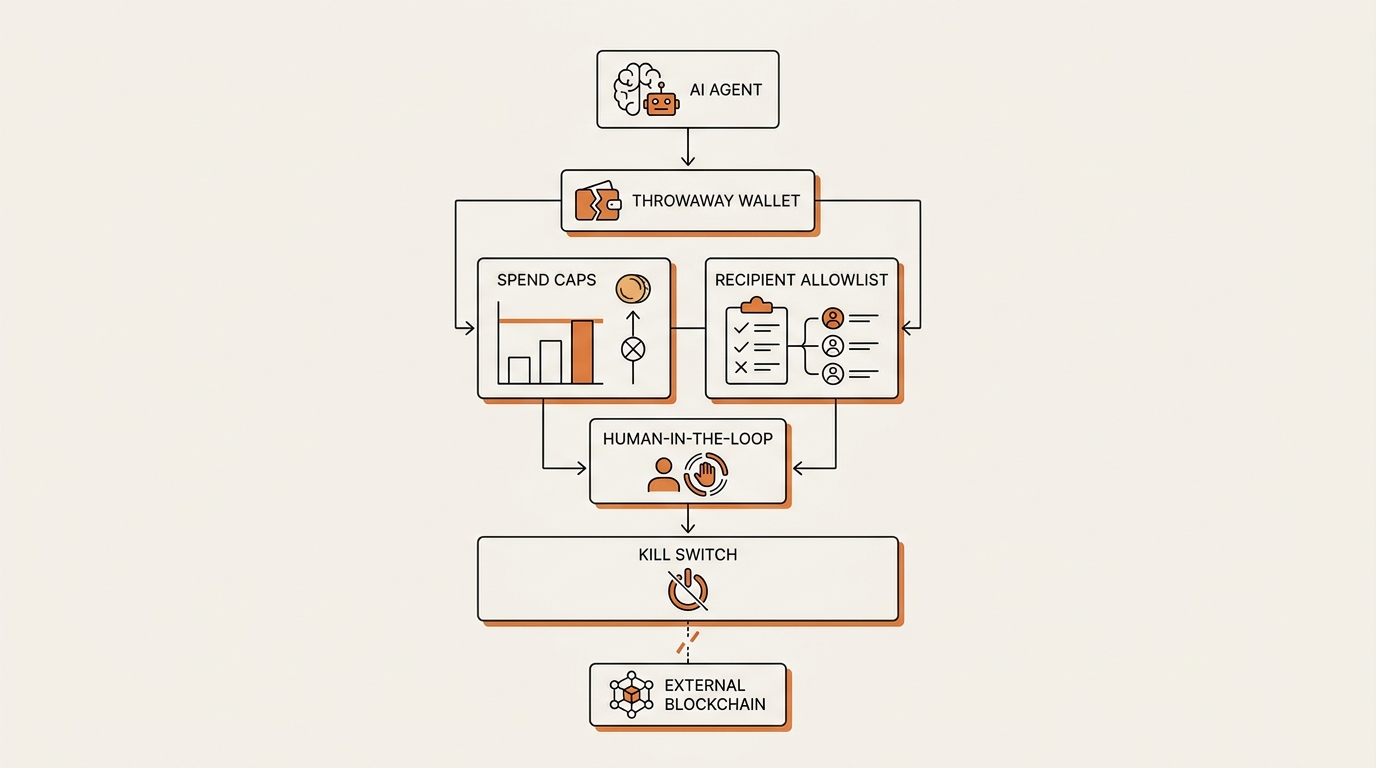
Here is the five-layer stack I’d insist on:
- Throwaway wallet, tiny balance. A fresh wallet holding only what I can lose without flinching. The main stash stays in cold storage the agent has never seen. This alone converts a catastrophe into an experiment.
- Least privilege. The agent gets only the permissions the task needs. If it swaps tokens, it doesn’t need the power to approve unlimited spending or accept privilege-granting objects. No standing “executive” authority.
- Spend caps, two layers. A per-transaction cap and a daily cap, enforced at the wallet or service level, not in a prompt. A prompt-level rule is a suggestion; an injected message can override a suggestion.
- Recipient allowlist. The agent can only send to addresses I pre-approved. A Morse-coded “send to 0xNever-seen” bounces off a hard allowlist. This one guardrail would have blunted the Bankr drain.
- Human-in-the-loop for anything irreversible, plus a kill switch. Any transfer above a threshold, or to a new address, waits for me. And I keep a one-click way to revoke the agent’s signing authority entirely. If it starts acting strange, I pull the plug, not negotiate.
Notice these aren’t clever. They’re the boring controls the pitch skips — and boring is exactly what agent wallet security looks like when it works. The same least-privilege instinct I use when I let AI agents act on my behalf at work applies here, except the blast radius is my savings instead of a mislabeled email.
Where this framework falls short
I want to be honest about the gaps, because a framework that only flatters itself is useless.
First, guardrails live somewhere, and that somewhere can be attacked. A daily cap enforced by a wallet service is only as trustworthy as that service. If the NFT-style permission escalation had targeted the cap logic itself, my layer 3 wobbles. Defense in depth helps; it doesn’t make you immune.
Second, allowlists fight the whole point of an autonomous agent. If I pre-approve every recipient, the agent can’t seize a genuinely new opportunity. I’m trading autonomy for safety on purpose — but that trade means Level 2 is a weaker product than the Level 3 pitch. Anyone selling you “safe and fully autonomous” is selling.
Third, this is May 2026 knowledge. Encoded injection was the trick this time. The next one will be different. The framework survives because it targets the class of failure — untrusted input plus too much authority — not this specific Morse-code stunt.
FAQ
What is the Grok/Bankr wallet exploit? It was a May 2026 incident where an AI trading agent on Base moved $150K–$175K in tokens after an attacker escalated the agent’s wallet permissions with an NFT, then sent a Morse-code message that decoded to a transfer instruction. The agent executed it.
How was the wallet drained without stealing a private key? The key was never compromised. The agent already had authority to sign transactions, and it was socially engineered — via an encoded message it treated as a command — into using that authority. The failure was in the agent’s judgment and permissions, not its cryptography.
What is prompt injection in an AI agent? Prompt injection is when untrusted input the agent reads gets treated as an instruction it should follow. OWASP lists it as LLM01. Here, a Morse-coded reply hid a transfer order that slipped past the agent’s normal filtering and became a command.
What is excessive agency and why does it matter for wallets? Excessive agency (OWASP LLM06) means an agent has more authority than its task requires. A wallet agent with unrestricted send power, or one whose power can be widened by an incoming object, is the loaded gun that prompt injection pulls the trigger on.
Is it safe to give an AI agent access to my crypto wallet? Read-only access carries near-zero drain risk. Signing access is safe only with hard controls: a separate wallet holding a tiny balance, per-transaction and daily caps, a recipient allowlist, and human confirmation for anything irreversible. Full autonomy over real funds is the configuration that got drained.
How do I limit what an AI agent can do with my funds? Use a permission budget. Give it a throwaway wallet, the least privilege its task needs, spend caps enforced at the wallet level, an allowlist of approved recipients, and a kill switch that revokes its authority in one click.
Did the victims get their money back? Roughly 80% of the funds were returned after the community traced the attacker. That’s a good outcome, but it depended on people and traceability — not on any built-in reversibility. On-chain, you should assume a bad transfer is final.
The condition that would flip my answer
I keep landing on Level 2 because of one asymmetry. An autonomous agent’s upside is convenience, and convenience is recoverable — I can always do the thing myself. Its downside is irreversible loss, and that isn’t recoverable. When the reward is refundable and the risk isn’t, you cap the risk. That’s the whole memo.
So what would move me to Level 3? Not a smarter model. A wallet layer that makes the authority itself injection-proof — permissions that can’t be widened by anything the agent merely reads, spend rules enforced below the model where no message can override them, and signing that requires a proof no decoded text can fake. The industry is reaching for this, from Coinbase’s guarded agent wallets to hardware-key isolation. The day those controls are provable rather than promised, autonomy stops being a bet and becomes a tool.
Until then, I let the agent watch, and I keep the pen.
Next in the Crypto Safety series: signature phishing — how a single wallet signature, not a token approval or an agent, can drain you, and the exact prompts I read before I ever sign anything.
seonjae — Korean office worker documenting his transition into AI systems, agents, and vibe coding — without a CS background. Shipping in public.