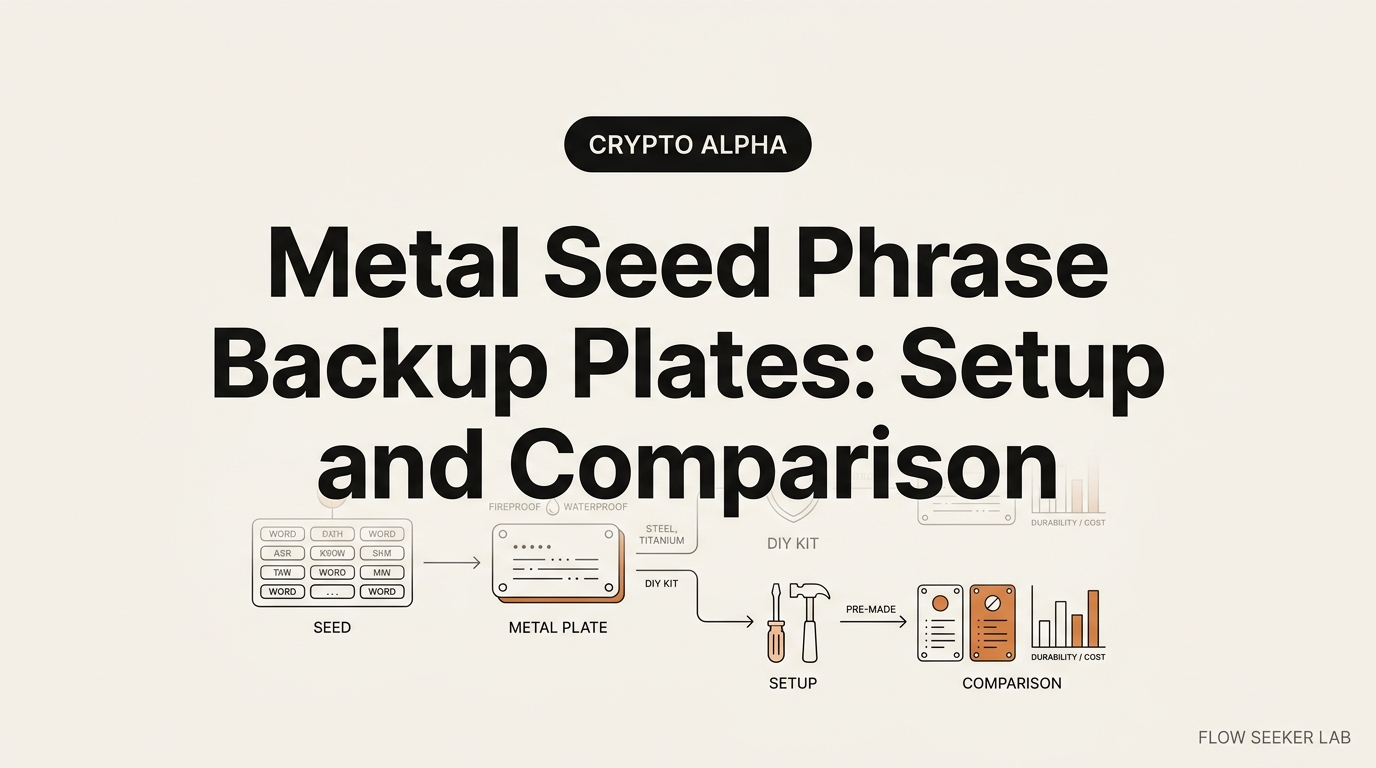
Metal Seed Phrase Backup Plates: Setup and Comparison
Metal Seed Phrase Backup Plates: Setup and Comparison
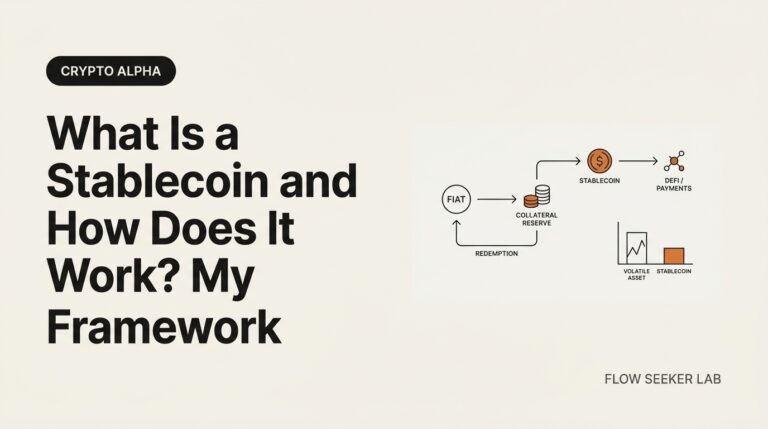
I own a hardware wallet. For two years my recovery phrase lived on the paper card that came in the box, folded inside a drawer.
Then I read about a house fire that took someone’s seed with it. That night I started looking at metal seed phrase backup plates, and I almost bought the wrong one for the wrong reason.
A metal seed phrase backup is simple in theory. You mark your recovery words onto steel or titanium so they survive what paper can’t.
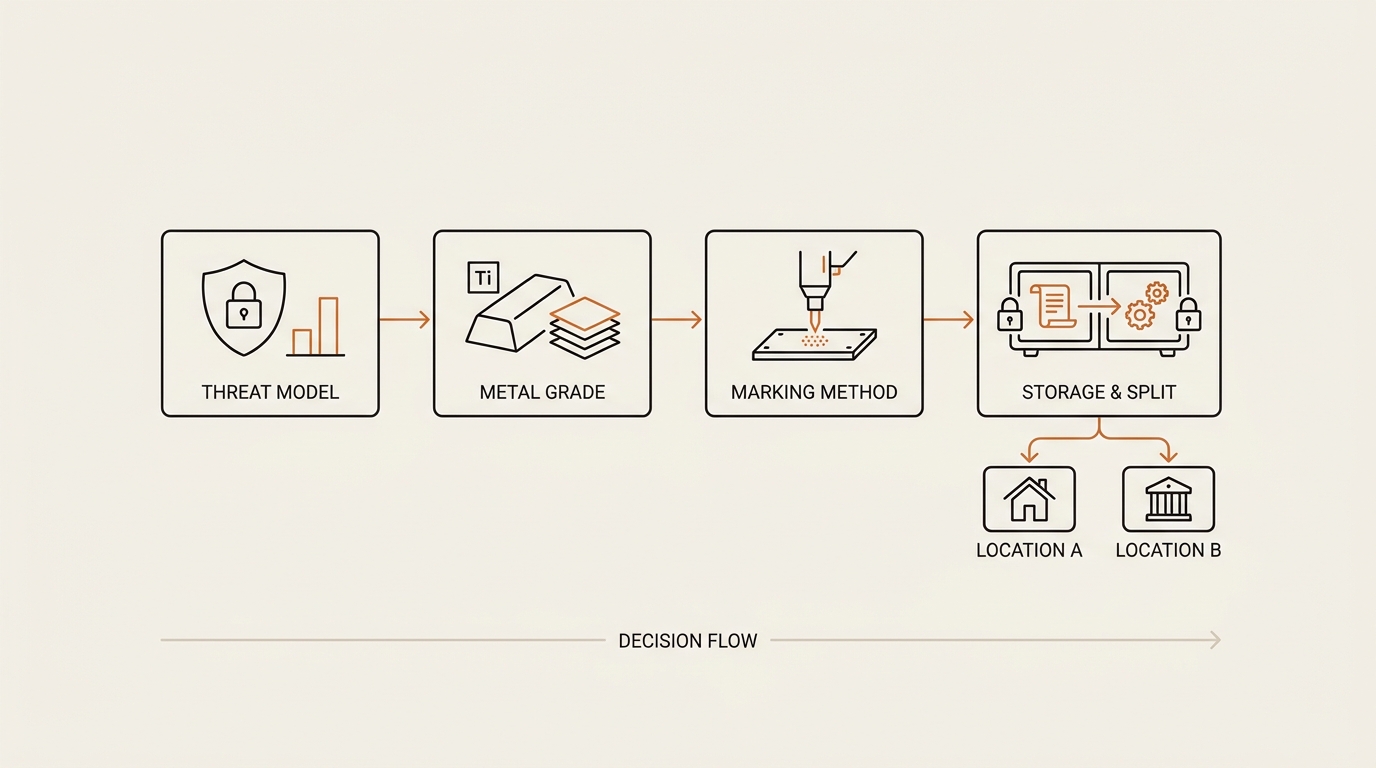
Here’s what I’ll walk through: the four questions I answered before I marked a single letter onto metal. Threat model first. Then metal grade, marking method, and storage — in that order. No product ranking, no “buy this one.” Frameworks, not forecasts.
Why paper survives a drawer but not a bad day
Paper does one job well. It sits in a drawer and stays readable.
The problem is that a drawer is a fair-weather plan. A metal seed phrase backup exists because paper fails against the exact events you keep a backup for: fire, flood, and slow time.
A house fire is not a candle. Residential structure fires reach roughly 1,090°C (about 2,000°F). Paper is gone long before that. So is ink.
Water is quieter but just as final. A burst pipe, a flooded basement, a firefighter’s hose — ink runs, paper pulps, and your twelve or twenty-four words turn into a gray smear.
Then there’s lamination, which I see recommended constantly. Lamination is a trap dressed as a solution. It slows moisture and handling wear, but it is not fire-rated, and heat delaminates the plastic and bakes the paper inside. It buys time. It does not buy protection.
Theft and time round out the list. A drawer offers zero resistance to someone who finds it, and a decade of humidity fades even archival ink. This is the threat model. Fire, flood, corrosion, theft, time. Everything after this is a response to that list.
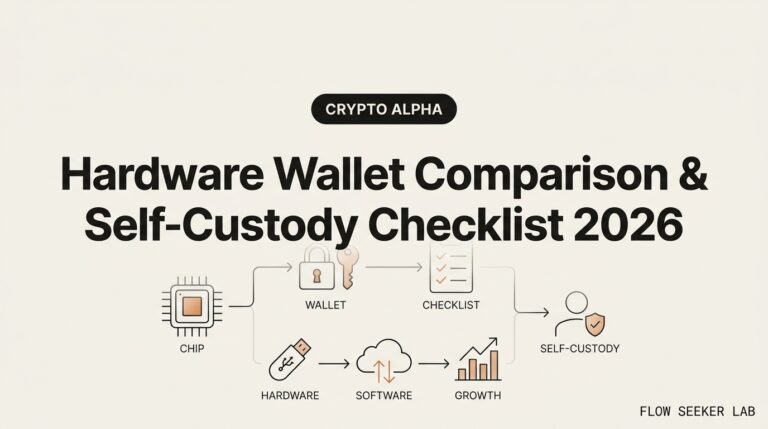
If you want the wider self-custody picture, I wrote a full hardware wallet self-custody checklist — the seed-backup step of that checklist is exactly this post.
The BIP39 trick that makes short plates work
Here’s the part almost nobody explains, and it’s the “aha” that made the whole category click for me.
Your recovery phrase is not random words. It comes from the BIP39 standard, which defines a fixed list of exactly 2,048 words. Every wallet that says “write down these 12 or 24 words” is pulling from that same list.
The clever part: in that list, every word is uniquely identified by its first four letters. No two words share the same first four characters. You can confirm this in the BIP39 specification itself.
So “abandon” and “ability” are already different at “aban” versus “abil.” “Advance” and “advice” split at “adva” versus “advi.” Four letters is always enough.
That is why a metal plate for a 24-word seed doesn’t need long rows. Most plates only give you four-letter columns per word. You stamp four letters, and on recovery your wallet autocompletes the rest.
This one fact changes how you read every metal seed phrase backup product. A plate with short four-letter rows isn’t cutting corners. It’s using the standard correctly. Once you know this, “supports 24 words” stops being about row length and starts being about how many words the plate physically fits.
The three marking methods, and the one that actually decides it
Now the comparison people expect: how do you get letters onto the metal? There are three families.
Stamping. You drive letter punches into a solid plate with a hammer, or with a spring-loaded automatic center punch. The marks are deep and permanent. Nobody can alter them later. The downside is human: a punch can slip, strikes land uneven, and a mistake is forever.
Engraving. A rotary tool like a Dremel or an electric engraver scribes the surface. It’s faster and more forgiving than a hammer. But the marks are shallower, which means they can be harder to read after a severe fire — I’d flag that as a claim to test, not a settled fact, and I’ll come back to why.
Tile and slot systems. Pre-made letter tiles slot into a housing, no tools required. You can reposition and reuse them. Think Cryptosteel-style capsules, where a threaded core holds a stack of letter tiles.
Reading the marketing, tile systems look like the obvious winner. No slips, no ruined plates, reusable. That’s exactly the trap I fell into.
Because the real deciding axis isn’t how you make the mark. It’s fixation — whether the letters stay put when the container fails.
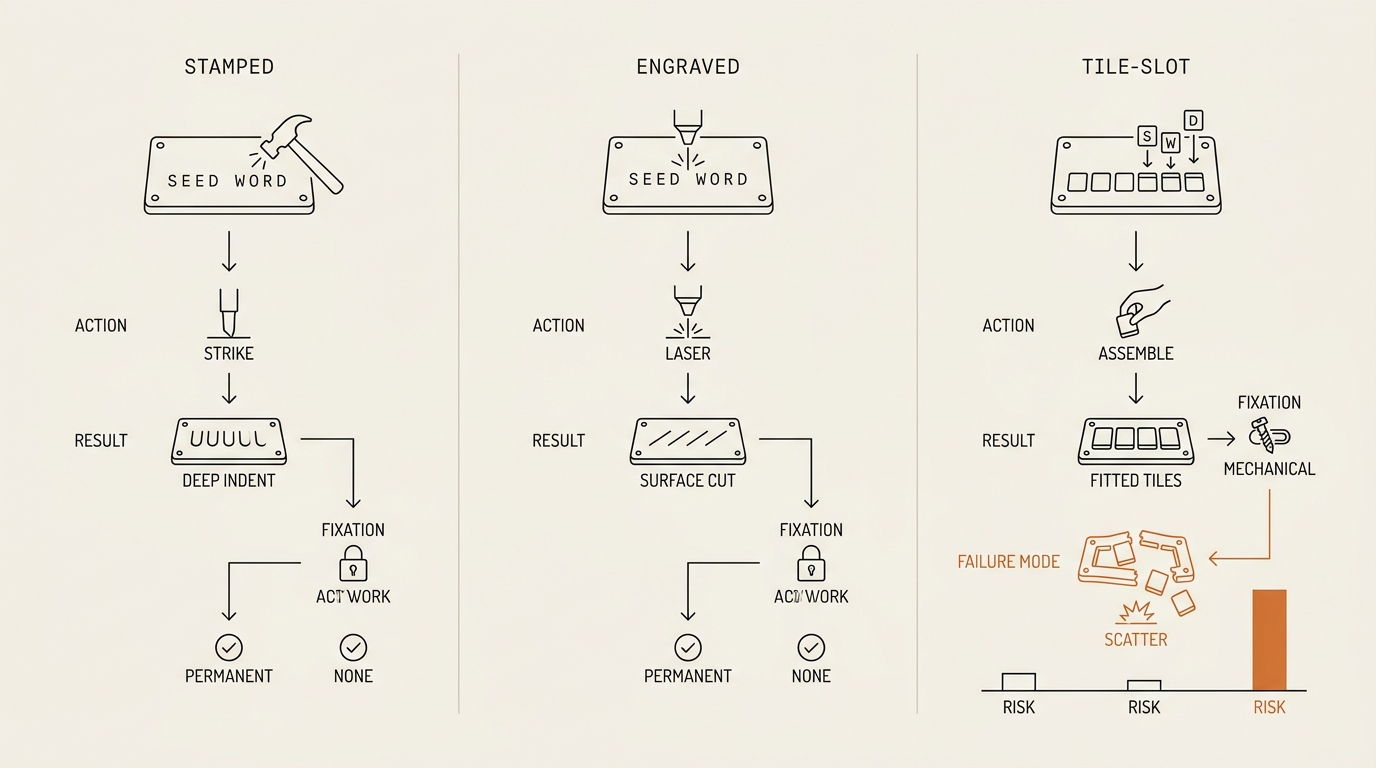
A monolithic stamped or engraved plate is one solid piece. The letters are part of the metal. If the plate survives, your words survive, in order.
A loose-tile system stores each letter separately. Each individual tile might survive a fire. But if the housing warps or fails, the tiles can scatter. Now you have a pile of surviving letters and no idea what order they went in. The backup is lost even though nothing melted.
That is the crux of the whole comparison. Not fire rating. Not price. Fixation. I’ll show the receipts in the “where I was wrong” section, because this is where I got it wrong first.
Metal grade: stamped vs engraved matters less than the metal underneath
Once fixation is settled, the next question is what the plate is made of. Three grades come up.
304 stainless steel is the standard. It’s the “18/8” steel in your kitchen sink, it melts around 1,400°C (about 2,650°F), and it comfortably survives a residential fire.
316 stainless steel adds molybdenum, which pushes corrosion resistance higher. It’s often called marine-grade for a reason — it holds up better in humid, coastal, or salty air over long periods. The 316 stainless steel reference covers why the corrosion behavior differs. For a plate you plan to bury in a fire safe for a decade, that margin matters.
Grade-5 titanium (the Ti-6Al-4V alloy) sits at the top tier. Higher melt point, extreme durability, and a premium price to match.
Here’s the number that reframes all of it. A house fire tops out near 1,090°C. Both stainless grades melt hundreds of degrees higher. Titanium higher still.
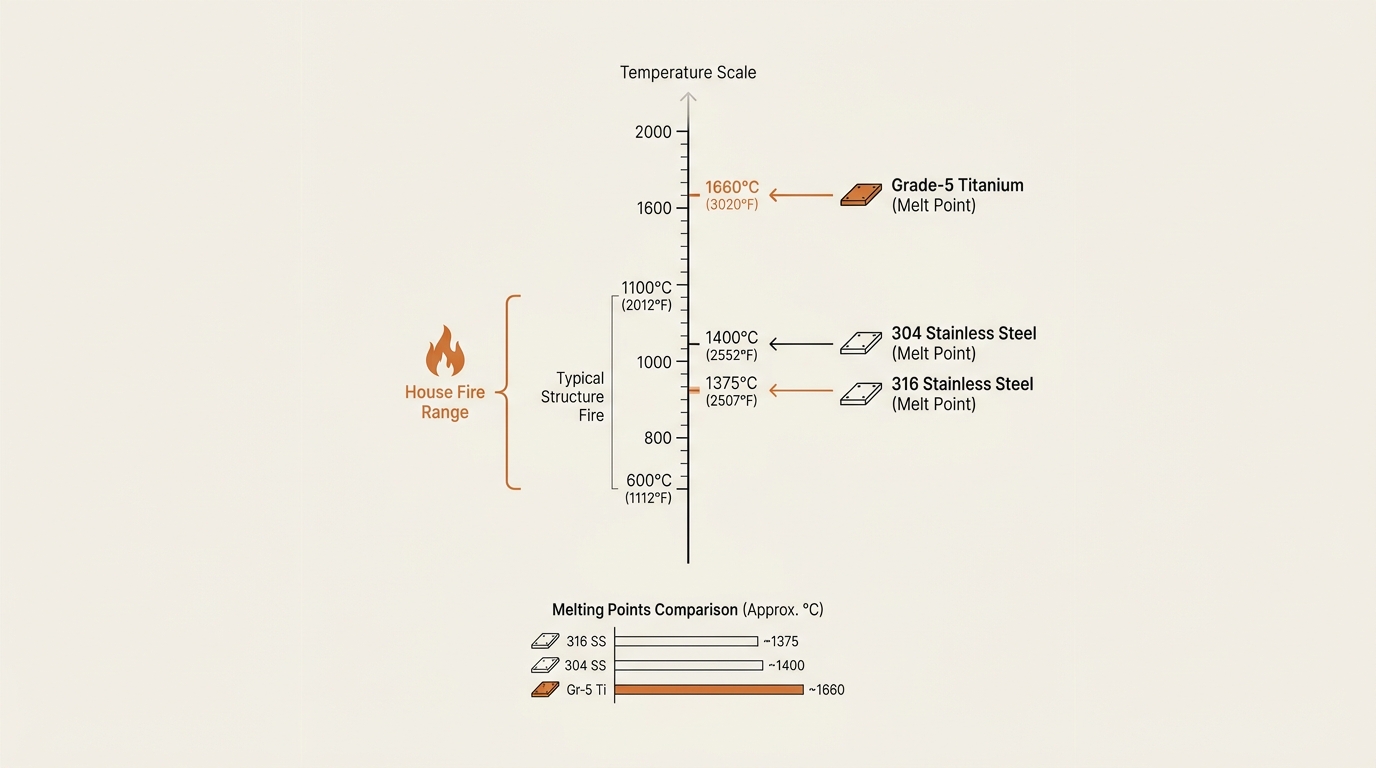
So a solid plate in any of these metals does not melt in a house fire. It can’t — the fire never gets hot enough. This is the conclusion from Jameson Lopp’s independent metal seed storage stress tests, where he ran roughly 70 devices over several years through propane torch heat, corrosion, and a hydraulic press.
The lesson I took: the metal is almost never the failure point. Design and fixation are. A well-built monolithic plate in stainless or titanium survives the fire. Stainless steel is the most practical readily-available metal for corrosion resistance. Titanium is an upgrade in durability and cost, not usually the difference between survival and loss.
Which means the “stamped vs engraved” debate is real but secondary. The metal underneath and how it holds the letters matter more than the exact tool that made the marks.
The comparison table — by category, not by brand
I built this metal seed phrase backup table to eliminate categories under my threat model, not to crown a product. Every fire figure is a vendor claim unless independently tested, and I’ve marked it that way. Products are named only as examples of a category, sourced, never as “the best.”
| Category | Metal & grade | Marking method | Words / columns | Fire rating | Water / corrosion | Fixation risk | DIY vs kit | Price tier | Tamper / privacy |
|---|---|---|---|---|---|---|---|---|---|
| DIY stamped plate | 304/316 steel blank | Hand or auto punch | Full seed, 4-letter cols | No vendor claim; steel survives per Lopp | Good (316 better) | Low — monolithic | DIY + hardware-store punches | $ | Fully in your hands; single-seed exposure if found |
| Sealed steel kit — e.g. Coinplate, Billfodl | 304/316 steel | Punch or pre-set tiles | 12 or 24 words | Vendor claim — verify vs Lopp | Good | Low to medium, depends on housing | Sealed kit | $$ | Can be inspected; single-seed exposure |
| Tile / slot system (Cryptosteel-style) | Steel capsule + tiles | Loose letter tiles | 12 or 24 words | Vendor claim — verify vs Lopp | Good | Higher — tiles can scatter | Kit | $$ | Reusable; tiles can be reset |
| Titanium plate — e.g. CryptoTag, Coldcard-style | Grade-5 titanium | Punch or engrave | 12 or 24 words | Vendor claim — highest melt point | Excellent | Low — monolithic | Kit | $$$ | In your hands; single-seed exposure |
Read the table by columns, not rows. The “fixation risk” column is the one I let decide, because it’s the one the marketing hides. The “fire rating” column is where I’d trust Lopp’s independent test over any printed number.
A metal plate is the endpoint of cold storage. If you’re still deciding how much to keep offline at all, my hot wallet vs cold wallet comparison covers the ratio question first.
How I’d actually mark a plate without ruining it
The setup is where people get hurt, and almost every mistake is avoidable. This is the sequence I follow.
1. Verify the seed offline first. Before it touches metal, confirm your recovery phrase restores correctly on your hardware wallet, fully offline. Never type your seed into a website, an app, a “checker” tool, or anything connected to the internet. Ever. A single online entry can undo the entire point of a metal backup.
2. Lay out all words before stamping. Write the four-letter version of each word on scrap paper first, in order. Confirm every word against the BIP39 list. You’re checking the plan before you make anything permanent.
3. Stamp four letters per word. Work slowly. If you’re hand-stamping, seat each punch, then strike once, clean and firm. Automatic center punches remove the aim problem. Do one word, stop, read it back, then move on.
4. Double-check the whole plate. Read it top to bottom against your verified list. Then read it again the next day with fresh eyes. Permanent mistakes deserve a second look.
5. Corrosion and rust check. If you touched the steel with bare hands, wipe off the oils. For long storage, 316 steel or titanium gives you a wider margin against slow corrosion.
6. Storage and separation. Store the plate away from the hardware wallet — different room, ideally different building. A fire-rated safe or a bank deposit box both work. For meaningful holdings, consider geographic separation so one fire, one flood, or one theft can’t take everything.
One honest limit: a single plate is still a single point of failure for theft. Anyone who finds it and can read four-letter columns holds your keys. That’s where split backups come in, and it’s the reason a metal plate is the start of a storage plan, not the whole thing.
Where I was wrong
I started this the way the roundups train you to. I sorted products by fireproof temperature. “2,300°F rated” felt like the number that mattered, so I nearly bought a tile-slot system with a big printed figure.
I was optimizing the wrong variable. The metal was never going to melt in a house fire — none of these do, because the fire doesn’t get hot enough. I was paying attention to a spec that was already solved.
What I missed was fixation. Lopp’s stress tests don’t just heat plates; they show how designs fail. And the recurring failure wasn’t melting — it was thin or hollow designs deforming, and loose tiles coming apart. A capsule of letter tiles can lose the housing, scatter the tiles, and leave you with surviving metal and a scrambled seed.
That reframed everything. The question stopped being “how hot is it rated” and became “if the container fails, do my words stay in order.” A monolithic stamped or engraved plate answers yes. A pile of loose tiles answers maybe.
I don’t over-trust printed fire numbers anymore. When I read any metal seed phrase backup review now, I trust the independent stress test, and I weight fixation above the headline spec. That single correction changed which category I’d buy, before I ever looked at a brand.
FAQ
Are metal seed phrase backup plates worth it? For meaningful or long-term holdings, yes — they survive fire, flood, and years of humidity that destroy paper. For tiny or test amounts, a paper card in a safe place is often enough. Match the backup to what you’re actually protecting, not to the fear.
Stamped vs engraved vs tile plates — which is more durable? The deciding factor is fixation, not the marking method itself. Monolithic stamped or engraved plates keep letters in order even if the plate is damaged. Loose-tile systems can scatter if the housing fails in a fire or flood, even when each tile survives.
Can you laminate a seed phrase instead? Lamination slows moisture and handling wear, but it is not fire-rated, and heat delaminates the plastic and damages the paper inside. It buys time against small accidents. It does not survive the fire or flood you keep a real backup for.
What fireproof rating does a seed backup need? House fires reach roughly 1,090°C (about 2,000°F). Both 304 and 316 stainless melt near 1,400°C, and grade-5 titanium melts higher, so a solid plate survives. The usual failure mode is design and fixation, not the metal melting — treat printed ratings as claims and weight independent stress tests higher.
Where should I store a metal seed plate? Store it separately from your hardware wallet, ideally in a different building. A fire-rated safe or a bank deposit box both work. For larger holdings, geographic separation or a split backup means one fire, flood, or theft can’t take everything.
Do I need to record the whole word or just the first four letters? Just the first four letters. Every BIP39 word is uniquely identified by its first four characters, which is why most plates only give four-letter columns. On recovery, your wallet autocompletes the full word from those four letters.
The four questions, not the four products
I never answered “which plate is best.” I answered four questions in order: what am I protecting against, what metal survives it, how do the letters stay fixed, and how do I store and split it. The product fell out of the answers.
A metal plate isn’t a purchase that ends your worry. It’s the durable half of a plan whose other half is separation — because the plate that survives a fire still has one weakness: it’s a single seed, in a single place, that anyone who finds it can read.
That’s the next question, and the next post in this Crypto Safety series: how to split a backup so no single fire, flood, or finder holds all of it — Shamir and SLIP39 split backups, and geographic distribution.
seonjae — Korean office worker documenting his transition into AI systems, agents, and vibe coding — without a CS background. Shipping in public.
This is a risk-reduction framework for durable seed storage, not a guarantee of safety. Never type your recovery phrase into any online tool. For the counterpoint — not holding a single seed at all — see seedless wallet recovery vs seed phrase.