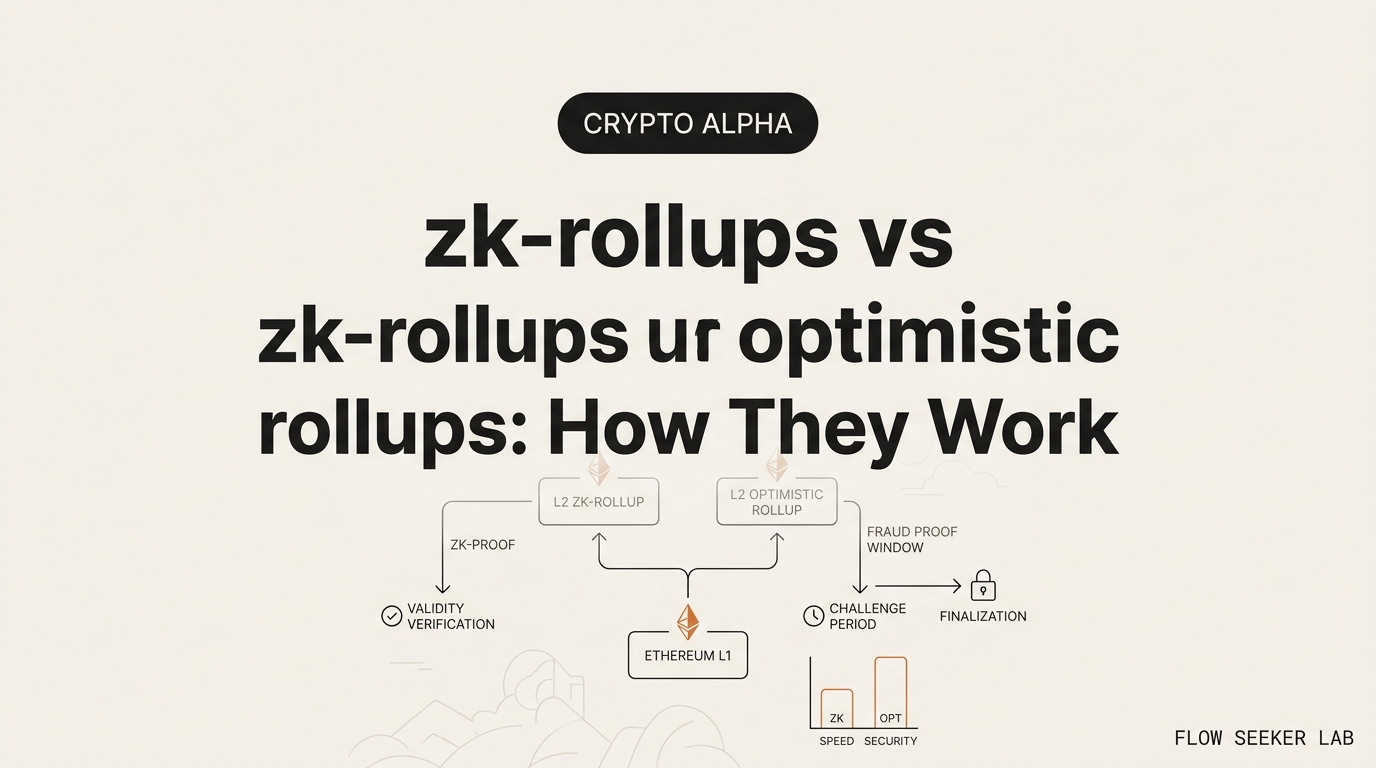
zk-rollups vs optimistic rollups: How They Work
zk-rollups vs optimistic rollups: How They Work for People Who Move Real Money
I once moved a few hundred dollars onto Arbitrum, clicked withdraw a week later, and watched a timer count down for seven days while I quietly assumed something was broken. Nothing was broken. That timer was the design. This is a zk-rollups vs optimistic rollups how they work breakdown written from the seat I actually sit in — not a cryptographer’s, but a non-developer who bridged money, paid a fee, and waited. I’ll walk you through how each rollup proves it isn’t lying, where the two camps genuinely disagree, and the plain rule I now use to decide which Layer 2 to reach for.
Most explainers you’ll find are written from the protocol’s chair. They show you a prover diagram and a feature matrix and declare a winner. I care about three things a normal wallet holder actually feels: how long until my money clears, what I’m trusting when I trust the chain, and which L2 to open on a Tuesday. Let me take both sides seriously first, because both are right about something.
The shared foundation: what every rollup is actually doing
Before the two camps split, they agree on the core trick. A rollup runs your transactions somewhere cheaper than Ethereum mainnet, then posts a compressed record back to Ethereum so the security of the base layer still stands behind it.
Here is the 40-second version. A rollup takes hundreds of Layer 2 transactions, executes them off-chain on its own sequencer, bundles them into one batch, and posts that batch plus a new state root down to Ethereum L1. You get cheaper, faster transactions because the heavy work happens off-chain, while Ethereum still holds the data and the final say. That’s the whole game. Both the optimistic and the zk camp do exactly this much.
The split is only about one question: how does Ethereum know the rollup didn’t lie about the new state? One camp says “assume it’s honest, and let anyone challenge it.” The other says “prove it mathematically before you accept it.” Everything downstream — your withdrawal wait, your trust assumption, your fee — flows from that single fork.
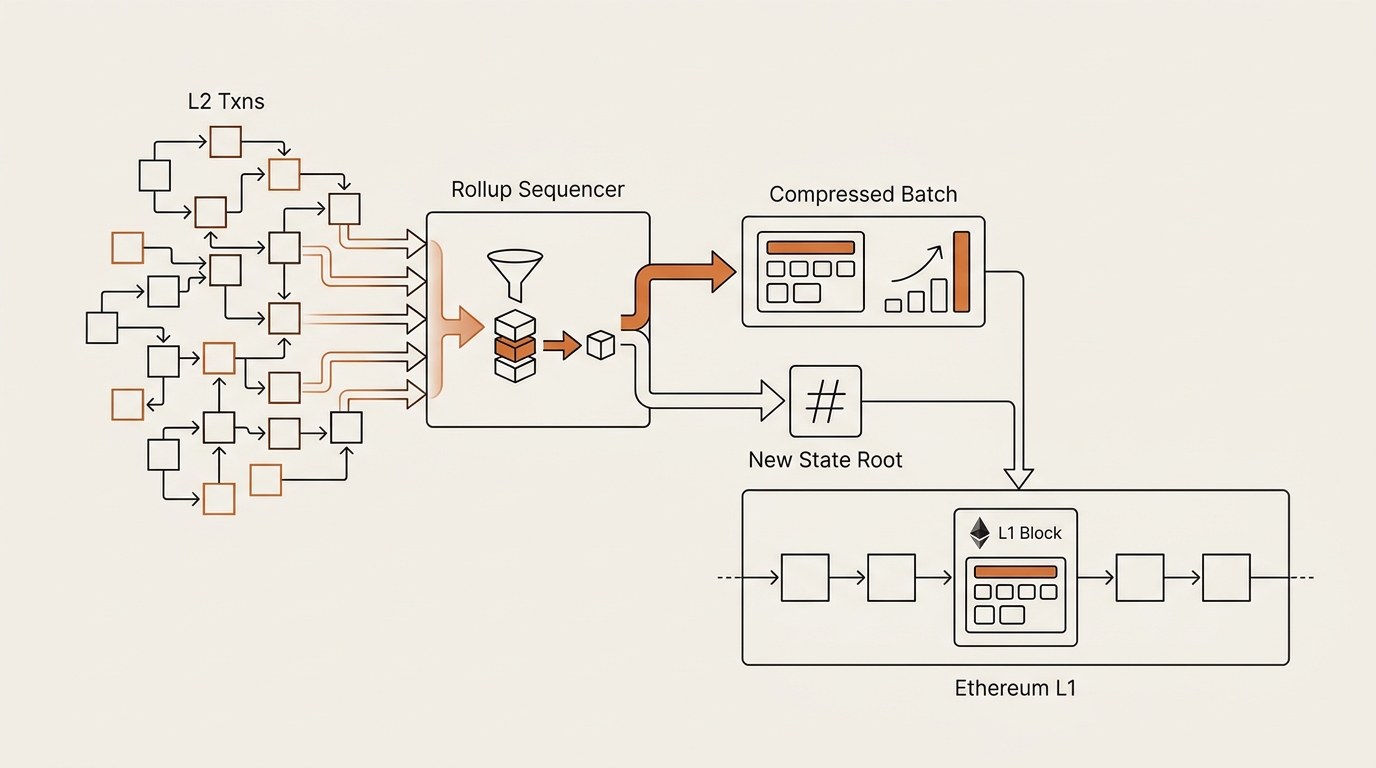
If you want the component both types lean on, the sequencer is it — the piece that orders your transactions before they’re batched. I broke down how L2 sequencers work separately, because whoever controls ordering controls a lot more than speed.
The optimistic rollup argument: trust first, verify only if challenged
The optimistic camp makes a bet that sounds almost lazy until you see the economics. When the sequencer posts a batch, it does not prove the batch is valid. It just asserts, “this is the new state, take my word for it.” The rollup optimistically assumes the operator is honest.
The safety net is the fraud proof and its challenge period. For a fixed window — seven days on Arbitrum and Optimism — anyone running a full node can re-execute the batch, spot a fraudulent state root, and submit a fraud proof to Ethereum. If the challenge is valid, the bad batch gets reverted and the dishonest party loses their bond. If nobody challenges within the window, the state is treated as final.
That’s the elegant part of the design: it only pays the cost of verification when something’s actually wrong. In the normal case — which is nearly always — no expensive proof gets computed at all. You just need at least one honest watcher out there willing to catch a lie. This keeps the on-chain machinery simple, and it’s a big reason this design shipped deep Ethereum compatibility early.
There’s a real cost, and I felt it personally. That seven-day window is exactly why my Arbitrum withdrawal sat on a timer. The rollup can’t let your money leave to L1 until the challenge period closes, because until then the state your withdrawal depends on could still be disputed. The wait isn’t a bug or congestion. It’s the price of the “trust, then allow challenges” model. Ethereum’s own documentation on optimistic rollups is blunt about this trade-off, and it’s worth reading in the project’s own words.
The optimistic camp’s honest summary: cheap to run in the common case, mature tooling, deep EVM equivalence, and a security model any developer can reason about — at the cost of a slow native exit.
The zk rollup argument: prove it up front, skip the waiting
The zk rollup camp finds the optimistic bet uncomfortable. Why assume honesty and hope someone’s watching, when you can force the rollup to prove every batch is valid before Ethereum accepts it?
That’s what a validity proof does. A zk rollup runs your transactions, then generates a cryptographic proof — often called a ZK proof or zero-knowledge proof — that mathematically demonstrates the new state root follows correctly from the old one and the batch of transactions. Ethereum verifies that small proof on-chain. If it checks out, the state is valid, full stop. No honest challenger required, no dispute window to wait out.
The payoff you feel is speed of finality. Once the validity proof is verified on L1, the state is final — so a native withdrawal clears in minutes to hours after proving, not seven days. There’s no “what if someone challenges” limbo, because the proof already closed that question. Ethereum’s documentation on zk-rollups frames validity proofs as the mechanism that makes this fast finality possible.
The zk camp pays for this elsewhere. Generating validity proofs takes serious compute — a specialized prover doing heavy math on every batch. And making the proving system speak fluent EVM was genuinely hard, which is why zkEVMs arrived later than the optimistic side did. That gap has largely closed, but the camp had to earn its EVM compatibility rather than inherit it.
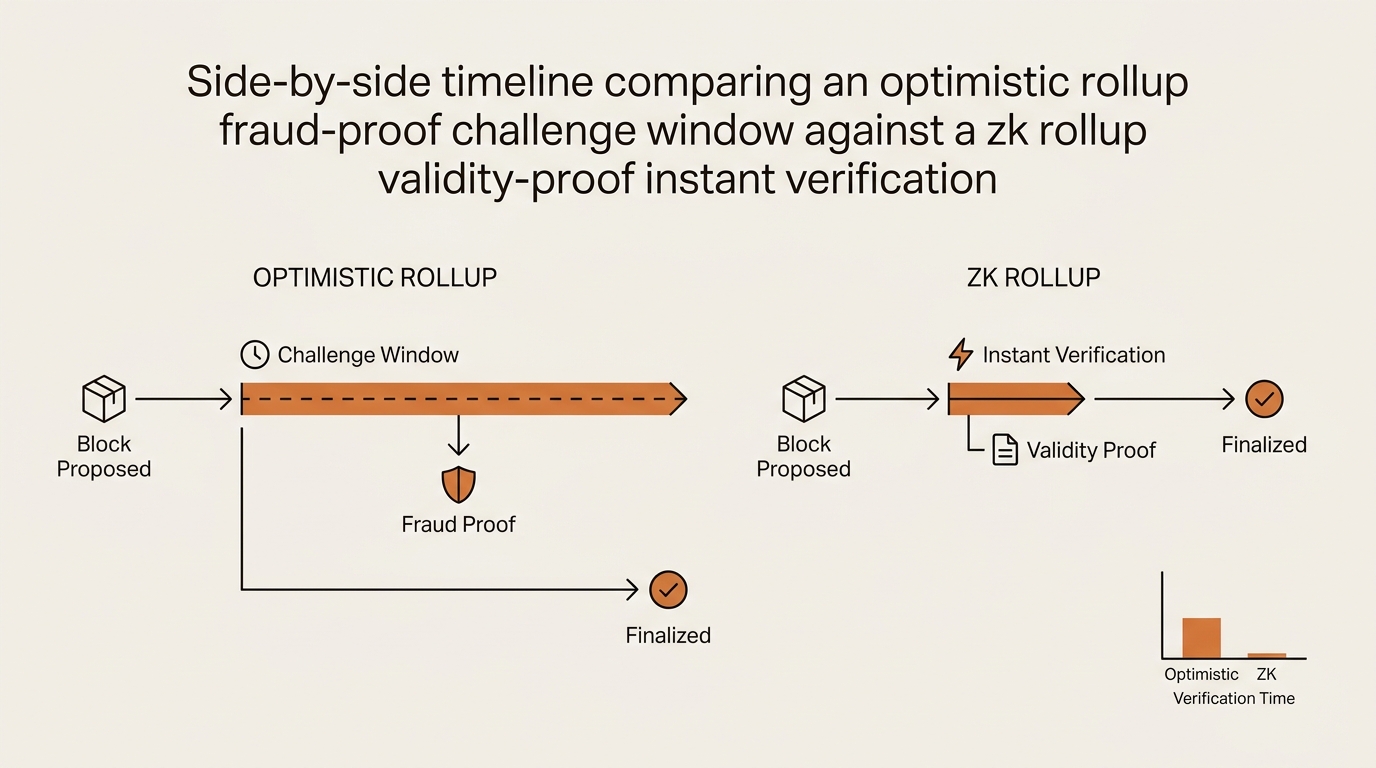
The zk camp’s honest summary: fast finality, cryptographic certainty instead of an economic assumption, and no seven-day exit — at the cost of prover complexity and a harder road to full EVM equivalence.
Both are right — so here’s the trade-off table, in the terms I actually think in
When I stopped reading these as “which is superior” and started reading them as “which failure mode do I prefer,” the comparison got useful. The vendor pages want a winner. A wallet holder wants a fit. Here is the same information a feature matrix would give you, but sorted by what a normal user feels.
| What you feel | Optimistic rollup | zk rollup |
|---|---|---|
| Native withdrawal time | ~7-day challenge window | Minutes to hours after the proof verifies |
| How validity is proven | Fraud proof — challenged only if disputed | Validity proof — verified up front, every batch |
| What you’re trusting | An honest challenger exists to catch a lie | Cryptographic math, no watcher needed |
| EVM compatibility | Deep equivalence, mature early | zkEVMs closed most of the gap |
| Fees after blobs (EIP-4844) | Near-parity | Near-parity |
| Examples | Arbitrum, Optimism (OP Stack) | zkSync Era, Starknet, Scroll, Polygon zkEVM, Linea |
Read the “what you’re trusting” row twice. The optimistic model trusts a social and economic assumption: someone honest is watching and can afford to submit a fraud proof. A zk rollup trusts math: the proof either verifies or it doesn’t. Neither is trust-free — they just put the trust in different places, and one of those places is easier to audit than the other. L2BEAT tracks exactly this, classifying rollups by “stage” so you can see how much you’re trusting the team versus the mechanism. I keep L2BEAT open when I’m deciding what I’m actually leaning on.
Now the row that matters most for daily use — the withdrawal timer versus the fees — is also where I got the most wrong.
Where I was wrong about rollups
I want to be honest about the specific things I misunderstood, because I doubt I’m alone.
I assumed the seven-day timer meant something failed. The first time I bridged off one of these L2s, the countdown made me think the transaction was stuck, the chain was congested, or I’d fat-fingered something. I refreshed the explorer far too many times. The wait was the challenge window doing its job — holding my exit until the dispute period closed. Once I understood the fraud-proof model, the timer stopped feeling like a failure and started feeling like a receipt.
I believed “zk is always cheaper,” and that’s outdated. For a while I repeated the line that zk rollups win on fees because they post less data. Then EIP-4844 introduced blobs — a cheaper lane for rollups to post their data to Ethereum — and the fee gap between the two models narrowed to near-parity for ordinary transfers. Proving cost versus data-posting cost is a real engineering difference, but it no longer maps cleanly to “zk = cheaper for me.” I stopped using price as the deciding axis.
I confused a bridge with a fast withdrawal, and I confused “fast finality” with “instant.” On the optimistic side, third-party bridges will front you the funds on L1 immediately for a fee — they eat the seven-day wait and take a cut. I once treated that as “the native withdrawal is fast,” which is wrong: I was paying someone to absorb the timer, and trusting their liquidity and honesty on top of the rollup’s. On the zk side, “fast finality” still means “fast after the proof is generated and verified,” not “the instant I click.” These are small distinctions that cost real money if you don’t see them. Ordering and speed also touch maximal extractable value, which is its own reason not to treat any exit as truly instant.
The pattern across all three mistakes: I was reading the marketing layer instead of the mechanism layer. The mechanism doesn’t lie to you. The timer, the proof, and the trust assumption are all sitting right there if you look.
The decision rule I actually use as a non-developer
I don’t pick a rollup by ideology. I pick by the job in front of me, and I never confuse “which chain’s token might do something” with “which chain fits this task” — that first question isn’t one I answer here.
Here’s the plain rule. Reach for a zk rollup when the exit speed matters to me — I’m moving funds around actively, I want to withdraw to L1 without a week-long timer, and finality certainty is worth more than ecosystem depth. Reach for the optimistic side when I want the deepest app ecosystem and the most battle-tested tooling, and I either plan to stay on the L2 for a while or I’m comfortable using a bridge to skip the wait when I genuinely need out.
Notice what’s not in that rule: fees. Post-blobs, they’re close enough that I don’t let a few cents decide. And notice what governs both branches — where I’m parking the money and how soon I need it back. That’s a wallet question, not a cryptography question.
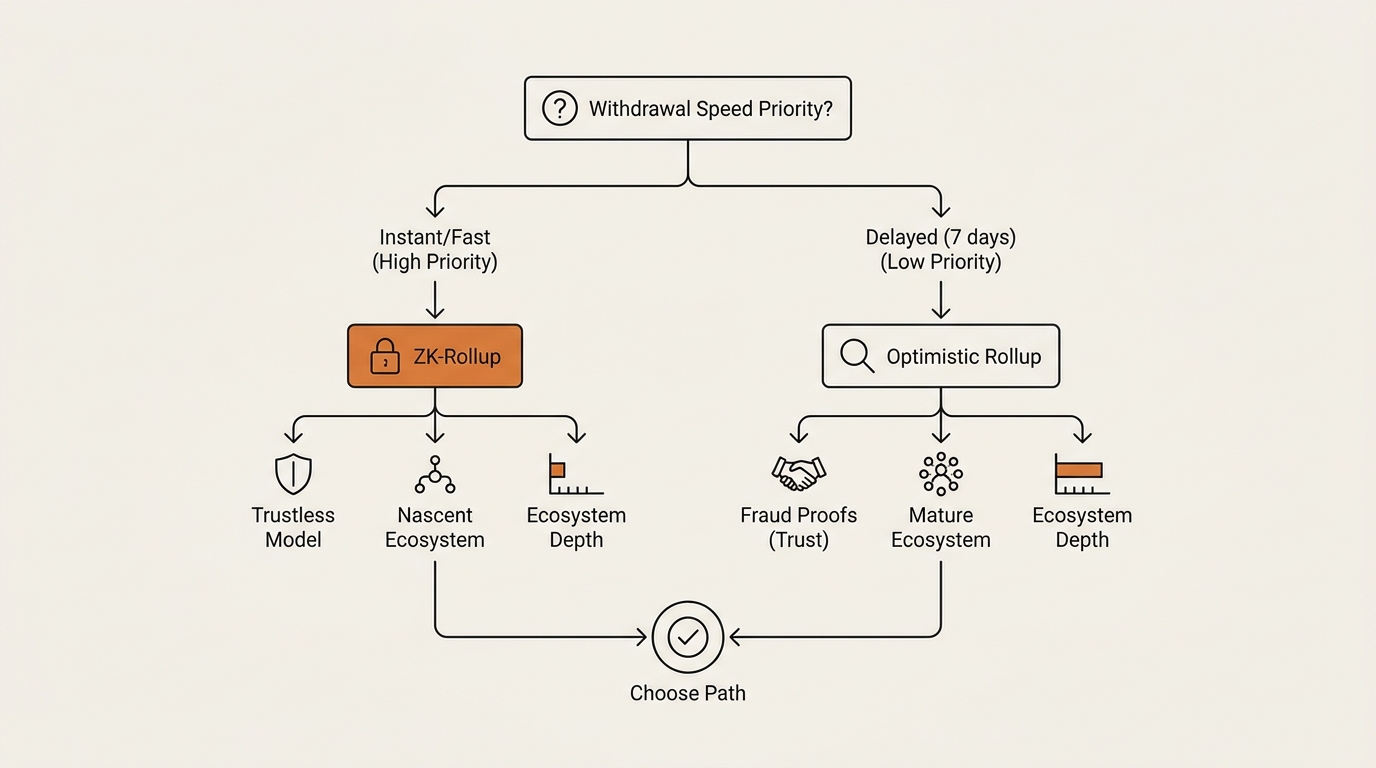
One more layer sits underneath all of this: how you actually hold and sign on an L2. If you’re using smart contract wallets, the way your transactions get bundled and paid for changes the day-to-day feel more than the rollup type does. The rollup decides how your money leaves. The wallet decides how it moves while it’s there.
What “near-parity” doesn’t cover — the honest limits of my rule
My decision rule is deliberately shallow, and I want to name where it thins out. It ignores decentralization stage: a rollup can be “optimistic” or “zk” on paper while still having a single sequencer and an upgrade key that could, in principle, override the whole model. That’s why L2BEAT’s stage system exists — the proof type is only half the trust story; who can push the emergency button is the other half.
My rule also ignores proof-system risk. A zk rollup’s validity proof is only as trustworthy as the code that generates and verifies it. A bug in a prover is a different failure mode than a missing honest challenger, and I’m not equipped to audit either. So “trust the math” really means “trust the math and the implementation of the math.” I hold both models with the same humility: the mechanism is elegant, the implementation is human.
FAQ
What is the main difference between zk-rollups and optimistic rollups, and how do they work? An optimistic rollup assumes each batch is valid and lets anyone submit a fraud proof during a challenge window. A zk rollup submits a validity proof up front, so Ethereum verifies each batch cryptographically before accepting it. Assumption-then-challenge versus proof-then-accept.
Why does an optimistic rollup withdrawal take seven days? The seven days is the fraud-proof challenge window. During it, any honest node can dispute a fraudulent batch. Your withdrawal to L1 can’t finalize until that window closes, because the state it depends on could still be challenged. The wait is the security model working, not a delay.
Are zk-rollups cheaper than optimistic rollups? Not reliably anymore. Before EIP-4844, the data-posting difference mattered more. After blobs gave rollups a cheaper data lane, fees for ordinary transfers landed at near-parity between the two. Proving cost versus posting cost differs under the hood, but “zk is always cheaper” is outdated.
Is Arbitrum a zk-rollup or an optimistic rollup? Arbitrum is an optimistic rollup, and so is Optimism (the OP Stack). The main zk rollups are zkSync Era, Starknet, Scroll, Polygon zkEVM, and Linea. If you’re waiting out a challenge window on a withdrawal, you’re almost certainly on the optimistic side.
Are zk-rollups more secure than optimistic rollups? They rely on different trust models, not a simple more-or-less. A zk rollup trusts cryptographic validity proofs; the optimistic model trusts that an honest challenger exists and will act. Both also depend on their implementation and decentralization stage, so audit who holds the upgrade keys, not just the proof type.
Do zk-rollups have EVM compatibility? Yes, through zkEVMs, though they arrived later. The optimistic model had deeper EVM equivalence early because it was simpler to build on Ethereum’s execution environment. zkEVMs like Scroll, Polygon zkEVM, and Linea have closed most of that gap, so compatibility is rarely the deciding factor now.
Which rollup is better for everyday users — zk or optimistic? Neither wins outright; it’s a fit. Reach for a zk rollup when fast withdrawals and finality certainty matter. Reach for the optimistic side when you want the deepest app ecosystem and mature tooling and don’t mind the exit wait or using a bridge. Match the tool to the task, not to a camp.
The reframe
Here’s what changed for me once I stopped hunting for a winner. The zk-versus-optimistic debate isn’t a contest between two technologies — it’s a choice between two questions Ethereum asks. Optimistic rollups ask “is anyone going to prove you wrong?” and give you a week to answer. Zk rollups ask “can you prove yourself right?” and want the answer immediately. Neither question is smarter. They just hand you a different receipt: one is a waiting period, the other is a proof. Pick the receipt you can live with for the money you’re moving.
Next in the Crypto Mental Models series, I’m going to open a block explorer and trace a real L2 withdrawal from click to L1 settlement — the exact seven-day timer and proof-verification steps, transaction by transaction, so you can watch the mechanism instead of reading about it.
seonjae — Korean office worker documenting his transition into AI systems, agents, and vibe coding — without a CS background. Shipping in public.