Account Abstraction Smart Contract Wallets Explained
Account Abstraction Smart Contract Wallets Explained
A vendor blog told me smart wallets were the future and my MetaMask was a relic. That night I almost migrated everything. Then I read the gas costs, and I stopped.
This is account abstraction smart contract wallets explained for someone like me — a non-developer who already owns a normal wallet and just wants to know whether to bother. Not the spec. The decision. I’ll argue both sides honestly, show where I was flat wrong, and land on a framework instead of a “switch everything” push.
Here’s the plan: what these wallets actually are in plain English, the case for switching, the case against, the 2025 plot twist that lets you skip the choice, and the split I actually use.
The two wallets, in plain English
Before any jargon, the core split. Your normal wallet — MetaMask, a Ledger, most Coinbase Wallet setups — is an EOA, an externally owned account. It’s controlled by one private key. That key, usually backed up as a 12-word seed phrase, is the account. Lose the phrase, lose the funds. Leak the phrase, someone else owns you. There’s no logic inside an EOA — it can only do what the key signs, one action at a time.
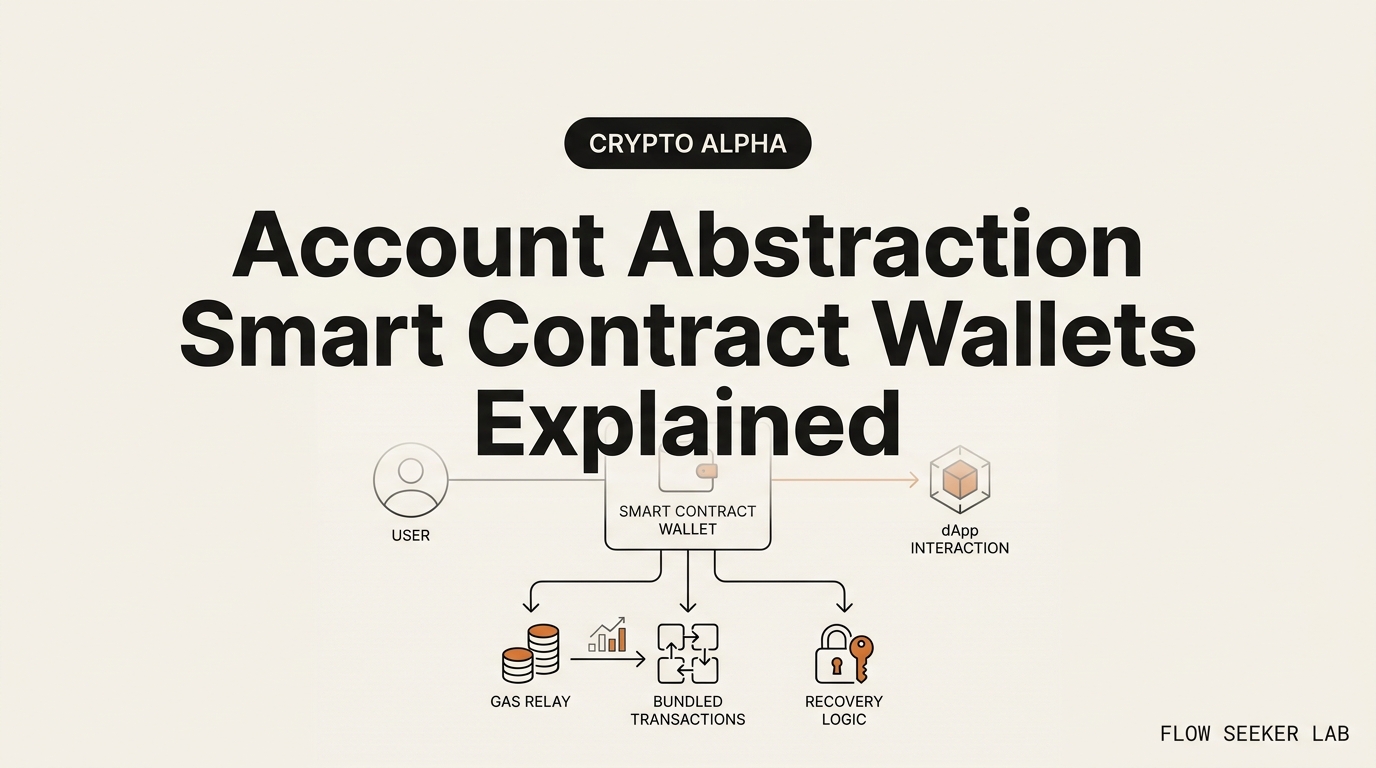
A smart contract wallet (or smart account) flips that. The account is a small program living on-chain. Rules live inside it: who can approve a transaction, spending limits, recovery by trusted contacts, permission to batch several actions into one. The key still signs, but the account decides what’s allowed.
That’s the whole idea of account abstraction — separating “who you are” from “one private key.” The account becomes programmable. Everything else in this debate is just consequences of that one move. Ethereum’s own account abstraction roadmap page frames it the same way, minus the vendor pitch.
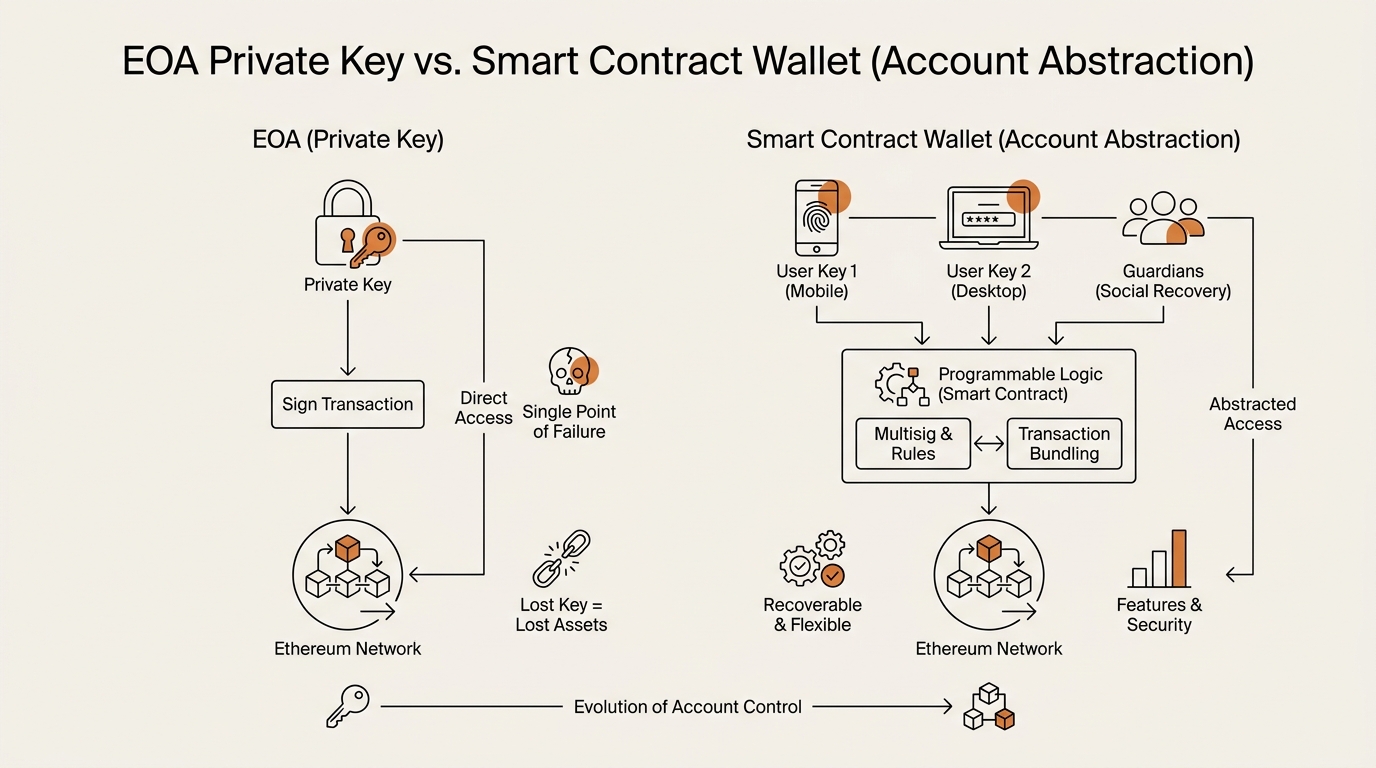
Four words show up whenever people explain the machinery. You don’t need to build with them, but you’ll see them, so here’s one plain sentence each. A UserOperation is the smart-account version of a transaction — a request to do something. A Bundler is a service that packages those requests and pushes them on-chain. The EntryPoint is a single audited contract that checks and runs them. A Paymaster is an optional contract that can pay your gas fee for you, or let you pay it in a stablecoin. Those four terms all come from the ERC-4337 specification, the standard that made smart accounts work without changing Ethereum itself. That’s it. Now we can argue.
The case for switching: real UX gains
The pro side is not hype. It fixes things that genuinely bite normal wallet users, and I felt every one of these before I understood the mechanism.
No single seed phrase to lose. With social recovery, you nominate guardians — other addresses, a passkey on your phone, a hardware key. Lose access, and a threshold of them restores you. My mother could never manage a 12-word phrase. She could tap “approve” on a passkey. That gap is the whole retail adoption story.
Pay gas in stablecoins, or not at all. Through a paymaster, an app can sponsor your fee or let you pay in USDC. If you’ve ever held tokens but couldn’t move them because you had zero ETH for gas, you know how dumb that felt. Account abstraction removes that specific trap.
Batch actions into one tap. On an EOA, “approve this token, then swap it” is two separate signatures. A smart account bundles them into one atomic step. Either both happen or neither does. Fewer clicks, and no half-finished state where you’ve approved but not swapped.
Session keys and spending limits. You can grant a temporary key that’s allowed to spend, say, up to 50 USDC on one app for one day, then expires. This matters far beyond convenience. It’s how you’d safely hand a wallet to software — the exact pattern I unpacked in my piece on giving an AI agent a wallet without handing over the keys. Scoped authority instead of all-or-nothing.
Reference implementations exist and are audited — Safe, Argent, Kernel, Coinbase Smart Wallet. I name them as examples of the pattern, not as picks. The point isn’t which one. The point is the capability is real and shipping.
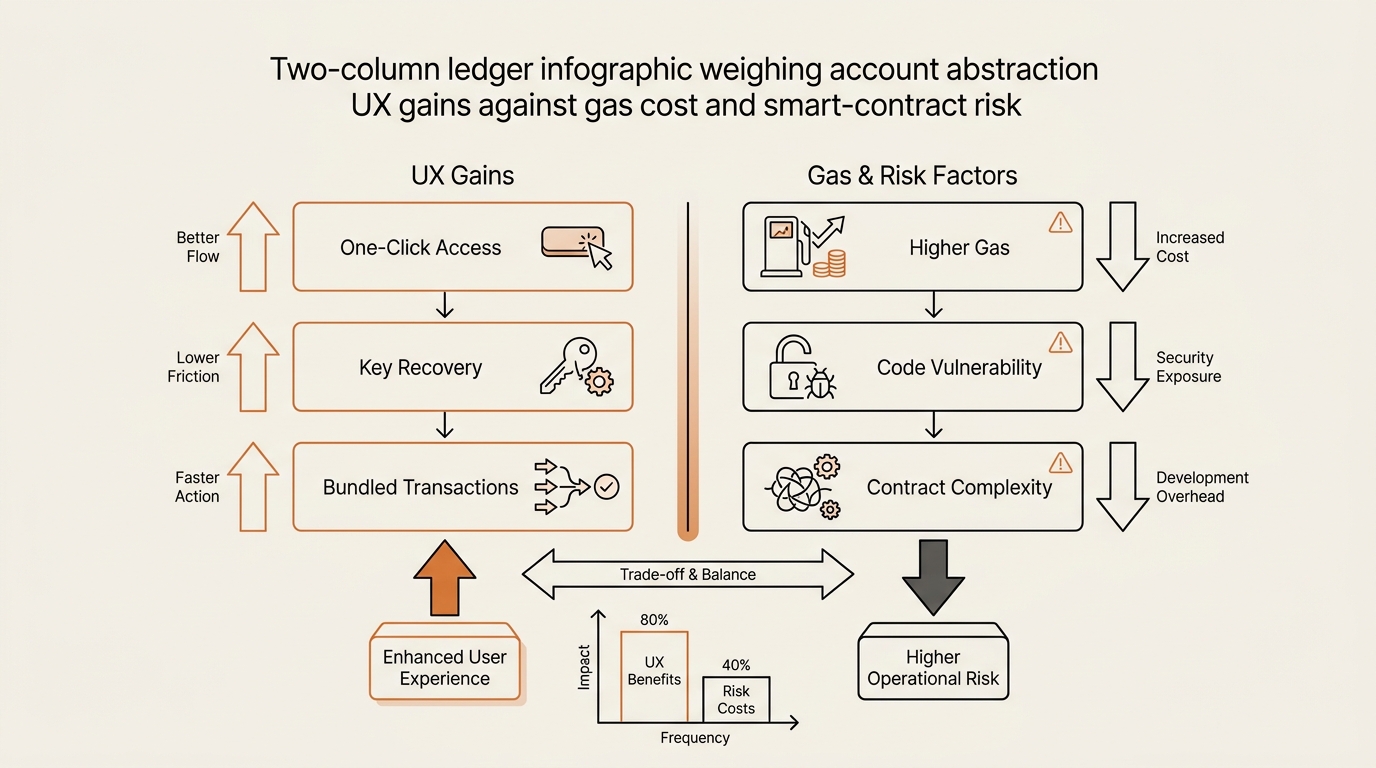
Here’s the honest ledger, side by side.
| Feature | Plain EOA (normal wallet) | Smart contract wallet |
|---|---|---|
| Recovery if you lose access | Seed phrase only — gone means gone | Guardians / passkeys / social recovery |
| Paying gas | Must hold native ETH | Sponsored, or pay in a stablecoin |
| Approve + swap | Two separate signatures | One batched, atomic action |
| Delegating limited spend | Not possible natively | Session keys with limits and expiry |
| Cost to create | Free (address already exists) | Deployment gas, one-time |
| Simple transfer gas | ~21,000 gas | Higher, ~100k+ range |
| Chain / tool support | Everywhere | Improving, still uneven |
The case against: the costs vendors gloss over
Now the con side, and this is where I had to correct myself.
A smart account isn’t free to exist. Your EOA address already exists on every chain — creating it cost nothing. A smart contract wallet is a deployed contract. Deploying it costs gas, often in the low hundreds of thousands range versus roughly 21,000 gas for a plain EOA transfer, per Ethereum’s own account documentation. For someone moving small amounts occasionally, that overhead can outweigh the convenience.
Simple sends can cost more, every time. Running logic isn’t free. A basic transfer from a smart account touches more computation than an EOA’s ~21,000-gas baseline. If your daily reality is “send some USDC to a friend now and then,” you may pay a small tax forever for features you rarely use.
More code means more surface. An EOA has almost no logic to attack. A smart account is a program, and programs have bugs. Audits reduce that risk, they don’t erase it. You’re trading “I only have to protect one key” for “I trust this contract’s code plus my key.”
Support is still uneven. Not every chain, dapp, or hardware device treats smart accounts as first-class. I’ve hit dapps that assumed an EOA and choked on a smart wallet signature. It’s improving. It’s not done.
There’s a subtler cost too: added mental overhead. Account abstraction gives you knobs — guardians, session keys, limits — and every knob is a decision you now own. For a non-developer, “more configurable” can quietly mean “more ways to misconfigure.” A plain wallet has one thing to protect. A smart account asks you to reason about a whole policy. That’s power, but power you have to actually understand for it to pay off.
And the biggest one, the point I got wrong, which deserves its own section.
What broke: where I was wrong about “safer”
I walked in believing a clean equation: no seed phrase equals safer. Social recovery, passkeys, guardians — surely that’s the end of getting drained.
It isn’t. I’d confused two different kinds of risk.
Operational risk is losing your key, forgetting your phrase, fumbling a backup. Smart accounts genuinely crush this. Recovery and passkeys are a real fix for the “I locked myself out” failure.
Application-layer risk is you authorizing something malicious. And a smart account does nothing about that. If a phishing site tricks you into signing a transaction that hands over your tokens, the wallet obediently executes it — because you approved it. Smart or plain, a signed malicious transaction drains you either way.
I saw this most clearly with token approvals. A smart account can hold approvals just like an EOA, and a malicious unlimited approval is just as dangerous either way — the mechanics I broke down in how token approvals drain wallets and how to revoke them. The wallet type doesn’t decide whether you get phished. Your signing habits do. Same story with a poisoned address you copy-paste from your own history — I covered that trap in the address poisoning scam, and no account model saves you from pasting the wrong destination.
So the honest correction: account abstraction removes a category of self-inflicted key mistakes. It does not remove the risk that you’ll approve the wrong thing. I’d sold myself a bigger promise than the technology makes. Session keys and spending limits cap the damage a bad signature can do, which is the actual security win — bounded blast radius, not immunity.
The 2025 plot twist: maybe you don’t switch at all
Here’s the development that reframes the whole “do I migrate?” anxiety. It’s called EIP-7702, and it went live with Ethereum’s Pectra upgrade on May 7, 2025.
Before Pectra, the debate was binary: keep your EOA, or move to a new smart-account address. EIP-7702 breaks that. It lets your existing EOA temporarily borrow smart-account powers — batching, sponsored gas, session keys — at the same address, by pointing to smart-account code for a transaction. You don’t move funds. You don’t get a new address. Your MetaMask can act like a smart wallet when an app supports it, then go back to being a plain key.
For a non-developer, that changes the question entirely. It’s no longer “abandon my wallet and migrate everything.” It’s “my current wallet can gain these features where it’s useful, without me relocating anything.” A lot of the migration dread I had was based on a choice that Pectra partly dissolved. Ethereum’s own Pectra and EIP-7702 page lays out the mechanism if you want the primary source.
The catch — because there’s always one — is that support has to be built app by app, wallet by wallet. EIP-7702 makes the upgrade possible at your address. It doesn’t make every dapp use it yet. It’s a bridge that’s being paved while people walk on it.
It also doesn’t erase the risk trade-off I described earlier. Borrowing smart-account code at your EOA means, for that transaction, your address behaves like a program — with all the flexibility and all the extra surface that implies. Account abstraction through 7702 is a convenience layer bolted onto an address you already trust, not a fresh security guarantee. The same discipline about what you sign still applies, because the wallet type never was the thing deciding whether you got phished.
The position I actually take: two wallets, two jobs
Both sides are real, so I don’t pick a winner. I split the job.
Spend wallet: smart account (or a 7702-upgraded EOA). For the money I move often — small swaps, app interactions, day-to-day activity — the UX gains earn their keep. Batching, stablecoin gas, and especially session keys with spending limits make frequent activity smoother and cap the downside when something goes wrong. This is the wallet that touches the messy internet.
Savings wallet: plain and cold. For funds I rarely touch, I want the smallest possible attack surface. A hardware wallet holding a plain EOA does one thing: sit still and stay offline. No contract logic to audit, no session keys to leak, no dapp connections. Fewer features is the feature.
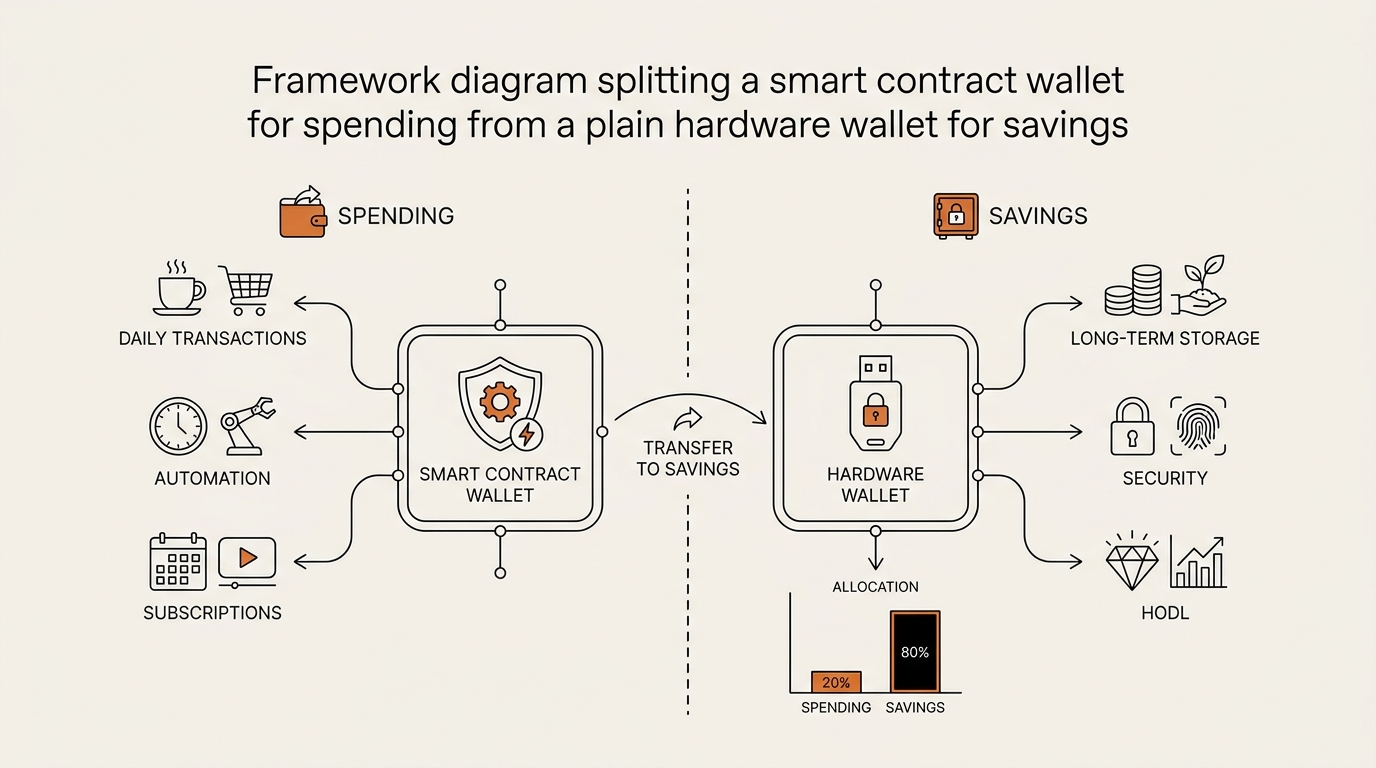
This isn’t novel — even wallet vendors quietly land here. It maps to a rule I keep repeating across these wallet posts: match the tool to how often the money moves and how reversible a mistake is. If you want to actually watch a smart-account deployment or a UserOperation land on-chain, that’s a good excuse to learn how to read on-chain data as a beginner — seeing the mechanism beats trusting a vendor diagram.
So the framework in one line: don’t ask “should I switch?” Ask “which of my two wallets is this, and does it need to be programmable?”
FAQ
What is account abstraction in simple terms? It’s separating your account from a single private key. Instead of one key controlling everything, the account becomes a small on-chain program with rules — recovery contacts, spending limits, batched actions. Account abstraction turns a rigid key into a programmable account you can set guardrails on.
What’s the difference between a smart contract wallet and a regular wallet (EOA)? A regular wallet (EOA) is controlled by one private key backed by a seed phrase, and does one action per signature. A smart contract wallet is a program on-chain with built-in rules: social recovery, spending limits, and batching. The EOA is simpler and cheaper; the smart account is more flexible.
Are account abstraction wallets safe? They reduce operational risk — losing a seed phrase, locking yourself out — through social recovery and passkeys. They don’t remove application-layer risk: if you sign a malicious transaction, it still drains you. Audited smart wallets are solid, but code adds surface. Safety still depends on your signing habits.
What is a paymaster and how do gasless transactions work? A paymaster is an optional contract that covers your gas fee. An app can sponsor the fee entirely, or let you pay it in a stablecoin like USDC instead of native ETH. That’s how “gasless” transactions work — the cost is paid, just not by you in ETH at that moment.
What is EIP-7702 and how is it different from ERC-4337? ERC-4337 is the standard for full smart contract wallets at their own address. EIP-7702, live since Pectra on May 7, 2025, lets your existing EOA temporarily borrow smart-account features at the same address — no migration. One builds a new smart wallet; the other upgrades the wallet you already have.
Does social recovery replace the seed phrase? For smart accounts, largely yes — recovery runs through guardians or passkeys instead of one phrase you must guard forever. But it only replaces the operational failure of losing that phrase. It does nothing to stop you from approving a malicious transaction, which is a separate risk entirely.
Do I actually need a smart wallet, or is my normal wallet fine? If you move funds rarely and value a small attack surface, a plain wallet is fine. If you interact with apps often and want recovery, spending limits, and batching, a smart account earns its keep. The practical answer is both — a programmable spend wallet and a plain savings wallet.
Where this lands
The vendor blog wasn’t lying about the UX. It was lying by omission — it skipped the gas math, the still-uneven support, and the fact that no wallet fixes a bad signature. Account abstraction is a real upgrade to how you hold money, not a shield over what you approve.
So the question was never “is my MetaMask a relic?” It’s “which of my wallets should be programmable, and which should just sit still?” Answer that per wallet, not per hype cycle.
Next in this Framework Deep Dive series: I’ll trace a real smart-account deployment and a UserOperation on a block explorer, step by step, so you can see the machinery instead of taking my word for it.
seonjae — Korean office worker documenting his transition into AI systems, agents, and vibe coding — without a CS background. Shipping in public.