Humanoid Robots Going Mainstream in 2026: A 4-Stage Filter
Humanoid Robots Going Mainstream in 2026: A Korean Office Worker’s 4-Stage Filter
Last month I watched a Figure 02 video on the BMW Spartanburg line during my lunch break in Seoul. The robot picked sheet metal. I picked at cold rice. My LinkedIn feed told me everything was changing forever. My actual job, importing the same auto parts I imported last quarter, did not change at all.
That gap is the reason I built this filter. If you are also a non-developer office worker reading about humanoid robots going mainstream in 2026, you do not need another robot leaderboard. You need a way to tell which headlines matter for your week, your team, and your quarter — and which ones are showroom theater. Below is the 4-stage test I now apply to every robot story I read.
I will walk through the stage definitions, place real 2026 robots on the map, share the moment I read the map wrong, and close with the limitations of this framework.
Why a Korean Desk Worker Even Needs a Robot Filter
I work in office logistics. I am not a roboticist. The closest I get to a factory is the Hyundai plant my brother-in-law shifts at in Ulsan.
But Korea sits on top of the most automation-dense manufacturing culture on earth. The International Federation of Robotics keeps ranking us number one or two in industrial robot density per worker. So when an American startup announces it is putting bipedal robots on a BMW line in South Carolina, three things land on me at once.
The first is calm. We already have robots. A lot of them. The second is suspicion. The press release says “deployed,” but my brother-in-law has worked next to a robot arm since 2019 and that arm does not look like a bipedal worker. The third is a question my boss might actually ask me: “Should we be doing something about this?”
Most articles I read about this 2026 wave are written for VCs or for executives. None of them are calibrated for a salaried Korean office worker who needs an honest answer in under five minutes. So I built one for myself.
This is a reading framework, not a stock pick or a job prediction. I will not tell you what to do with TSLA. I will not tell you your spreadsheet job is ending next Tuesday. I will tell you how to sort the noise.
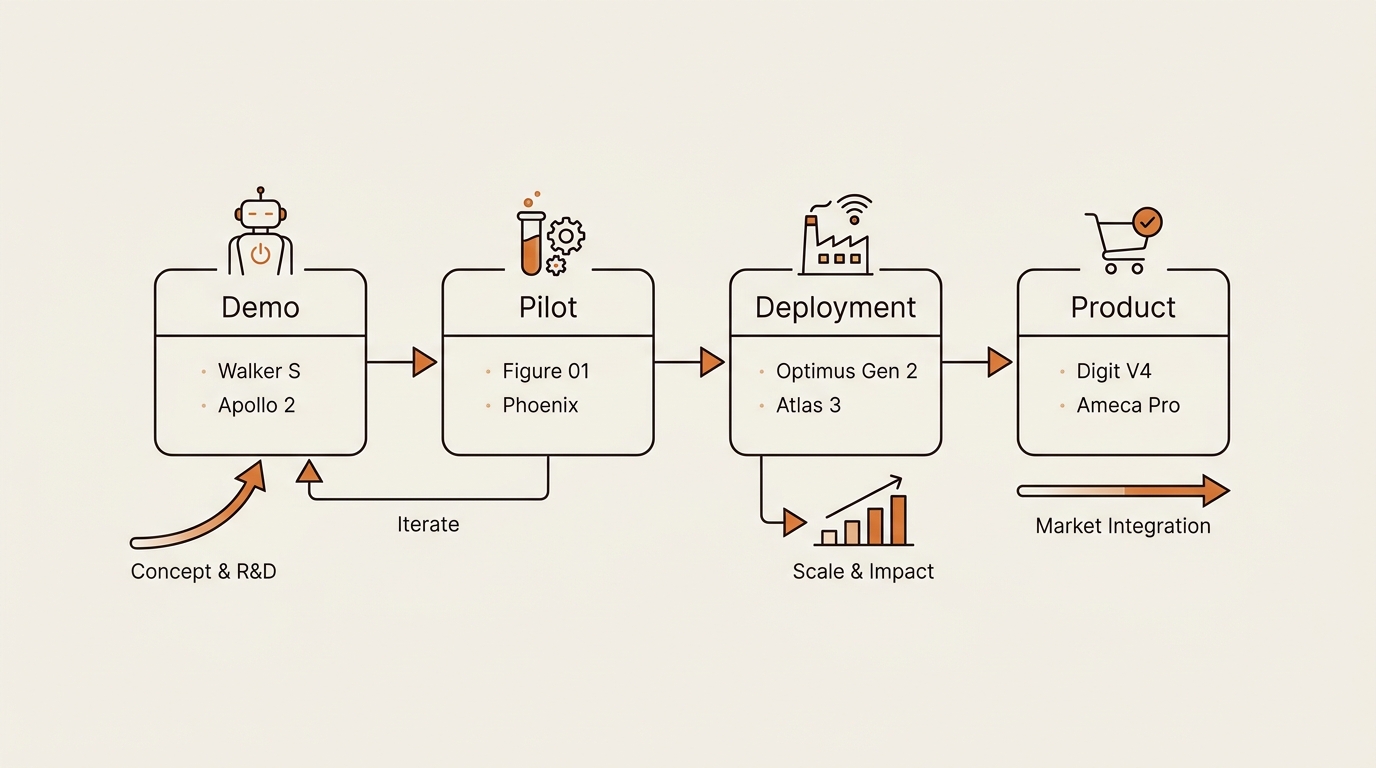
The 4-Stage Filter: Demo, Pilot, Deployment, Product
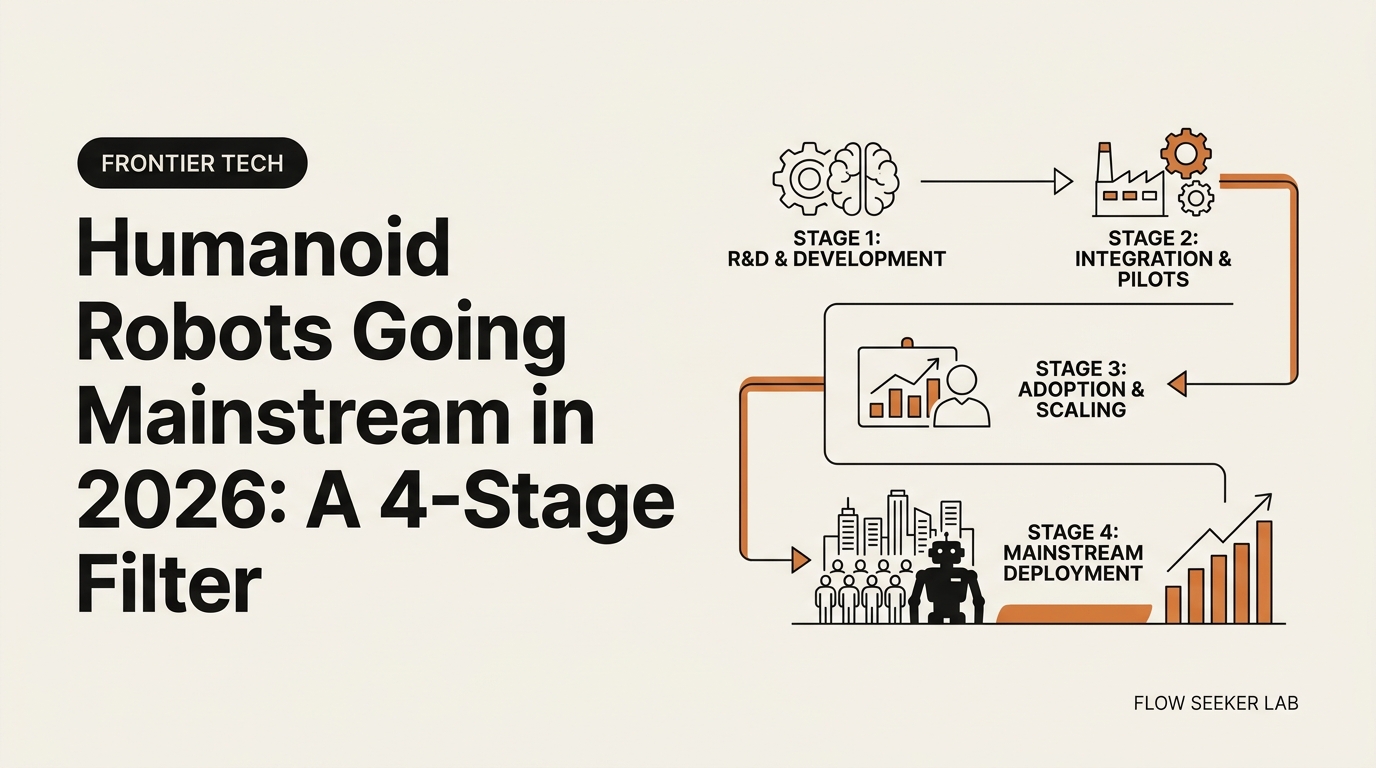
Here is the whole framework in one definition. Every robot headline in 2026 lives at one of four stages. Demo is a video. Pilot is a paid trial inside one customer site. Deployment is paid production work, measured in units shipped or hours run. Product is a thing you can buy off a shelf or website with a price and a warranty. The further right the stage, the more it matters for your week.
That is the snippet. Now the texture.
Stage 1 — Demo
A demo is a video. Sometimes it is staged. Sometimes it is teleoperated by a human off-camera. Sometimes the robot does the task once in fifty takes. None of that makes the demo a lie, but it does mean the demo is a capability claim, not a deployment.
In 2026, the demo stage is crowded. Unitree, EngineAI, Galbot, and a dozen Chinese biped startups push viral videos weekly. The robots run, dance, kick a ball, fold a shirt. Reading these as “robots are here” is the most common mistake I see in office Slack channels.
My rule: if the only evidence is a video, log it as Stage 1 and stop. Do not forward it to your boss.
Stage 2 — Pilot
A pilot means a paying customer has agreed to let the robot try real work on a real site, usually for a fixed period, often with the robot vendor’s engineers babysitting it. The customer is testing. The vendor is collecting data. Money may or may not change hands for the work itself; the contract is more about access than about output.
Apptronik Apollo at Mercedes-Benz started here. So did most Figure pilots before BMW. So has every public 1X NEO household trial. Pilots are real signal. They mean a buyer with a procurement budget agreed to take the legal and operational risk of a bipedal robot on their floor. That filters out 90 percent of the demo noise.
But pilots are still bounded experiments. They do not yet tell you the robot can hold a line shift without a vendor engineer in the room.
Stage 3 — Deployment
Deployment means production work, billed, on the customer’s clock, without the vendor babysitting. The robot is a coworker that ships a measurable output.
This is where 2026 hype runs into 2026 reality. Figure has reported real production work at BMW Spartanburg on sheet metal handling. Agility Robotics’ Digit has been on Amazon and GXO sites moving tote bins. Apptronik claims production status at Mercedes. Every other “deployment” story I read this year deserves a careful look at the verbs — announced, plans to, will pilot are all Stage 2 disguised as Stage 3.
Deployment is also where the bodies of the robots stop mattering and the boring work starts mattering: changeover time between tasks, mean time between failures, who pays when the robot drops a $400 part, what the safety enclosure looks like, who covers night shifts. None of that fits in a viral video. All of it decides whether the deployment lasts.
Stage 4 — Product
Product is the stage where a humanoid robot has a SKU, a price, a warranty, a service contract, and a customer who can buy it without negotiating a custom pilot. For industrial models, this means a published rental rate (Robotics-as-a-Service is common) and a stocked parts catalog. For consumer models, this means a shopping cart.
In June 2026, this stage is almost empty for general-purpose humanoids. 1X has taken NEO preorders at around $20,000 with a 2026 ship target. Unitree sells smaller-form bipeds for research labs. But “I can ship one to your warehouse next month with a maintenance SLA” is still not a normal sentence to say about Figure or Optimus.
This is the stage that, when it fills out, will mean these robots are actually mainstream — not in a press release sense, but in a procurement-form sense.
Placing 2026’s Headline Robots on the Map
Let me put the loudest 2026 names on the filter. These placements are my reading as of mid-2026, based on public statements, vendor pages, and the IEEE Spectrum robotics coverage.
| Robot | Stage | Why I placed it here |
|---|---|---|
| Tesla Optimus | Demo / early Pilot | Musk’s own January 2026 admission, see below |
| Figure 02 / 03 | Deployment (narrow) | BMW Spartanburg sheet-metal work, reported in production |
| 1X NEO | Pilot (consumer) | Home trials announced; preorder open, not at scale |
| Apptronik Apollo | Deployment (narrow) | Mercedes-Benz production statements |
| Agility Digit | Deployment (narrow) | GXO, Amazon site work |
| Boston Dynamics Atlas | Demo / early Pilot | Hyundai parent, electric Atlas trials |
| Unitree G1 | Product (research) | Available to buy for labs, not industrial work |
A single deployment line does not equal mainstream. It equals one customer, one site, one task. That is the calibration most coverage misses.
The Optimus row is the one I want to spend a paragraph on. In January 2026, Elon Musk himself said Optimus is “not in usage in our factories in a material way.” Roland Berger’s convergence-moment piece noted the same gap between announcement and shop floor. Almost no SEO blog acknowledges this. If you are reading a 2026 post that puts Optimus at “deployment” without quoting Musk’s own walkback, the post is reporting hype, not reality.
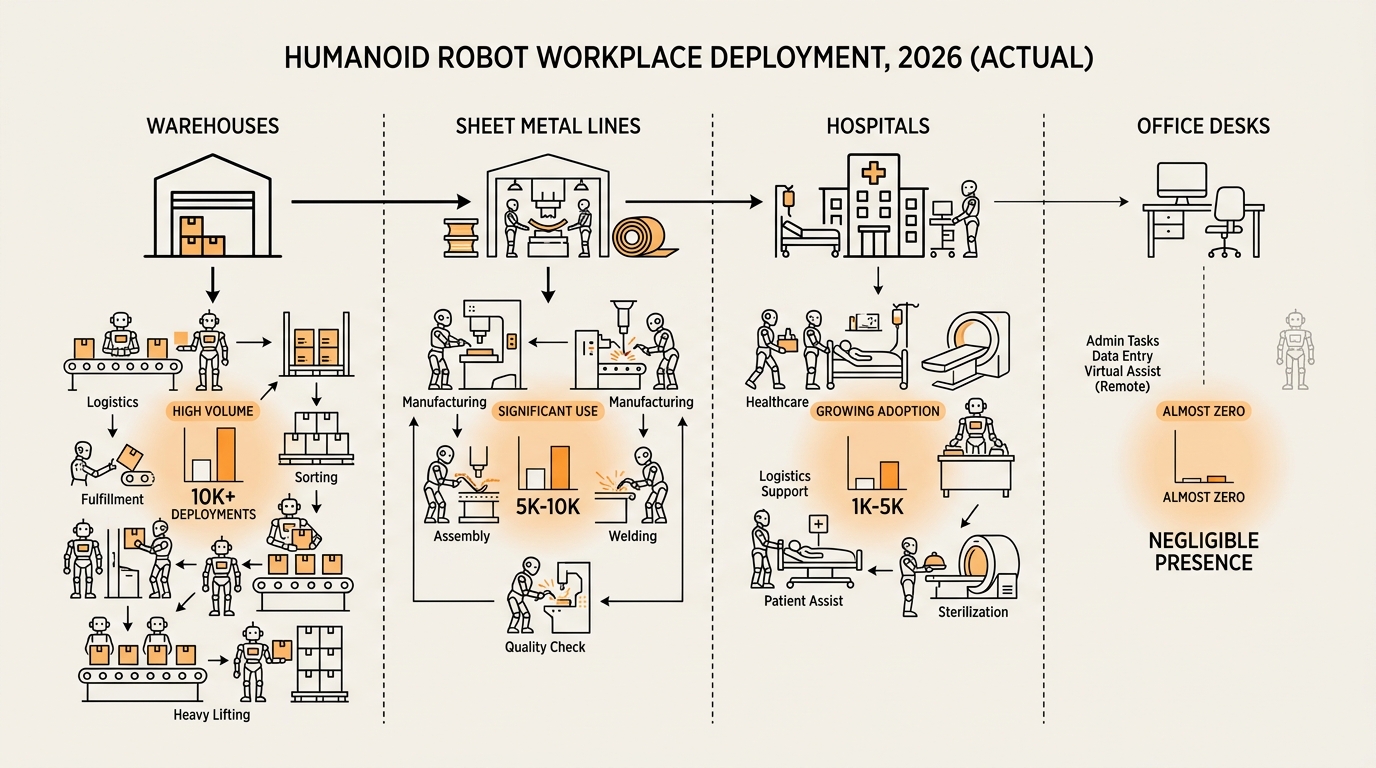
What Broke: I Bought the “Optimus Mass Production by End of 2025” Story
I have to confess the thing that pushed me to build this filter in the first place. In early 2025, I read the “Optimus will mass-produce by end of 2025” headlines and quietly told a few colleagues that bipedal robots were a year out from real factory work. I tracked the topic. I drafted a memo. I even floated a side conversation with our operations lead about what it might mean for our warehouse contracts.
Then 2025 ended. The goalposts moved to 2026. Then they moved to “thousands of units” and then to “we’ll see.” Then Musk himself said Optimus is not doing material work in Tesla’s factories. The memo I had drafted sat in my Notion looking dumb.
What I changed: I stopped quoting CEO timelines as deployment signals. I started counting only third-party reports — customer-confirmed deployments, IEEE write-ups, IFR data drops. What I measured: how often a “deployment” headline in 2024–25 survived twelve months without a quiet downgrade. The hit rate, for general-purpose biped CEO claims, was below half.
What I would do differently: I would have applied this exact 4-stage filter to my own memo. The Optimus claim was a Stage 1 demo wrapped in Stage 3 vocabulary. Now I would have caught that.
This is the kind of mistake the Korea AI adoption gap post warned me about for software. Apparently I had to make it for hardware too.
The Reading Loop You Can Actually Use This Week
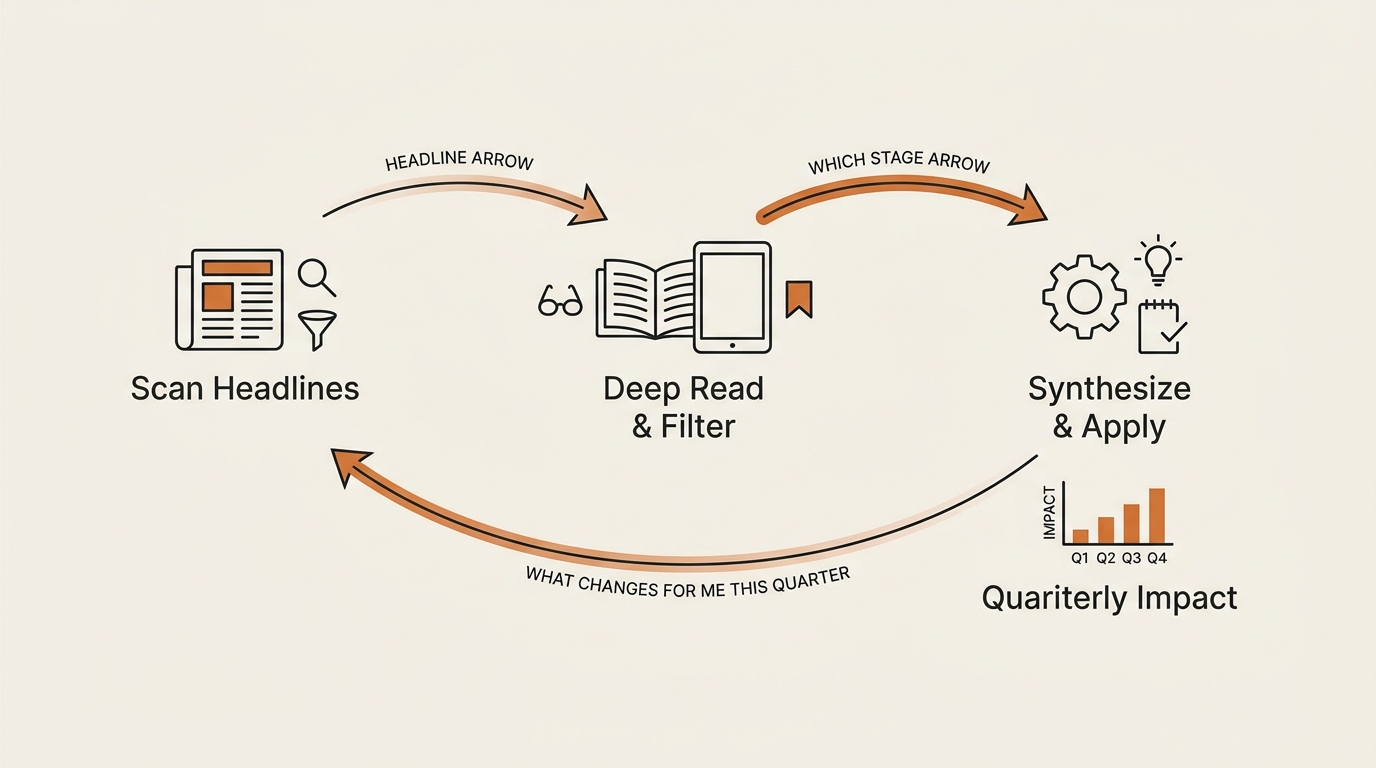
Every time you see one of these mainstream headlines, run it through three questions. This is the loop I now use in under sixty seconds.
- Which stage is this, by the verbs? Demoed and unveiled are Stage 1. Trialed and piloted are Stage 2. In production with a named customer and a measurable output is Stage 3. Available with a price is Stage 4.
- Who is the source? Vendor press release, vendor-friendly trade outlet, third-party reporter, or a regulator filing? Down-rank vendor sources by one stage automatically.
- What changes for me this quarter? Almost always the honest answer is: nothing. Sometimes it is: my procurement team should ask one question. Rarely it is: my role is shifting in eighteen months.
That third question is the whole point. Most coverage assumes the right reaction is excitement or panic. The right reaction, for an office worker, is usually patience with one calibrated note in your work log.
Where This Framework Falls Short
I would not be honest if I did not say the filter has gaps. It is a tool, not a complete map.
It underweights consumer-product surprise launches. If 1X NEO actually ships at $20,000 in working condition to ten thousand homes in 2026, that is a Stage 4 product moment that arrives in a single Tuesday, and the filter will look slow. The same is true for any Chinese biped that hits a real consumer SKU price.
It also underweights the cumulative effect of small pilots. One pilot at Mercedes is signal. Twenty pilots across twenty automakers in one quarter is a different kind of signal, even if no single one is a deployment yet. The filter rates them individually but does not sum the wave.
And it almost entirely misses the data-collection layer. The MIT Technology Review piece on gig workers training these robots at home describes a quiet army of teleoperators feeding behavior data to the next model generation. That work is not a demo, a pilot, a deployment, or a product. It is the substrate underneath all four stages, and the filter does not see it.
So treat the 4-stage filter as a noise reducer, not a forecast. It will not tell you what is coming. It will tell you which 90 percent of today’s headlines are not yet news.
What Mainstream Actually Looks Like When It Arrives
If I take the framework seriously, mainstream is not “Optimus deployed in Tesla factories.” Mainstream is a procurement form. Mainstream is a Hyundai or Samsung plant manager filling out a request for a humanoid the same way she requests a forklift today, with a published lease rate, a service window, and a parts catalog. Mainstream is boring.
That boring moment is not here yet in mid-2026. It is closer than it was in 2024. It is further than the press releases say. The frameworks in our why I stopped chasing AI tools and thirty days without AI tools posts apply here too: pace yourself, watch the boring metrics, ignore the showroom.
FAQ
Are humanoid robots actually going mainstream in 2026? By the strict definition I use — products you can buy with a price and a warranty — no, not yet for general-purpose humanoids. By the loose definition of “real customers running them on real lines,” yes, but only in narrow industrial deployments at a handful of automakers and logistics sites. The wave is real and slower than the headlines.
Which bipedal robot is the most advanced in 2026 — Figure, Optimus, or 1X NEO? Each lives at a different stage of my filter, so they are not directly comparable. Figure has the strongest public deployment evidence at BMW. Optimus has the loudest demos and the weakest deployment story per Musk’s own 2026 statement. 1X NEO is the only one with a consumer SKU and a published price near $20,000.
How much does a bipedal robot cost in 2026? For industrial humanoids, costs are usually wrapped in Robotics-as-a-Service contracts in the low five figures per month rather than a sticker price. Consumer-side, 1X has talked about NEO at roughly $20,000. Unitree’s smaller research bipeds run lower. Most vendors avoid listing a price at all in mid-2026.
Will bipedal robots take office jobs? Not in 2026. Today’s bipeds handle physical, repetitive, structured tasks like sheet metal handling, tote moving, and basic kitting. They do not run spreadsheets, write reports, or sit through meetings. The work most at risk from current bipedal models is repetitive manual work, not desk work.
When will bipedal robots be in homes? 1X is shipping NEO trials and preorders in 2026. Wider home availability with reliable safety and useful task range looks more like late decade. The household environment is harder than a factory — clutter, kids, pets, stairs — so home deployment lags industrial deployment by several years.
Is Tesla Optimus really being used in Tesla factories? According to Elon Musk’s own January 2026 statement, Optimus is “not in usage in our factories in a material way.” Tesla has shown demos and internal trials. There is no public, third-party confirmation of Optimus performing measurable production work on a Tesla line as of mid-2026.
What’s Next in the Framework Deep Dive Series
The next post in this series applies the same reading discipline to industrial AI more broadly — specifically, how to read AI adoption gap stories without being swept by either Silicon Valley triumphalism or Korean caution. Same filter, different physical layer.
If you found this useful, save the three reading-loop questions somewhere you will see them. They are the part of this framework I actually use in the wild.
seonjae — Korean office worker documenting his transition into AI systems, agents, and vibe coding — without a CS background. Shipping in public.