The Anthropic and OpenAI IPO Outlook: A User’s Framework
The Anthropic and OpenAI IPO Outlook: A User’s Framework
I pay for ChatGPT Plus and Claude Pro every month. So when the “trillion-dollar listing” headlines started, my first reaction was the wrong one.
This post is the framework I now use to read the Anthropic and OpenAI IPO outlook — not as a trader trying to get a slice, but as someone who uses these tools every workday. No price targets. No dates I can’t defend. Just the four things I check before I believe any AI lab IPO headline.
Here’s the order: where I read it wrong first, what an AI lab IPO even means, the four levers I use, and what a listing would change for you as a user.
Where I was wrong about the AI lab IPO story
The first time I saw “OpenAI files confidential S-1,” I did the math in my head like a lottery ticket. Big number, my daily tool, surely there’s a way in.
There mostly isn’t. And that was the first thing I had to unlearn.
Pre-IPO shares in these companies trade on secondary markets that are gated behind accredited investor rules — broadly, a high income or net-worth bar that most working professionals don’t clear. On top of that, both companies restrict or void share transfers they haven’t approved. So the honest starting point for a piece on the Anthropic and OpenAI IPO outlook isn’t “how do I buy in.” It’s “I probably can’t, and neither can most readers, so let’s talk about what’s actually useful to understand.”
That reframe changed the whole exercise. Once I stopped reading these stories as a buyer, I started reading them as a user. And a user has a much better question: if the company behind my daily tool answers to public shareholders, what changes for me?
My Korean coworkers and I talk about this on the commute chat more than I expected — not the valuation, but whether the free tier survives a quarterly-earnings cycle. That’s the lens this whole post is written from.
What an AI lab IPO actually means
Quick definition, because the headlines blur it.
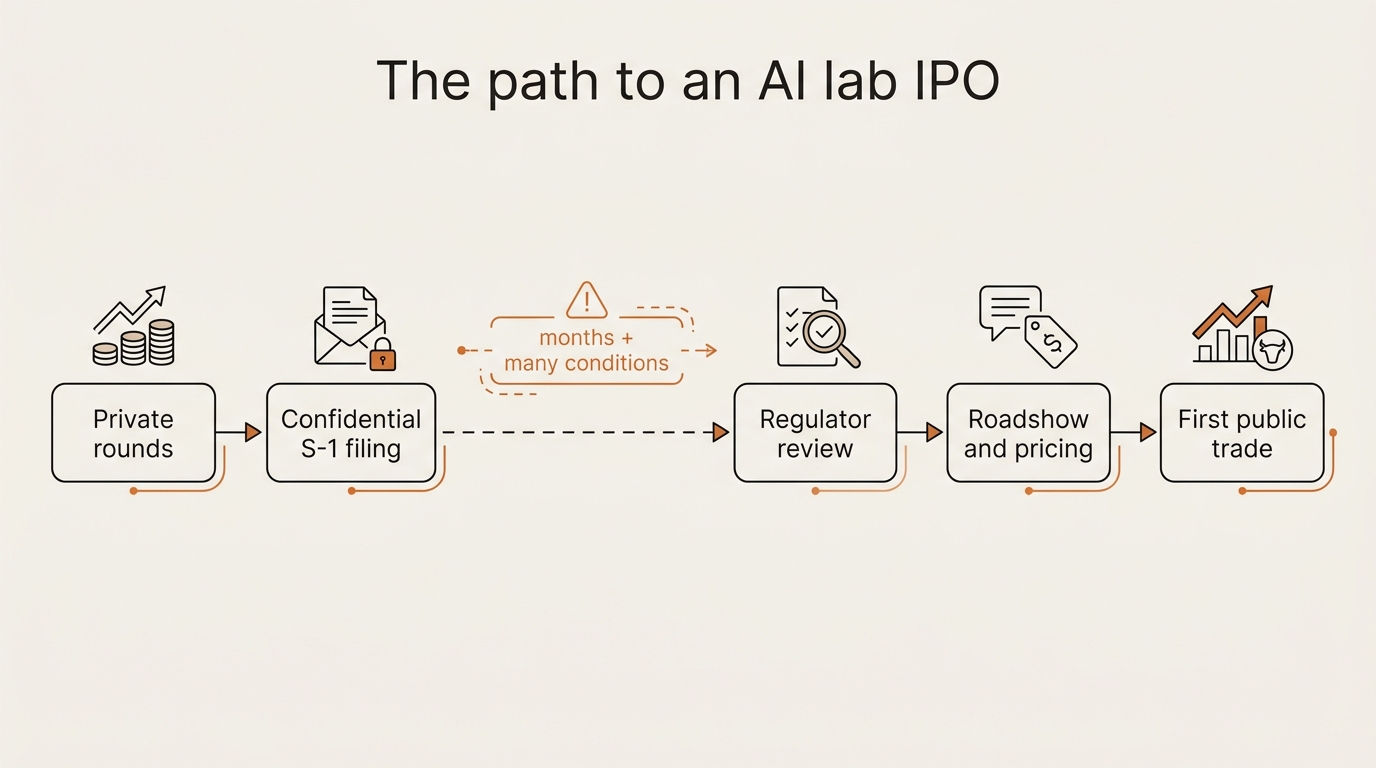
An AI lab IPO is the moment a private frontier AI company — Anthropic or OpenAI — sells shares to the public for the first time and starts trading on an exchange. A confidential S-1 filing begins the process privately with regulators; it is a step toward a listing, not a promise to list, and not a price. “Filed” and “priced” are months and many conditions apart.
That gap between filed and priced is where most of the hype lives. As of mid-2026, both companies have reportedly made confidential filings, and OpenAI itself cautioned that an actual listing “may be a while.” So when you read a confident IPO date, treat it as a forecast, not a fact.
The four levers I read before I trust any AI lab IPO headline
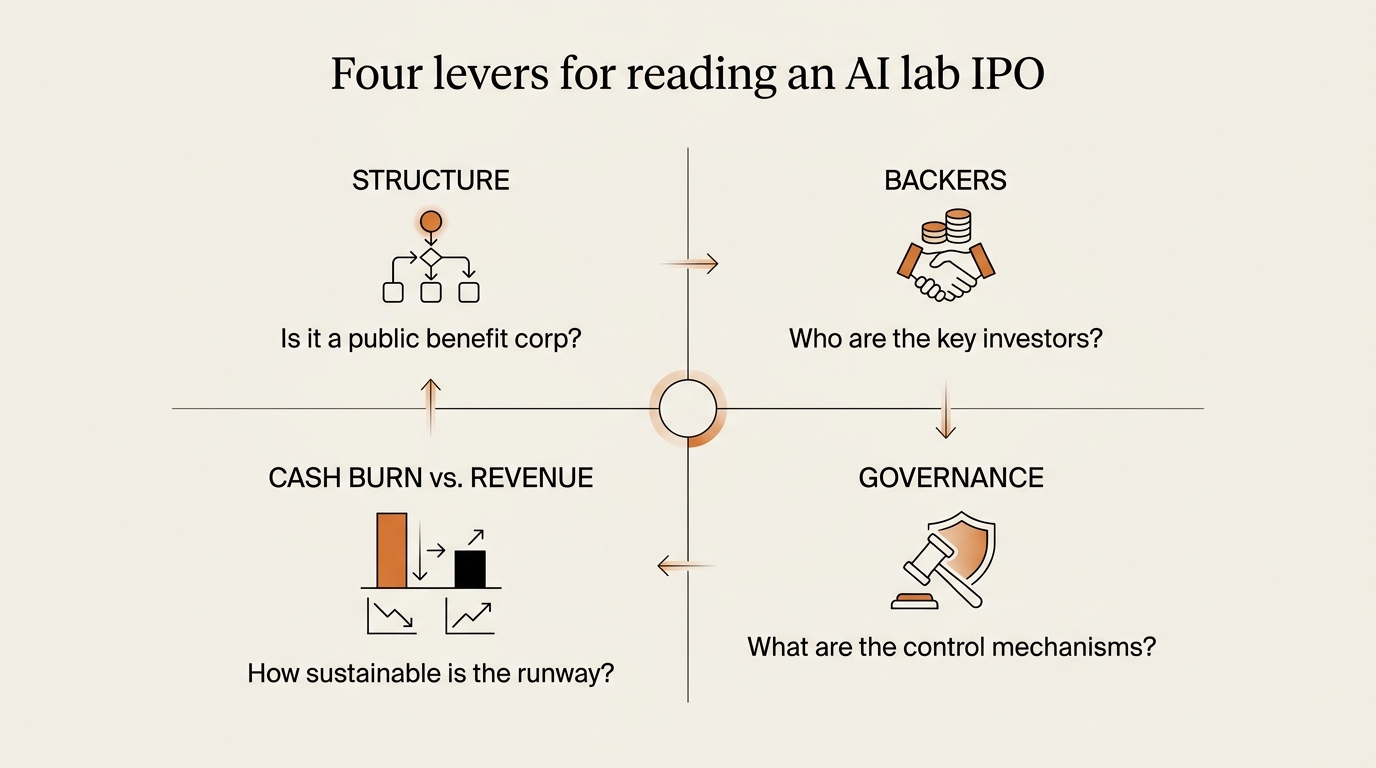
Here’s the framework. When an AI lab IPO story lands, I don’t start with the valuation. I check four levers, in this order, because each one tells me something the headline number can’t.
| Lever | The question it answers | Why it matters to a user |
|---|---|---|
| Structure | Who is legally allowed to maximize profit here? | Caps and nonprofit control limit how hard the company can squeeze users |
| Backers | Who already owns a big strategic slice? | A cloud giant’s interests shape pricing and product more than retail shareholders |
| Cash burn vs. revenue | Is this profitable, or growing into a loss? | Unprofitable labs face pressure to monetize the product you rely on |
| Governance | Who actually steers the mission after a listing? | Trusts and foundations decide whether public-market pressure overrides the charter |
Lever 1 — Structure: who is allowed to maximize profit
This is the lever the headlines skip, and it’s the one I read first.
OpenAI completed a restructuring to a public benefit corporation — OpenAI Group PBC — on October 28, 2025, with the nonprofit OpenAI Foundation holding control (a reported stake of roughly a quarter of the company). The older “capped-profit” model, which limited investor returns above a ceiling, was wound down in that change. You can read the company’s own account on OpenAI’s structure page, and the reporting on the restructuring at CNBC.
Anthropic is a Delaware public benefit corporation governed by a Long-Term Benefit Trust — five independent trustees who appoint a growing share of the board. Anthropic explains the design on its own page about the trust.
Why does a user care? Because a PBC is legally allowed to weigh its mission against pure profit, and a nonprofit or a trust sitting on top of the cap table can, in principle, resist the “squeeze every user” reflex that public markets reward. That doesn’t guarantee restraint. But it’s a structural brake the typical software IPO doesn’t have, and it’s the first thing I weigh.
Lever 2 — Backers: who already owns a strategic slice
The second lever: a frontier lab doesn’t go public as a blank slate. Big strategic owners are already inside.
Microsoft holds a reported as-converted stake of around 27% in OpenAI, with IP and product rights tied in through the early 2030s. Anthropic counts Amazon and Google as major backers, reported as minority investors without board control. These aren’t neutral index funds. They’re cloud and platform companies whose own roadmaps depend on the lab’s output.
For a user, that matters more than the float. If your AI tool’s compute, pricing, and distribution are entangled with a cloud giant, a public listing doesn’t suddenly make the company answer to you. It adds quarterly shareholders to a table where the strategic backer was already sitting. So I read the backer list as “who has leverage over the product,” not just “who funded it.”
Lever 3 — Cash burn vs. revenue: growth is not profit
Here’s the lever the valuation headline actively hides.
Reported revenue for these labs is genuinely large and growing fast — figures in the tens of billions of run-rate get thrown around for both companies by mid-2026. But run-rate revenue is not profit. Training frontier models and serving them at scale burns enormous amounts of cash, and a company can post a huge top line while spending more than it earns.
That’s not a knock. It’s the normal shape of a capital-hungry growth company. But it sets up the pressure a user should watch: an AI lab IPO that lists while still burning cash takes on public-market expectations to show a path to profit. The fastest lever a company can pull to show that path is the product you use — higher prices, tighter free tiers, more upsell. I wrote about separating a loud headline number from the structural one in a different context, and the discipline transfers cleanly here: the valuation is the loud number, the burn-vs-revenue gap is the structural one.
Lever 4 — Governance: who steers after the bell rings
The last lever closes the loop with the first. Structure sets up who can constrain profit; governance is who actually does.
OpenAI’s setup leaves the nonprofit Foundation in a controlling position over the PBC. Anthropic’s Long-Term Benefit Trust appoints trustees who in turn shape the board. The open question for any AI lab IPO is whether those mechanisms survive contact with public markets — whether a foundation or a trust can hold a charter line when activist shareholders push the other way.
I don’t pretend to know the answer. But I know to look for it. When a listing happens, the governance disclosures in the filing will tell you how much steering power public shareholders actually get. That’s the section I’ll read first, ahead of the valuation.
What an Anthropic and OpenAI IPO would change for you as a user
Strip away the trading angle and the practical question is small and concrete: does the tool I use get better, worse, or just louder?
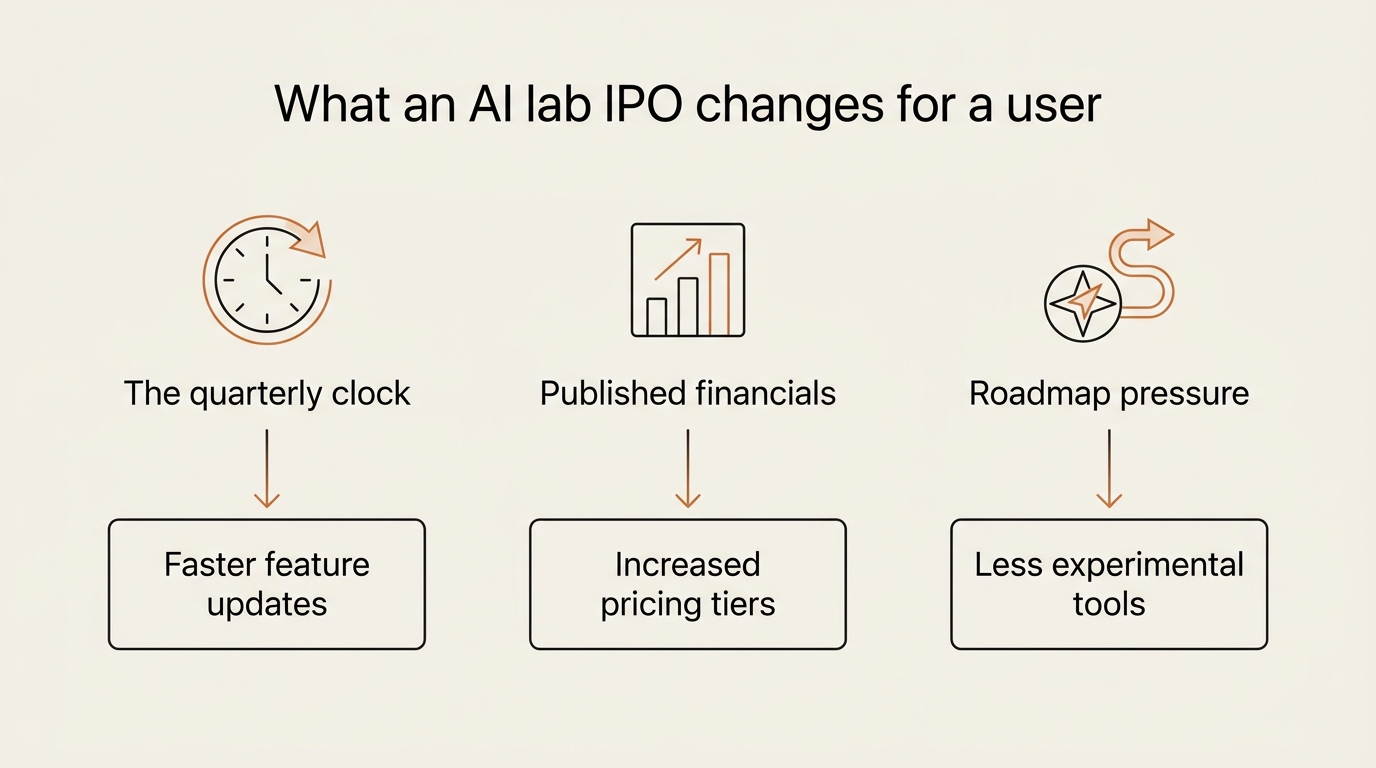
Three things would plausibly shift, and none of them is a stock price.
First, the quarterly clock. Public companies report every three months, and missing expectations is punished fast. That cadence rewards moves you can show in 90 days — price changes, new paid tiers, usage caps — over slow, quiet quality work. As a daily user, I’d watch pricing pages more closely the quarter after any listing.
Second, transparency cuts both ways. A listed company has to publish real financials. For the first time you’d see actual revenue, costs, and user numbers instead of leaked estimates. That’s genuinely useful for reading the company honestly — even if you never buy a share.
Third, roadmap pressure. Public scrutiny can push a lab toward features that demo well to the market rather than ones that quietly help users. It can also push toward stability and reliability, which helps. Which way it breaks depends on the governance lever above.
This is why I treat the Anthropic and OpenAI IPO outlook as a base-layer story about the tools I depend on, not a tool-chase or a trade. If you want the broader habit, I wrote up how I keep up with AI news without burning out — the same filter applies: read the structure, ignore the odds.
What broke when I tried to track this
My first attempt to follow the Anthropic and OpenAI IPO outlook was a mess, and the failure taught me the framework above.
I built a simple tracker — a note where I logged every valuation figure I saw, with a date. The idea was to watch the number converge. Instead it diverged. In a single week I logged a reported OpenAI figure near $730B from one source and another near $1T from a second, and two Anthropic numbers that were hundreds of billions apart. My “tracker” was just a list of contradictions.
What broke: I was tracking the wrong variable. Valuation is the loudest, least stable number in any AI lab IPO story — it’s a negotiated private-round figure or a media estimate, not a settled price. Logging it told me nothing except that reporters disagree.
What I changed: I scrapped the valuation log and rebuilt the note around the four levers. Structure, backers, burn-vs-revenue, governance — those move slowly and are sourced to filings and company pages, not to whoever published the splashiest headline that morning. The note got shorter and far more useful.
What I’d do differently from the start: anchor on the structural facts, treat every number as “reported as of [date],” and never let a valuation headline be the thing I react to. The lab behind the tool you use at work — the subject I touched on in the OpenAI Academy piece — is worth understanding structurally, long before any ticker exists.
Where this framework falls short
I’d rather flag the holes than pretend the four levers settle it.
The framework reads structure, but structure can be rewritten. A PBC charter or a trust can be amended under enough pressure, and a listing is exactly the kind of pressure that tests it. My levers tell you where to look, not what management will choose.
It’s also deliberately user-centric, which means it ignores the question a real investor needs answered — whether the shares are worth the price. That’s by design here, but if your goal is to invest rather than to understand, this framework is the wrong tool, and you’d want professional, regulated guidance, not a blog.
And it ages. Every reported number in this post is a mid-2026 snapshot. The structural facts are stickier than the valuations, but a confidential filing can turn into a withdrawn one, and a “may be a while” can turn into a roadshow. Re-check the primary sources — the company pages and the actual filing — before you lean on any figure here.
FAQ
Is OpenAI publicly traded? No. As of mid-2026 OpenAI is private. It restructured into OpenAI Group PBC in October 2025 under the controlling nonprofit OpenAI Foundation, and has reportedly made a confidential S-1 filing, but a confidential filing is a step toward a possible listing, not a live, tradable stock.
Will Anthropic go public? There’s no confirmed date. Anthropic has reportedly made a confidential filing around mid-2026, but “filed” is not “priced.” Treat any specific Anthropic IPO date you see as a forecast or a prediction-market guess, not a settled plan.
Can a regular person invest in OpenAI or Anthropic before an IPO? Mostly no. Pre-IPO shares trade on secondary markets gated by accredited-investor rules, and both companies restrict transfers they haven’t approved. For most working professionals the realistic answer is that you can’t buy in pre-IPO — which is exactly why this post is about understanding, not buying.
What are OpenAI’s and Anthropic’s valuations? Only reported private-round and media estimates exist, and they vary widely — hundreds of billions to around a trillion, depending on the source and the week. There’s no public market price until a listing happens, so treat every figure as an estimate with a date attached.
Why is OpenAI a public benefit corporation instead of a normal company? A public benefit corporation is legally allowed to weigh its stated mission alongside profit. OpenAI moved from its older capped-profit model to a PBC controlled by the nonprofit Foundation, which is meant to keep mission constraints in place even as outside capital grows.
What would an AI lab IPO change for me as a user? Three things to watch: a quarterly-earnings clock that rewards fast monetization, real published financials that let you read the company honestly, and roadmap pressure that can pull features toward what demos well for the market. None of it is a stock price — it’s about the tool you already pay for.
Written by seonjae — Korean office worker documenting his transition into AI systems, agents, and vibe coding — without a CS background. Shipping in public.
Next in the Framework Deep Dive series: how I read a frontier lab’s research announcements the same way — structure first, hype last.