Korea’s AI Adoption Gap: Individuals Sprint, Companies Stall
Korea’s AI Adoption Gap: Why Individuals Sprint and Companies Stall
The korea ai adoption gap is becoming more visible every day. On Saturday I built an AI agent at my kitchen table in two hours, but on Monday my company told me our AI proposal was still “under review.”
That single weekend captures the whole korea ai adoption story better than any chart. Individuals here are sprinting. Companies are stuck idling in pilots and committee reviews.
I’m a Korean office worker with no CS degree. I live on both sides of this gap every week — racing ahead alone, then waiting in line at work. This post is the inside view you won’t get from a policy report.
Here’s my promise: by the end, you’ll understand why the korea ai adoption gap exists, what the new AI Basic Act changes, and a framework to turn the gap into your own advantage instead of waiting for your employer to catch up.
The korea ai adoption gap: The numbers that don’t add up
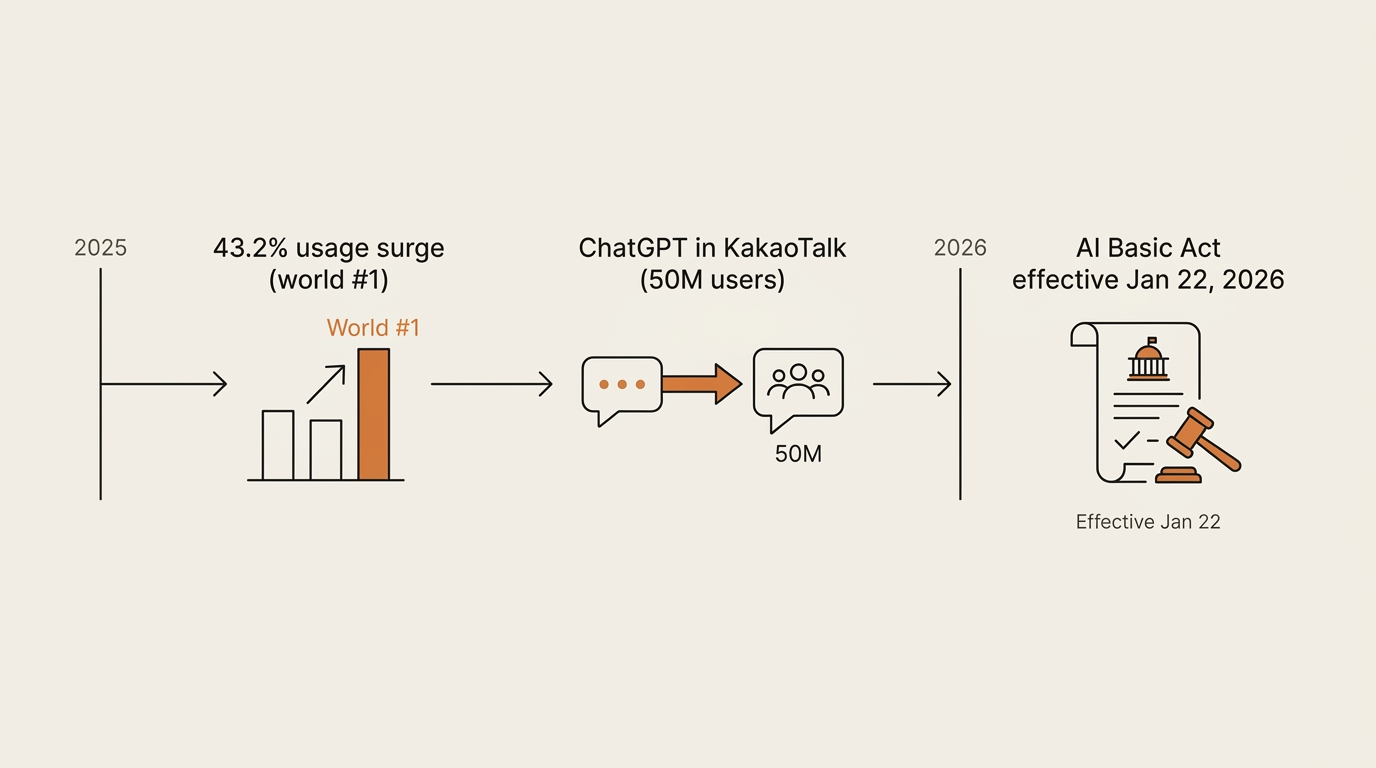
Start with the headline most articles stop at. Korea AI adoption grew 43.2% between the first half of 2025 and Q1 2026 — the fastest rise in the world, according to Seoulz.
Sounds like a country winning a race. Then you read the next line.
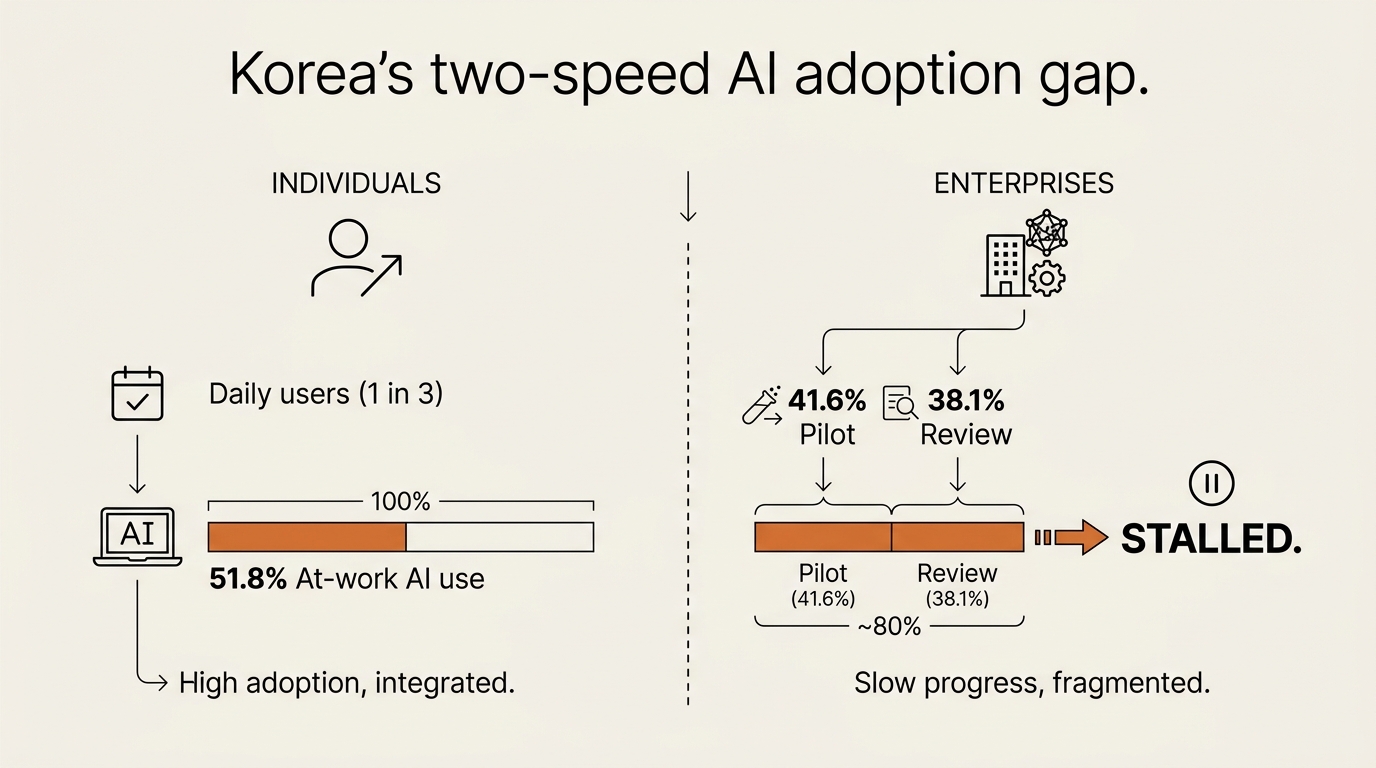
On the company side, 41.6% of firms are still stuck in pilots and 38.1% are merely “reviewing” AI. Add those up and roughly 80% of Korean companies have not put AI into real production.
So which is it? World’s fastest adopter, or a nation of stalled pilots? Both. That contradiction is the actual story, and almost nobody writes about it from the inside.
This is what I call a two-speed AI economy. The individual lane moves at highway speed. The enterprise lane is parked.
I’m not here to forecast where this ends. I’m here to map how the korea ai adoption gap actually works, because the map is what you can act on.
How individuals actually use AI here
Walk through any Seoul office and the personal adoption is everywhere, mostly invisible to management.
According to the OECD’s report on AI and the labour market in Korea, about one in three Korean workers uses AI every single day. Not monthly. Daily. And 47.6% have already listed AI skills on a resume — people are treating this as career capital, not a toy.
The Korea Herald reports that 63.5% of workers have tried generative AI and 51.8% use it for actual work tasks, saving around 1.5 hours a week on average. South Korean workers, the paper notes, embraced AI faster than they once embraced the internet.
Then came the moment that made AI fully mainstream here. ChatGPT got integrated directly into KakaoTalk, the messaging app 50 million Koreans live inside, per KED Global. The entire country now has a frontier model one tap away from the app it already opens 50 times a day.
What does this look like in practice? My colleagues use AI quietly, on personal accounts:
- Drafting the polite, hierarchy-aware Korean emails that eat up our mornings
- Summarizing 40-page reports before a 9 a.m. meeting
- Translating English documents without waiting for the one person on the team who’s “good at English”
- Cleaning up messy spreadsheets the boss wants “by lunch”
None of this is sanctioned. All of it is happening. This is bottom-up adoption — workers solving their own problems, on their own dime, with their own ChatGPT Plus or Claude Pro subscriptions. If you pay for one of those too, you already understand the instinct.
The individual lane is fast precisely because it skips the part that slows everything else down: approval.
One more thing worth naming. A lot of this usage is happening on personal logins, not company-issued accounts. People paste a draft into their own ChatGPT, copy the result back, and never tell IT. It’s shadow AI, and it’s the rational response to a company that hasn’t decided yet. The work needs doing today. The committee meets next month. Workers fill the gap themselves, quietly, and the official adoption numbers never even capture it. The real individual lane is probably faster than the surveys show.
Why the corporate side of the korea ai adoption gap stalls
Now the other lane. Why is roughly 80% of enterprise Korea still parked?
The numbers point to a culture problem more than a technology problem. The OECD found that 56.3% of Korean workers were not consulted at all about how AI gets introduced at their workplace. The decisions happen somewhere above them, slowly, behind closed doors.
There’s also a fear gap. The OECD reports that 56.5% of companies expect AI to “replace specific tasks,” yet 95.5% say their team headcount hasn’t actually changed. The anxiety is real even though the layoffs aren’t. That anxiety alone is enough to freeze a committee.
If you’ve never worked in a Korean company, here’s the texture behind those numbers.
First, hierarchy. Decisions climb the ladder. A genuinely good idea from a junior staffer has to survive a team lead, a manager, a director, and often an executive — each of whom can ask for “one more review.” Speed is not the system’s goal. Not being blamed is.
Second, the “검토” (geomto, “under review”) culture. In a Korean office, “we’ll review it” is a complete sentence that can last a quarter. Review is where ideas go to be safe. Nobody gets in trouble for reviewing something. People get in trouble for shipping something that breaks.
Third, the consultation problem. Rolling out AI touches HR, labor relations, and sometimes the union. Skip that step and you risk a dispute; do it properly and you add months. So the safe move is to keep “reviewing.”
There’s a fourth, quieter reason too: data. A Korean company that lets staff feed internal documents into an outside model worries about leaks, trade secrets, and client confidentiality — reasonable worries. But the standard response isn’t “let’s find a safe way to use this.” It’s “let’s block it and study it.” A block is easy to defend. A careful rollout is a career risk if anything goes wrong. So the tools get blocked at work, and the same employees use their phones to do the exact thing the laptop won’t allow. The gap doesn’t close. It just moves under the desk.
Put those four forces together and the stall makes sense. It isn’t that Korean companies don’t see the value. They see it clearly. They’re optimizing for a different thing than speed — they’re optimizing for nobody being blamed when it’s over. In that objective function, “under review” is not a failure. It’s the winning move.
Here’s the table I keep in my head when I think about the korea ai adoption gap.
| Dimension | Individual lane | Enterprise lane |
|---|---|---|
| Decision maker | One person (you) | A committee, up the ladder |
| Approval needed | None | HR, labor, legal, executives |
| Default speed | Same day | A quarter or more |
| Risk posture | “Let me just try it” | “Let me not get blamed” |
| Cost | Personal subscription | Procurement + security review |
| Outcome | Shipped | “Under review” |
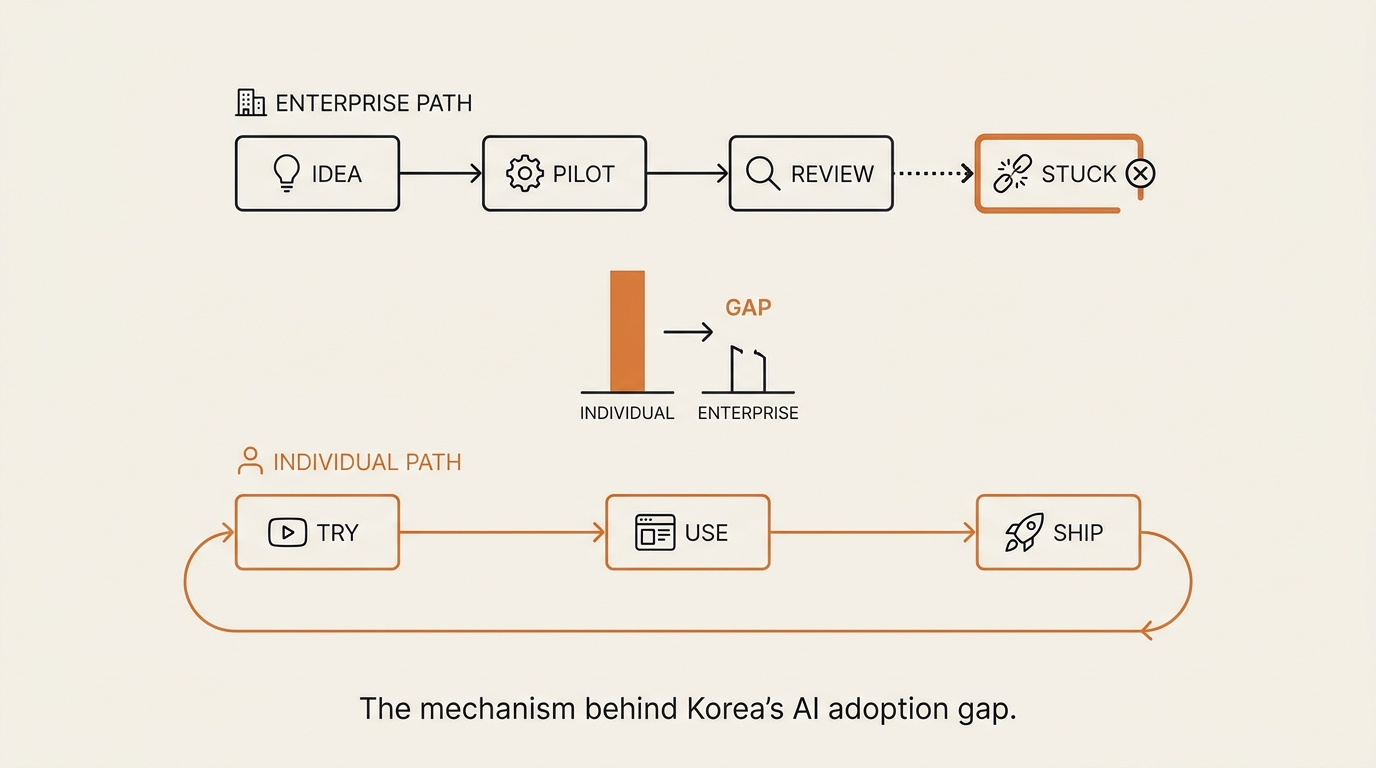
Neither lane is “wrong.” A big company that ships a broken AI hiring tool can face lawsuits and headlines. Caution has a logic. But for you, the individual, that caution is the opening.
What broke: I waited for my company first
I want to be honest about how long it took me to see the korea ai adoption gap for what it was, because I got it wrong for months.
My first instinct was the obedient one. I thought the responsible path was to bring AI to my company. So I wrote a proper proposal. A small internal tool to auto-summarize our weekly reports. Clean deck, conservative scope, clear cost.
It went into “review.” Then a second review. Then a meeting to schedule the review of the review. I kept polishing the deck, certain that a better slide would unstick it. It never did. Four months later it was still, technically, “under consideration.”
That was the mistake. Not the proposal — the waiting. I had tied my own AI progress to my company’s clock, and my company’s clock runs in quarters.
The turning point was almost embarrassing. One Saturday, frustrated, I rebuilt the exact same report-summarizer for myself — outside work, on my own account, in an afternoon. No committee. No deck. It just worked. That weekend agent became the seed of my first no-code AI agent build log.
The lesson stung: I’d spent four months trying to move an organization when I could have moved myself in an afternoon. The korea ai adoption gap wasn’t my obstacle. It was the opportunity I kept handing back.
The new rulebook: Korea’s AI Basic Act
There’s a fresh variable in all of this, and it cuts both ways.
On January 22, 2026, Korea’s AI Basic Act took effect, as covered by Littler. It’s the first comprehensive AI law in Asia, and it puts extra obligations on “high-impact” AI — systems used in things like hiring decisions, lending, and other areas that materially affect people’s lives.
Here’s the part that matters for the gap. New compliance duties give cautious enterprises a brand-new, completely legitimate reason to keep “reviewing.” A committee that wanted cover now has a statute to point at. In the short term, expect the enterprise lane to slow down even more, not speed up.
For you as an individual, the practical takeaway is simpler. Using ChatGPT to draft your own emails or summarize your own reading is nowhere near “high-impact AI.” The law is aimed at consequential automated decisions, not at a person using a chatbot to work better. So your personal lane stays open while the corporate lane gets one more reason to idle.
I’m not giving legal advice — read the law or ask a professional for your specific case. I’m pointing at a pattern: regulation tends to widen this gap before it closes it.
It’s the opposite of what most people assume. The intuition is that rules force companies to “get serious” about AI. In practice, a new law hands a risk-averse organization the perfect excuse to slow down and form a working group, and questions take quarters. Nothing in the statute tells an individual to stop using a chatbot to write a better email. So regulation lands on the two lanes very differently: friction for the enterprise, business as usual for the person — a gap-widener in the near term, not a gap-closer.
Turning the gap into an edge: a framework
So here’s the framework I now use instead of waiting. It’s built on one principle that runs through everything I write: don’t bet on forecasts, build the base that pays off either way.
The logic is simple. The korea ai adoption gap is real and it isn’t closing this quarter. Whether you “win” depends entirely on which lane you choose to live in.
1. Stop tying your progress to the company clock. Your employer’s AI timeline is measured in quarters and committees. Yours can be measured in afternoons. Decouple the two. The moment I stopped waiting for approval, my real learning started.
2. Build a personal system, not a one-off trick. A clever prompt fades. A repeatable workflow compounds. Pick one painful, recurring task — the report summary, the daily briefing, the inbox triage — and turn it into something you run on autopilot. If you’ve never built one, building a simple AI agent without coding is the place to start, no CS degree required.
3. Go deep on a few tools instead of chasing every release. The temptation in a 43.2%-growth market is to try everything. Don’t. Depth beats breadth, and I have the before-and-after data from my own 30-day experiment with this to back it up.
4. Compound quietly. You don’t need a launch or a memo. Each week your personal system gets a little better while the committee meets again. Over a year, that’s an enormous gap — in your favor this time. This is the long game, and it’s the same logic behind building bases before placing bets.
5. Bring it to work later, from a position of proof. Once your personal system has months of receipts, you’re no longer pitching a slide. You’re showing a thing that already works. That’s a far easier “review” to pass — and you lost nothing waiting, because you didn’t wait.
The korea ai adoption gap isn’t a problem to solve. For an individual, it’s a head start that’s already been handed to you. What’s left to decide is whether you step into the fast lane or keep standing in the slow one.
FAQ
How widely is AI used in the Korean workplace? Very widely on the individual level. The Korea Herald reports 63.5% of workers have tried generative AI and 51.8% use it for actual work, while the OECD finds about one in three use it every day — saving roughly 1.5 hours a week.
Why are Korean companies slow to adopt AI if individuals are fast? Roughly 80% of firms are stuck in pilots (41.6%) or reviews (38.1%), per Seoulz. The bottleneck is cultural, not technical: hierarchical sign-off, a “let me not get blamed” risk posture, and required consultation with HR and labor that individuals simply skip.
What is the Korea AI Basic Act and when did it take effect? It’s Asia’s first comprehensive AI law, effective January 22, 2026 (per Littler). It adds obligations for “high-impact” AI used in consequential decisions like hiring. Personal chatbot use for your own work falls far outside that scope.
Is South Korea ahead in AI adoption? On individual usage growth, yes — a 43.2% rise, the world’s fastest per Seoulz. On enterprise production deployment, no. It’s a two-speed economy, which is exactly why “is Korea ahead?” has two opposite answers.
Will AI replace jobs in Korea? Not yet, by the data. The OECD found 56.5% of companies expect AI to replace specific tasks, but 95.5% report no change in team headcount. The fear is running ahead of the reality.
Why do AI pilots get stuck before production? Production requires sign-off, security review, compliance, and consultation. A pilot requires none of that. The same dynamic that lets you ship a personal tool in an afternoon is the dynamic that keeps a company’s pilot frozen for a year.
seonjae — Korean office worker documenting his transition into AI systems, agents, and vibe coding — without a CS background. Shipping in public.
Next in Asia Pulse: I’m taking the same inside view to Japan — why a country famous for robotics is one of the slowest adopters of workplace AI, and what that tells us about culture versus capability. The gap shows up everywhere; the shape changes by country.