How to Keep Up With AI Without Burning Out: My Weekly System
How to Keep Up With AI Without Burning Out: My Weekly System as a Non-Developer
Last year I bookmarked around 60 AI tools and used almost none of them. I want to talk about how to keep up with AI when you have a 9-to-6 job, no CS degree, and a brain that is already full by Wednesday. Here is the promise: a weekly routine you can copy in one sitting, built for limited hours instead of unlimited curiosity. I’ll show you the failure that forced it, the system that replaced it, and the three sources I kept after dropping twenty.
This is the constructive sequel to the rest of this series. Earlier I argued that you should stop chasing every shiny tool. Fair. But “stop chasing” leaves a real question open: then how to keep up with AI at all without falling behind? That gap is what this post fills.
I am not an AI insider. I am a Korean office worker who got tired, fell off the wagon, and had to build a smaller, slower system to climb back on.
You Can’t Keep Up With Everything — And the Data Says That’s Normal
Let me take the pressure off first, because the pressure is the actual problem.
You cannot read everything. Nobody can. The release pace outruns any human reading speed, so the goal is not coverage. The goal is a system that survives a busy week.
If you feel behind, you are in good company. A 2025 Pew Research Center survey of U.S. workers found that 52% are worried about future AI use at work, and about a third feel overwhelmed by it. Among workers aged 18 to 29, 40% reported feeling overwhelmed. That AI overwhelm you feel on a Sunday night is not a personal flaw. It is the median response.
There is a productivity cost too, and it is measurable. A BCG study covered by Fortune on what it called “AI brain fry” found output rose when workers used up to three AI tools but dropped once they reached four or more. More oversight correlated with more mental fatigue and more information overload. In plain terms: past a small number of tools, adding more makes you slower, not sharper.
I am treating overwhelm and AI fatigue here as workflow problems, not health diagnoses. I am a builder, not a doctor. But the numbers gave me permission to stop pretending I could track the whole field. So the real question shifts from “how do I keep up with AI?” to “how do I keep up with AI without burning out?” — and that one has an answer.
What Broke: The Year I Tried to Keep Up With Everything
Here is the part I am not proud of.
For about a year, my plan for how to keep up with AI was “subscribe to everything and skim it later.” Later never came. That is not how to keep up with AI. That is how to drown in it.
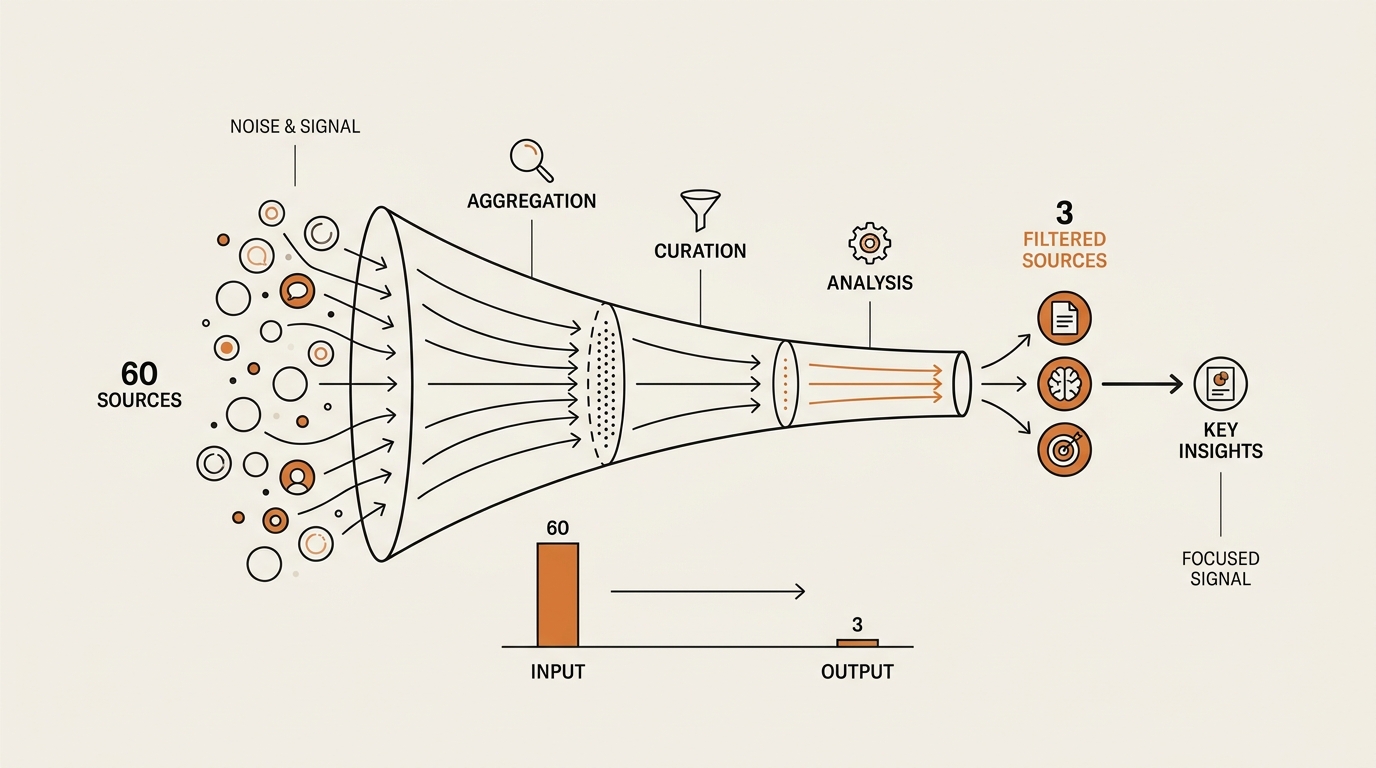
I had eleven newsletters. I followed maybe 40 AI accounts. I had a “read it this weekend” folder that hit 60 saved tools and articles. Every launch felt urgent. Every thread felt like homework I was failing.
The pattern was always the same. A new model would drop on a Wednesday. My feed would explode. I would open six tabs, sign up for two trials, save four articles, and tell myself I would test them properly on Saturday. Saturday I was tired. The tabs stayed open until my browser begged for mercy.
By February I noticed the symptoms. I was anxious but not informed. I could recite tool names I had never opened. I felt three weeks behind on something I could not even name. My actual work — the emails, the small scripts, the briefings I built — got worse because my attention was sprayed across 40 directions at once.
The breaking point was small and stupid. One Tuesday I spent 90 minutes during a lunch break “evaluating” a new agent platform I had seen trending. I created an account, watched a demo, opened the docs, and then could not remember what problem I had been trying to solve. I closed the tab. I had spent my one free hour of the day consuming hype and produced nothing. That hour is the most honest data point in this whole post.
So I quit the chase. I documented that reset in my 30 days without new AI tools experiment, where I stopped subscribing to anything new and just watched what I actually missed. The answer was: almost nothing. But going cold turkey is not a long-term plan either. You still need to keep up with AI somehow. You just need a smaller engine to do it.
The Shift: Keep Up With the Base Layer, Not the Tool Layer
The fix started when I stopped treating “AI news” as one thing.
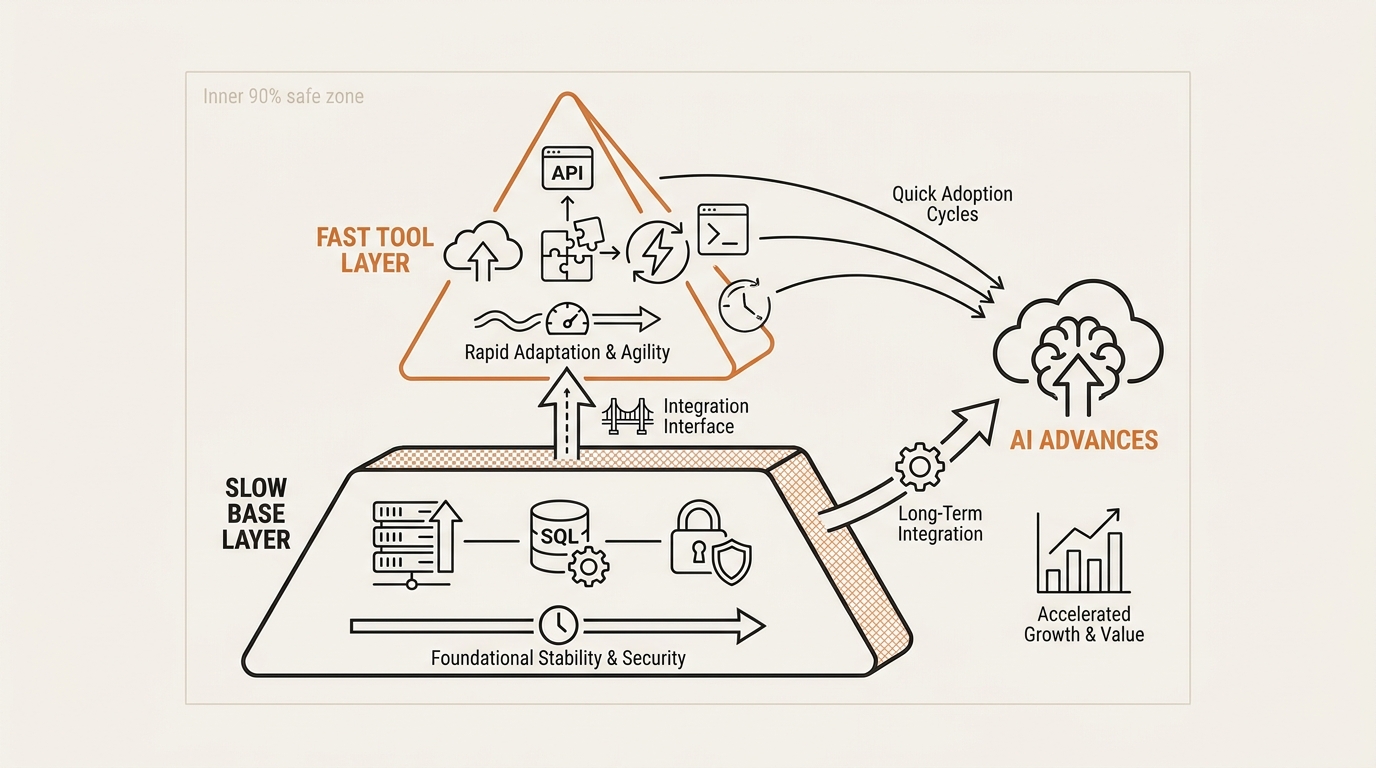
There are two layers, and they move at completely different speeds. Confusing them is what burned me out.
The tool layer is fast and loud. New apps, new features, new pricing, new wrappers. It changes weekly. It is also mostly disposable — most of it will not exist or will not matter to you in six months.
The base layer is slow and quiet. How models actually behave. How prompting really works. What an agent is and where it breaks. How to think about context, cost, and guardrails. This changes slowly, and once you learn it, it transfers to every tool that comes after.
| Layer | Changes | What it is | How much to chase |
|---|---|---|---|
| Tool layer | Weekly | Apps, features, pricing, launches | Skim only — once a week, time-boxed |
| Base layer | Slowly (months) | Model behavior, prompting, agents, cost, guardrails | Invest here — this is what compounds |
Once I saw this split, my AI fatigue made sense. I had been pouring all my energy into the fast layer, the one that resets every week, and almost none into the slow layer that actually compounds. I built this whole idea out more carefully in bases before bets, my five rules for compounding AI learning — the short version is that you build your base before you bet on any tool.
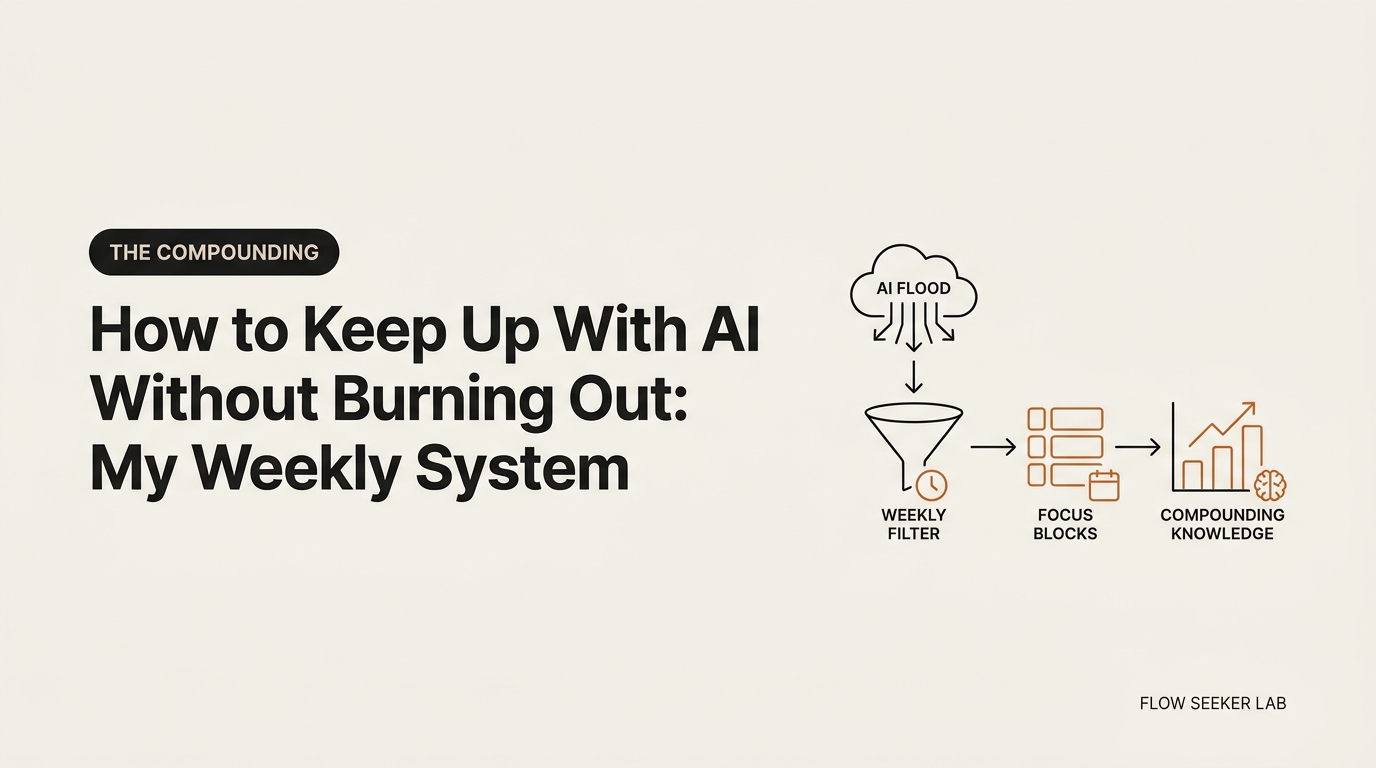
So the new rule for how to keep up with AI became: spend 80% of my learning time on the base layer, and let the tool layer wash over me in a strictly time-boxed skim. I stopped trying to be early. I started trying to be durable. Learning how to keep up with AI is really learning which layer deserves your scarce hours.
My Weekly Keep-Up-With-AI Routine, Time-Boxed for a Working Professional
This is the core of the post. It is the routine I actually run, and it fits inside a normal work week.
The whole thing is built around one principle: cap the time, not the curiosity. If I do not put a box around it, it eats my Saturday. So every block has a hard stop.
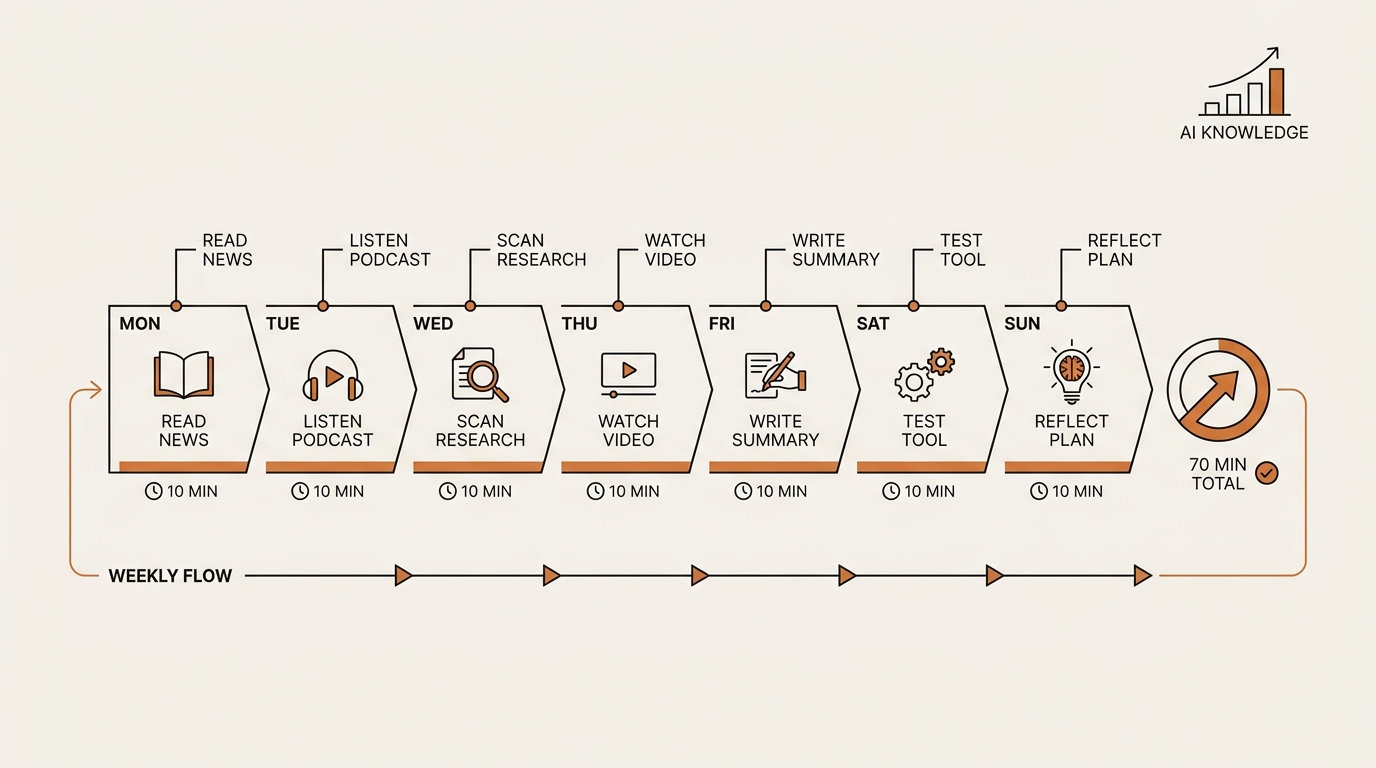
Here is the literal schedule. Total: about 70 minutes a week.
| When | Block | Time | What I do |
|---|---|---|---|
| Mon–Fri | Daily skim | 10 min | One scroll of my 3 kept sources during my commute. No clicking trials. Save at most one link. |
| Sunday | Deep block | 30 min | Read the one or two things I saved. Actually use one — a prompt, a feature, a doc. |
| Sunday | Base study | 20 min | Read one piece of slow, durable material (docs, a primer, a paper summary). |
| Monthly | Tool review | 10 min | Second Sunday only: glance at what launched. Add a tool only by removing one. |
A few things make this survivable.
The daily 10-minute skim is read-only. I am not allowed to sign up for anything during it. I scroll, I note one thing at most, I close the app. On a Korean commute that is roughly from one subway stop to the next. The constraint is the feature, not a limitation.
The Sunday 30-minute deep block is where keeping up actually happens. I take the one or two things I flagged during the week and I use one. I do not just read about a new prompting technique. I run it on a real email or a real script. Using beats reading every single time. One used idea is worth twenty saved articles.
The Sunday 20-minute base study is the part that compounds. I read something slow on purpose — a docs page from Anthropic or OpenAI, a careful primer, a summary of one paper. No news. Just the durable layer. Over a year, this 20-minute habit taught me more than the entire year of frantic feed-scrolling did.
The monthly tool review is when I let myself look at the launch firehose, and even then for ten minutes. If something genuinely earns a spot, it has to replace an existing tool. The stack stays small by design — which is the exact lesson from the BCG “brain fry” finding above.
That is the whole system for keeping up with AI for professionals who do not have spare hours. Seventy minutes, hard stops, and a bias toward using over reading. It is boring. Boring is why it survives a bad week.
The 3 Sources I Kept and the 20+ I Dropped
Curation did more for me than any productivity trick. Fewer sources, chosen on purpose, beat a wide net every time.
My filter is simple. I keep a source only if it is close to the actual builders or if it consistently does the thinking for me instead of just reacting. Everything that only amplifies hype gets cut.
| Kept (3 core) | Why it stays |
|---|---|
| Primary lab sources (Anthropic / OpenAI docs and changelogs) | Closest to the truth. No telephone game. The base layer lives here. |
| One thoughtful weekly digest | One human filters the week for me so I do not have to drink the firehose. |
| One practitioner who actually ships | Real workflows, real failures — not launch hype. |
| Dropped (the 20+) | Why it went |
| 8 of my 11 newsletters | Overlapping summaries of the same launches. Redundant noise. |
| Most of the 40 accounts I followed | Reaction and hot takes, not signal. Pure AI overwhelm fuel. |
| “Best 50 AI tools” listicles | Engineered for clicks, not for my actual work. |
| Trial-of-the-week impulses | Each one cost an hour and taught me nothing durable. |
The dropped pile was not bad content. Some of it was good. But “good” is not the bar. The bar is: does this earn a slot in 70 minutes a week? Almost none of it did.
The principle behind the cut is to stay close to the source. When I read a model’s behavior described thirdhand through a hype thread, I get a distorted copy. When I read the lab’s own docs, I get the base layer directly. Fewer hops, less distortion, less fatigue.
This is also where I disagree gently with the institutional advice. Harvard’s professional school frames keeping up with AI as reskilling, and that is true at the career level. But a regular worker does not reskill by enrolling in everything. You reskill by running a small, repeatable weekly loop for a year. The course is the goal; the routine is how you actually get there.
Why This Compounds: The Long Game
Here is why a smaller system beats a bigger one over time.
A 70-minute week looks like less. It is actually more, because almost all of it lands on the base layer that carries forward. The frantic year taught me tool names that are already obsolete. This quiet year taught me how models behave, which still holds.
Compounding only works if you stay in the loop long enough to let it. Burnout is the thing that ends the loop. So the most important feature of this routine is not its content — it is that it is light enough to survive a brutal week at the office. A system you keep beats a perfect system you abandon by March.
I learned the cost of the alternative the hard way. The whole reason I could rebuild a sane routine is that I first stopped chasing every new AI tool — this post is the answer to the question that one left hanging. Stop chasing, yes. But then run a small engine, weekly, for years.
The long game is not about being first to every launch. It is about still being in the game in three years, having quietly compounded while the people who tried to read everything burned out and quit. Frameworks, not forecasts. Slow and durable wins.
That is how to keep up with AI without it keeping you up at night.
FAQ
Is it even possible to keep up with AI? Not with everything — and that is fine. You cannot read every launch, and trying is the fast lane to AI fatigue. What is possible is keeping up with the slow base layer (how models behave, how prompting works) and skimming the fast tool layer in a time-boxed way. Aim for durable, not complete.
Why do I feel so overwhelmed by AI? Because the volume genuinely outpaces any human reading speed, and because most of us track the fastest, loudest layer. Pew found about a third of workers feel overwhelmed, and BCG found productivity drops past three or four tools. The overwhelm is a structural feature of the field, not a personal failing. The fix is a smaller, fixed system.
How much time per week do I actually need to keep up with AI? My routine is about 70 minutes a week: a 10-minute daily skim, a 30-minute Sunday deep block where I use one new thing, and a 20-minute base-layer study session. The exact number matters less than the hard stop. Cap the time so curiosity does not eat your weekend.
What’s the difference between keeping up with AI tools and AI fundamentals? Tools are the fast layer — apps, features, pricing — and most of them will not matter to you in six months. Fundamentals are the base layer — model behavior, prompting, agents, cost, guardrails — and they transfer to every future tool. Spend most of your energy on the base layer; let the tool layer wash over you.
Where should I get my AI news from? Stay close to the source. I keep three: primary lab docs and changelogs (Anthropic, OpenAI), one thoughtful weekly digest, and one practitioner who actually ships. I dropped 8 of 11 newsletters and most of the accounts I followed because they just re-summarized the same launches. Fewer, closer sources beat a wide net.
How do non-developers keep up with AI without coding? The same way I do — by using, not reading. In the Sunday deep block I take one new idea and run it on a real email or a small task, no code required. The base layer (how to prompt, how agents fail, how cost works) is conceptual, not technical. You do not need Python to understand it; you need a weekly loop and a hard stop.
seonjae — Korean office worker documenting his transition into AI systems, agents, and vibe coding — without a CS background. Shipping in public.
Series: The Compounding (#4) · Published 2026-06-01 · flowseekerlab.io
What’s next in The Compounding? The routine tells you when to study, but the Sunday deep block runs on one thing I have not shown you yet: the small prompt library I reuse every week so I am not rewriting from scratch. Next post — how I built a personal prompt library as a non-developer, and the three prompts that earn their keep. That is where keeping up turns into actually getting faster.