Claude Sonnet 5 Agentic Model Launch: Cheap-Autonomy Trap
Claude Sonnet 5 Agentic Model Launch: When Cheap Agents Meet a Non-Developer’s Judgment
Last week my token bill for an all-day research agent came to less than a coffee. That felt like a win. Then I remembered the same agent had, two months earlier, quietly emailed a half-finished draft to a colleague — and I got a little less excited.
The Claude Sonnet 5 agentic model launch on June 30, 2026 dropped the price of running your own agents so far that “just let it run” stopped being a budget question. For a non-developer who pays for a plan and now gets this model by default, that changes the math in a way nobody in the launch coverage talks about honestly.
Here’s the thing I’ll walk through: cheaper autonomy is a real unlock, but it also multiplies every place an agent can fail without you watching. I’ll lay out both sides, then hand you the rule I actually use to decide what runs unattended and what stays behind a human gate.
What the Claude Sonnet 5 agentic model launch actually changed
Let me get the facts out of the way, because I don’t want this to become another spec recap.
Anthropic released Claude Sonnet 5 on June 30, 2026. It’s their most agentic Sonnet model yet — it makes plans, uses tools like browsers and terminals, and keeps going on multi-step work at a level that used to need a bigger, pricier model. In some knowledge-work cases it gets close to Opus 4.8, which is why the press keeps saying “near-Opus.”
The number that matters for us is price. Intro pricing runs at $2 per million input tokens and $10 per million output tokens through August 31, 2026, then settles to the standard $3 input and $15 output. It’s now the default model for Free and Pro plans, and it’s in Claude Code.
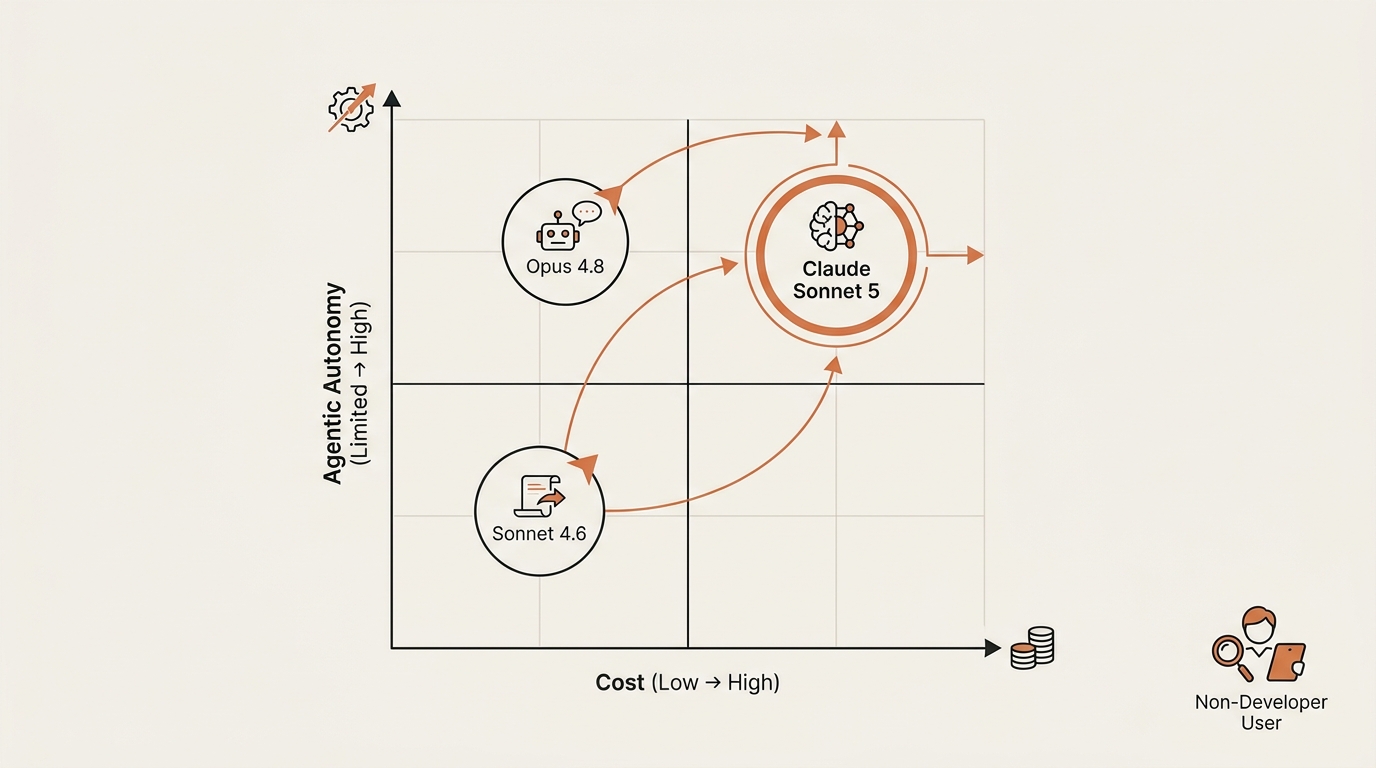
So the shift isn’t “a smarter chatbot.” The shift is that agentic work — planning, tool use, running for a while without you — got cheap enough to leave on. TechCrunch framed the launch bluntly as a cheaper way to run agents while Anthropic races toward an IPO. That business context is real, and I wrote about the Anthropic and OpenAI IPO race separately. But the part that lands on my desk is simpler: the brake is gone.
The old brake was cost. When every agent run cost real money, I only automated things worth paying for. That accidental discipline is what just disappeared.
Side A: cheap agents change what’s worth automating
Let me argue the optimistic side first, because it’s true.
When running an agent all day costs almost nothing, the list of tasks worth handing off gets longer. Work that used to sit in “too small to bother” now fits under the line. I don’t need a business case for a 40-cent research pass. I just run it.
Three things got genuinely better for me after the Sonnet 5 launch.
First, background research. I now let an agent read a long report, pull the five claims that matter, and flag what it couldn’t verify. It runs while I’m in meetings. In my testing it needs fewer nudges to finish than Sonnet 4.6 did.
Second, first drafts of repetitive writing. Meeting notes, status summaries, the boring internal update every Korean office worker knows too well — the one you send before the 9 a.m. standup. The agent gets me to a rough draft I edit, not a blank page.
Third, reversible internal cleanup. Renaming files by a rule, tagging a backlog, reformatting a messy sheet. These are tasks where a mistake costs me a minute to undo.
Notice the pattern in all three. They’re cheap to run and cheap to be wrong about. That second half is the part Side A quietly assumes and never says out loud. The launch coverage stops here — “look how much more you can automate.” It’s not wrong. It’s incomplete.
Side B: cheap doesn’t make an agent safe to leave alone
Now the other side, which the reviews mention in a footnote and then move past.
Every failure mode an agent had last month, it still has this month. Wrong tool. Wrong recipient. Acting when it should have asked. A confident summary of a document it half-read. Anthropic’s own Claude Sonnet 5 system card is the safest Sonnet to date on agentic behavior, and it still isn’t the safest model in the family — Opus 4.8 leads on the misalignment measures. “Safest Sonnet yet” is not “safe to walk away from.”
Here’s the trap. Cost used to limit how many places an agent could fail. If I only ran ten agent actions a day because each cost money, I had ten chances to be wrong. Now I might run three hundred. Same failure rate, thirty times the exposure. Cheap tokens don’t fix the errors — they let you make far more of them, faster, in places you’re no longer watching.
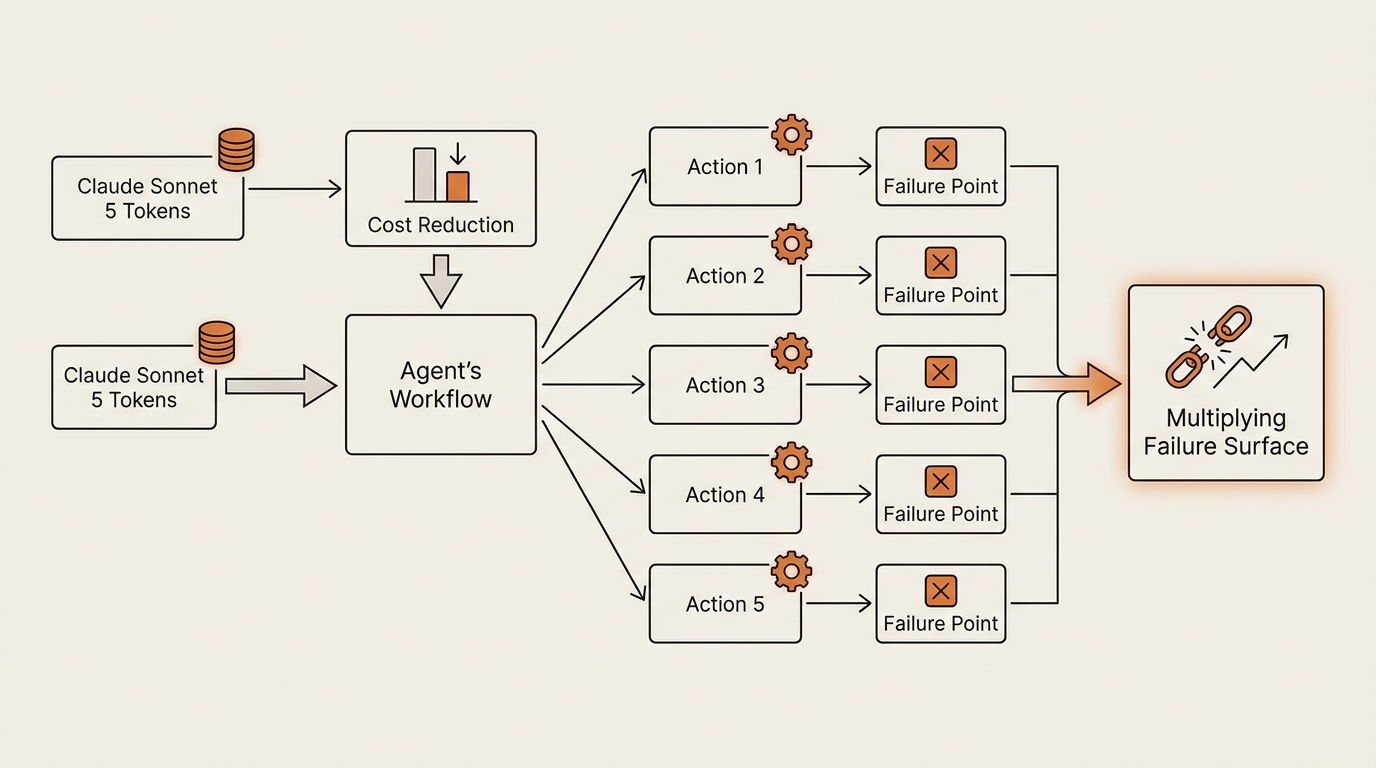
And the temptation is sharper now. When a run cost a dollar, removing the human review gate felt reckless. When it costs a cent, “just let it send” feels reasonable. The price drop doesn’t just enable more automation — it erodes the instinct that used to stop me from over-delegating.
I argued a version of this before, in my email triage agent safety framework: the agent drafts, but it doesn’t auto-send. The Claude Sonnet 5 agentic model launch didn’t retire that rule. It made it more important, because the cost that used to enforce it is gone.
Where I was wrong: the reversible-looking task that wasn’t
Here’s the mistake that taught me the actual rule.
Months back, on an older model, I built a small “research helper” agent. Its job was to read my saved articles and drop a weekly summary into a shared team doc. Read and summarize. Reversible. Low stakes. I gave it write access to the doc and stopped watching.
What I missed: the doc was shared, and “write a summary” quietly became “publish a summary my whole team sees the moment it lands.” One week the agent misread a draft memo as final and summarized a decision that hadn’t been made. A colleague read it before I did and asked me about a plan that didn’t exist.
Nothing broke technically. The agent did exactly what I told it. The failure was mine — I sorted the task by what the model was doing (summarizing, which feels reversible) instead of by what the output touched (a shared, externally-visible surface). Editing a private draft is reversible. Publishing to people is not.
Cheaper tokens would have made that worse, not better. I’d have run the agent daily instead of weekly, and the wrong summary would have shipped five times before I noticed. That’s when I stopped trusting the “cheaper feels safer” instinct. Cheap changes the budget. It does not change the blast radius.
The framework: sort by reversibility and blast radius, not by what the model can do
So how do I resolve the debate? Both sides are right. Cheap autonomy is a real unlock and it multiplies exposure. The way out isn’t to pick a side — it’s to stop sorting tasks by the wrong axis.
Most people sort agent tasks by capability: can the model do this? After this launch, the answer is “more than before,” so that question just tells you to automate everything. Useless.
I sort by two questions the model’s price never touches:
- Reversibility — if the agent gets this wrong, how hard is it to undo? A draft I delete versus a payment I can’t claw back.
- Blast radius — who sees or feels the mistake? Only me, or a colleague, a customer, my bank?
Put them on a grid and the decision makes itself. This is the same “what to hand off” instinct I broke down in how to use AI agents at work, now pushed into the cheap-token regime where the temptation to over-delegate is much higher.
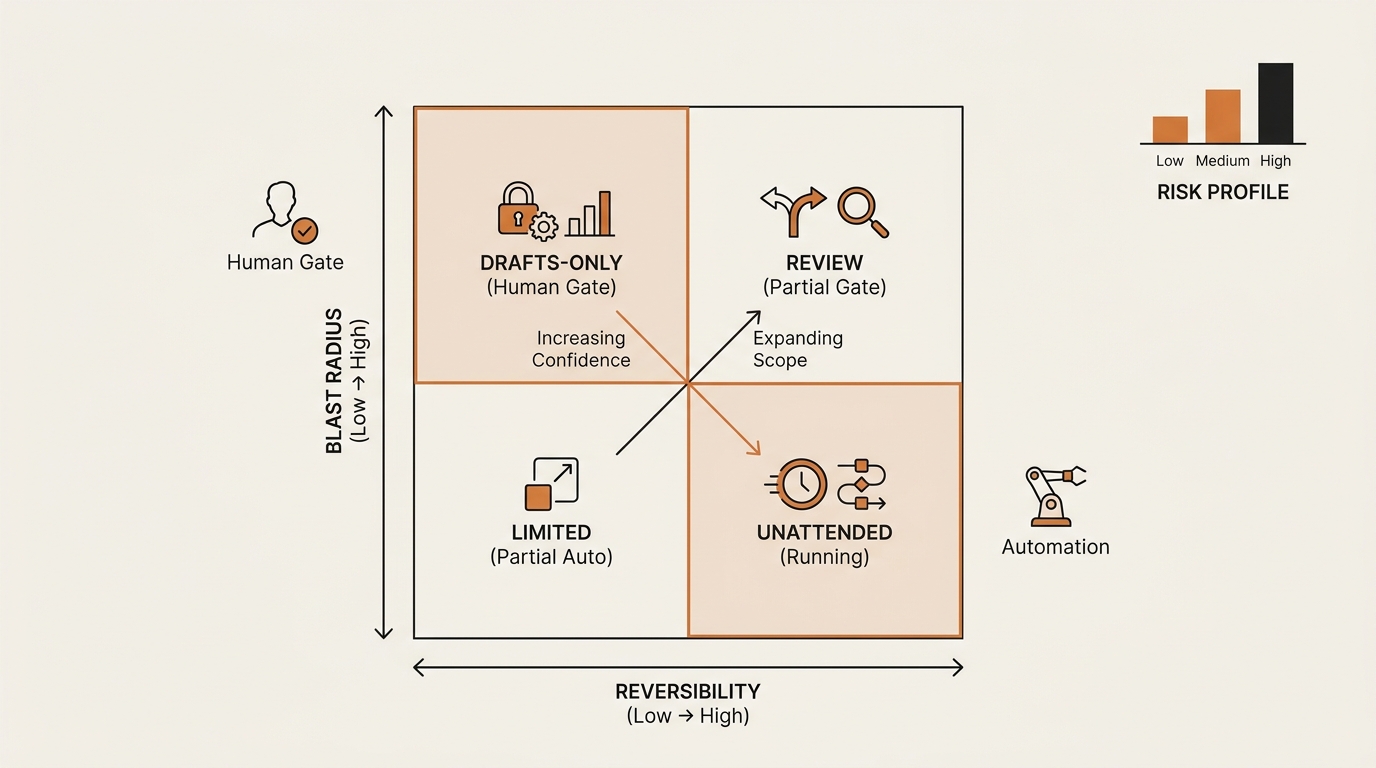
Here’s the grid I keep on a sticky note.
| Task | Reversible? | Blast radius | With cheap Sonnet 5 |
|---|---|---|---|
| Summarize a report for me | Yes | Just me | Run all day, unattended |
| Draft an email | Yes | Just me (until I send) | Run all day, I send |
| Reformat/rename my own files | Yes | Just me | Run all day, unattended |
| Research + flag unverified claims | Yes | Just me | Run all day, unattended |
| Post to a shared team doc | No | My team | Drafts only, I publish |
| Send an email to a client | No | Client | Drafts only, I send |
| Pay an invoice / move money | No | My bank | Never unattended |
| Book or cancel anything | No | Vendor + calendar | Drafts only, I confirm |
| Publish or post publicly | No | The public | Drafts only, I publish |
The rule in one line: reversible and low-blast tasks run all day now that they’re cheap; anything irreversible or externally-visible stays drafts-only behind a human gate, no matter how cheap or capable the model gets.
Cost moved. The gate didn’t. That’s the whole point — the boundary is set by consequences, not by the model’s price or skill.
Where this framework falls short
I won’t pretend the grid is clean. Two edges give me trouble.
The first is hidden irreversibility — my exact mistake. A task looks reversible (“just a summary”) but sits on a surface that makes it public. The fix isn’t a better model; it’s asking “who can see the output?” before “can the agent do it?” Check the surface, not the verb.
The second is chained actions. A reversible step can trigger an irreversible one downstream. An agent that “just files” an email might auto-forward it by a rule you forgot. Once an agent has tools that reach outside your own sandbox, treat the whole chain by its most irreversible link, not its first friendly-looking step. This is the same discipline I use around wallet and on-chain security, where one irreversible action ends the game.
Neither edge is solved by the model being smarter or cheaper. They’re judgment problems. That’s exactly why price can’t answer them.
FAQ
How much does Claude Sonnet 5 cost? Intro pricing is $2 per million input tokens and $10 per million output tokens through August 31, 2026. After that it moves to the standard $3 input and $15 output per million. For most non-developer usage inside a paid plan, you won’t touch the API meter directly.
Is Claude Sonnet 5 free? Yes. It’s the default model for Free and Pro plans, so if you use Claude at all, you’re likely already on it. It’s also available in Claude Code and on the Claude Platform. “Free to use” is not the same as “free of consequences” — the framework above is about the second part.
Sonnet 5 vs Opus 4.8 — what’s the difference? Sonnet 5 gets near-Opus on a lot of knowledge work at a much lower price. Opus 4.8 still leads on the hardest coding, computer-use, and safety-alignment measures by a margin. I reach for Sonnet 5 by default and only step up to Opus when a task is both hard and high-stakes.
Is Claude Sonnet 5 better than Sonnet 4.6? On Anthropic’s published comparisons, yes — reasoning, tool use, coding, and multi-step agentic work all improved, at the same standard price. In my own use it finishes longer tasks with fewer nudges. That’s an upgrade, not a reason to remove your review gate.
Is Sonnet 5 good at coding and agents? It’s a strong mid-tier agentic model. It plans, uses browsers and terminals, and keeps going through multi-step work. It still gets you closer to finished work, not to finished-and-shipped. Human review before execution stays part of the loop.
What is the context window of Sonnet 5? Anthropic documents a context window of up to roughly 1M tokens at standard pricing. A big window helps it hold a long task together — but a longer leash on an unattended agent is exactly why the reversibility rule matters more, not less.
Can I trust Claude Sonnet 5 to run unattended? For reversible, low-blast-radius tasks, yes — that’s the whole unlock. For anything irreversible or externally-visible (send, pay, book, publish, trade), keep it drafts-only with you in the loop. “Try it first, don’t trust it blindly” is the honest read of the reviews and the system card.
The one thing to decide this week
The Claude Sonnet 5 agentic model launch didn’t hand you a new question. It sharpened an old one. When running an agent costs almost nothing, the only thing left rationing your automation is your own judgment about consequences.
So before you turn on a new all-day agent, don’t ask what the model can do. Draw the two-column grid — reversible or not, who it touches — and let anything in the “no” column stay a draft. Cheap moved the budget. It didn’t move the blast radius.
Next in this Framework Deep Dive series: I’m going to run one of these all-day agents against the grid for a full week and log exactly where the “reversible” column leaks. If you’ve ever let an agent do something that looked safe until it wasn’t, that post is for you.
seonjae — Korean office worker documenting his transition into AI systems, agents, and vibe coding — without a CS background. Shipping in public.