OpenAI Astra Math Proofs: The Verifier Is the Story
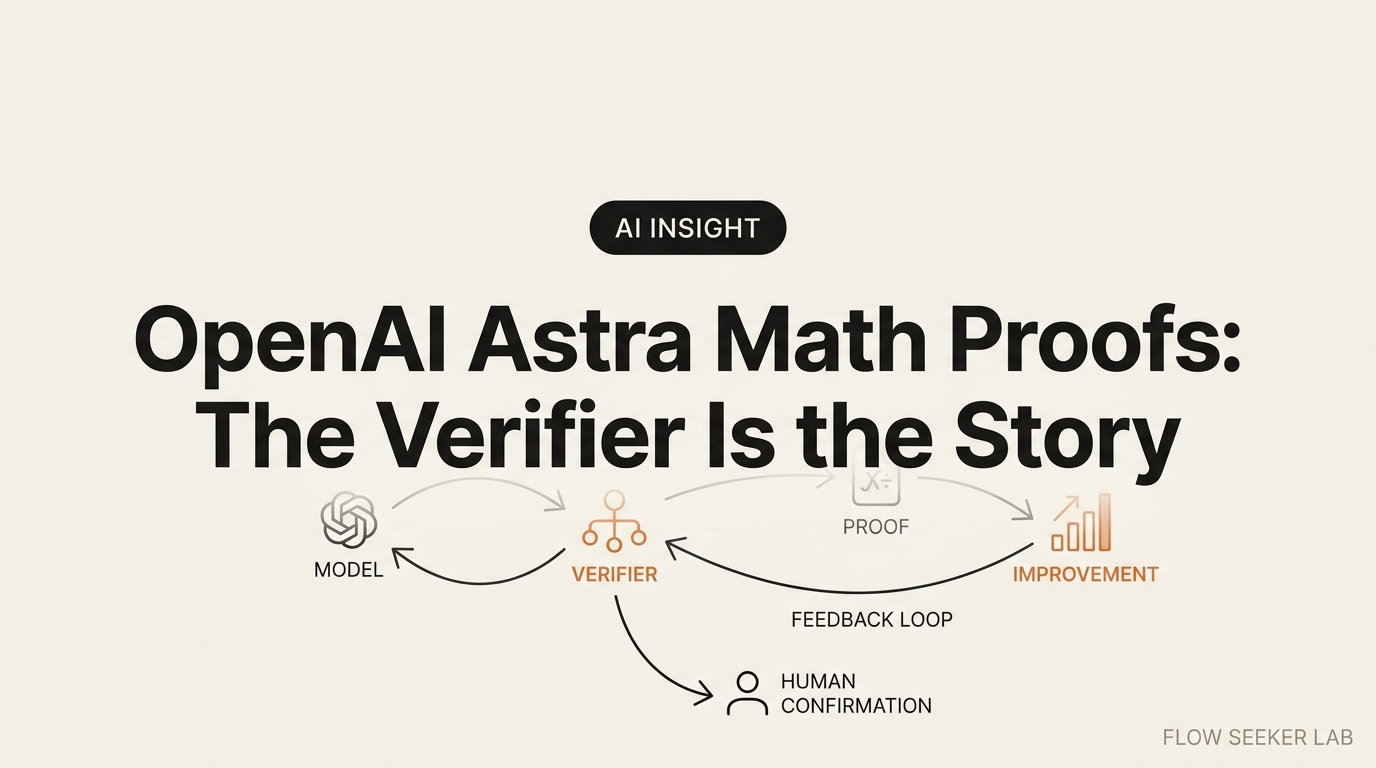
OpenAI Astra Math Proofs: Why the Verifier, Not the Model, Is the Real Story
Two colleagues sent me the same headline last week, both reading it the same way: “AI just solved math no human could crack.”
Here is the part almost nobody said out loud about the OpenAI Astra math proofs — the model was probably wrong many times, and it did not matter. A cheap, automatic checker caught every wrong step for free. That checker, not the model, is the transferable move. If you pay for ChatGPT Plus or Claude Pro and you keep wondering “how do I know the AI didn’t just make this up,” this is the most useful thing you’ll read about the news all week.
I’ll lay out both ways people are reading Astra, tell you which one I think is load-bearing, and hand you a Generator + Verifier habit you can wire into your own work this week — no math degree required.
What actually happened, in one paragraph
On August 1, 2026, OpenAI published results from an internal version of its next model family, called Astra. It produced new solutions to 10 problems in math and theoretical computer science, each one open for at least a decade. The release included a 249-page technical manuscript, a separate 62-page account of how the arguments came together, and — the part I care about — Lean 4 proof certificates on GitHub under an Apache 2.0 license. Finding all 10 solutions cost roughly $2,000 in tokens at OpenAI’s Sol API rates. Thomas Bloom, the University of Manchester mathematician who runs erdosproblems.com, called it “big news.” You can read OpenAI’s own write-up for the full list.
The fields are exactly as intimidating as they sound: group theory, von Neumann algebras, high-dimensional geometry, quantum complexity, lattice cryptography, extremal combinatorics. One result is an explicit construction of a non-sofic group — a question open since Gromov introduced soficity in 1999. Others disprove Connes’s rigidity conjecture and prove Ehrhart’s volume conjecture.
I’ll be honest: I cannot evaluate a single one of those theorems, and neither can most people reading this. That’s fine. The theorems are not the lesson. The loop is.
Reading one: Astra is a genius, and that’s the story
This is the reading my colleagues had, and it’s the one most of the headlines pushed. It goes like this: the model is now smart enough to outthink specialist mathematicians on problems they’d been stuck on for years. The intelligence lives inside the model. The $2,000 price tag becomes a punchline — “it did in a weekend what a department couldn’t do in a decade.”
I understand the pull. It’s a clean, dramatic story, and part of it is even true — the model clearly generated arguments no human had written down before. If you stop there, the takeaway for your own life is a shrug: wait for the model to get smart enough, then trust it.
Here’s why that reading quietly fails you. It puts all the weight on the generator being right. But nobody — not OpenAI, not Bloom, not you — trusts a 249-page argument from a language model because the model seems confident. A confident wrong proof is the single most dangerous thing an AI can produce. If “Astra is a genius” were the whole story, you’d still have no way to know which of those 10 proofs to believe. And that is the exact problem you face every day with a chatbot.
Reading two: the cheap verifier is the story
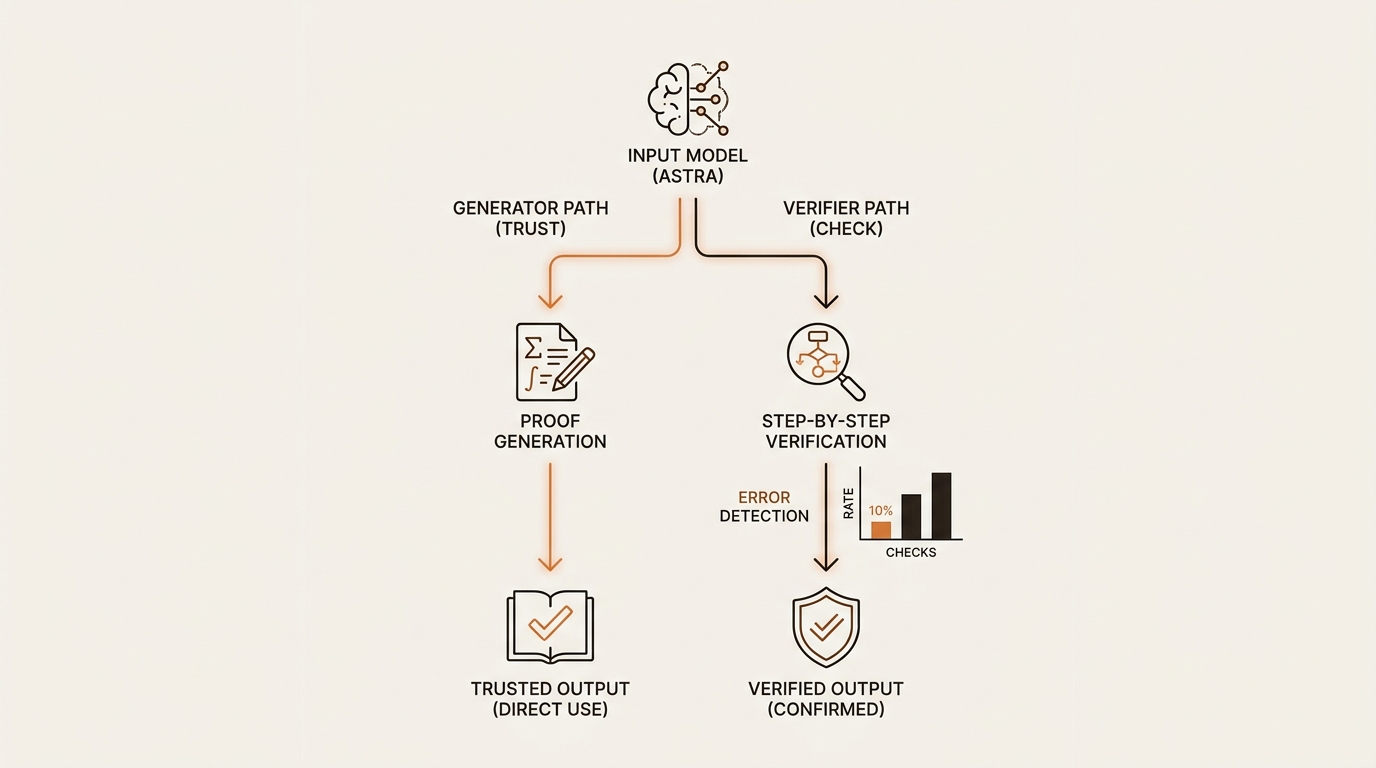
Now the reading I actually hold. The load-bearing invention in the Astra release is not the model — it’s the verifier in the loop. Lean 4 is a proof assistant: think of it as a compiler for truth. You feed it a proof written in its formal language, and its kernel checks every logical step and returns a binary verdict. Pass or fail. No opinion, no vibe, no “looks right to me.” Lean’s checking rules are public, so formal verification doesn’t ask you to trust the author — it asks you to trust math you can re-run yourself.
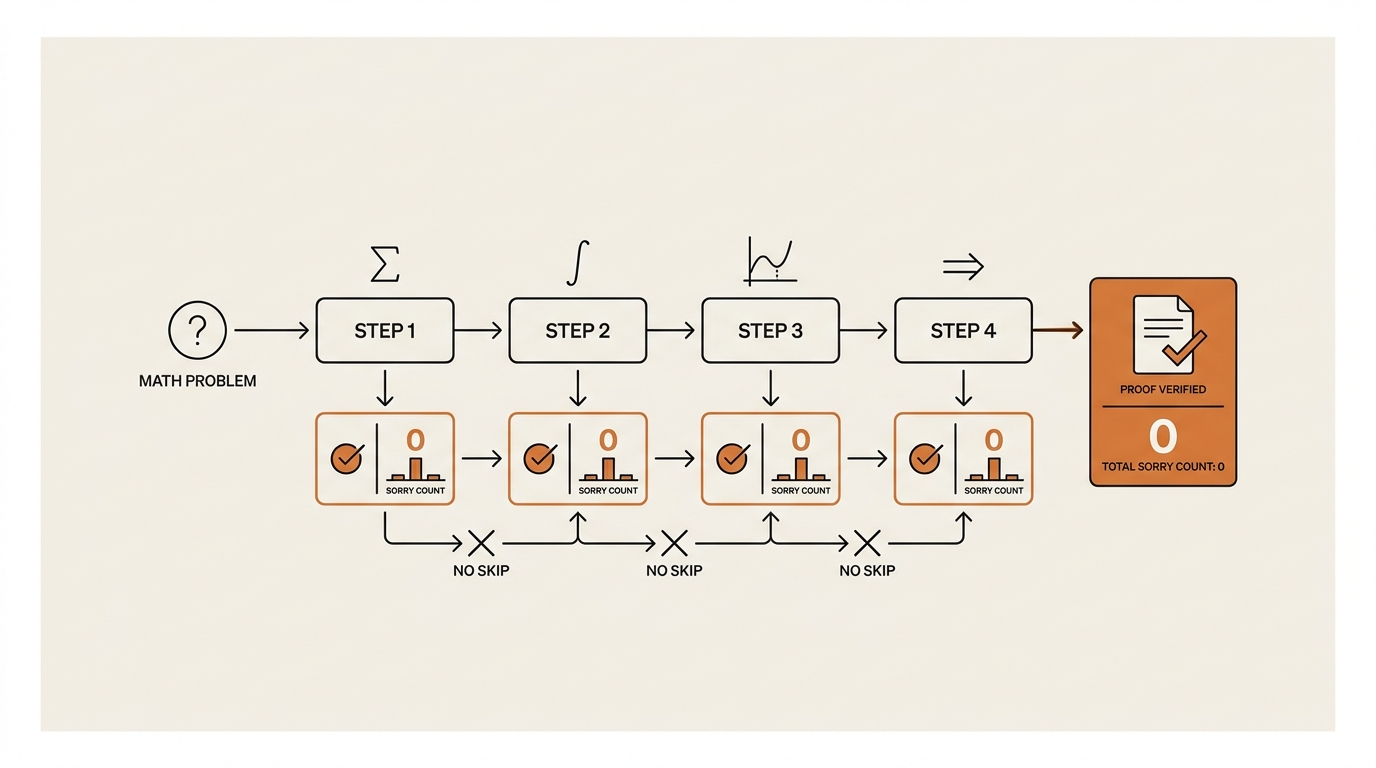
That’s why the GitHub detail matters more than the $2,000 one. The repository’s “sorry” count is zero. In Lean, sorry is a placeholder that says “skip this step, assume it’s true.” Zero of them across all 10 proofs means every single step was actually proven, not waved through. Anyone with the Lean compiler can download the certificates and re-check the whole thing without trusting OpenAI at all.
Sit with that. The trust was removed from the model entirely. The model was free to be wrong as many times as it needed to be, because a $0 automatic checker rejected every dead end and only let complete proofs through. The genius, if there is one, is in the pairing: an expensive generator that produces lots of maybe-right guesses, plus a cheap verifier that turns “maybe” into “yes/no” for almost nothing.
This isn’t a one-off, either. DeepMind’s AlphaProof hit silver-medal level on International Math Olympiad problems back in 2024 using the same shape — an AI generator feeding a Lean verifier. The industry has been circling this pattern for a while. This release is just the loudest example yet.
Where the two readings actually land
Hold both honestly and one wins on usefulness. The genius reading is more exciting and gives you nothing to do. The verifier reading is more boring and hands you a habit.
Because here’s the translation. Your daily anxiety — “did ChatGPT make this up?” — is the same question OpenAI faced with a 249-page proof. Their answer was not “wait for a smarter model.” Their answer was “attach a checker the generator can’t argue with.” That answer scales all the way down to a spreadsheet.
| Reading | Where the trust sits | What it tells you to do | Ages well? |
|---|---|---|---|
| Astra is a genius | Inside the model | Wait for the model to improve, then trust it | No — dated the day the next model ships |
| The verifier is the story | In a checker anyone can re-run | Attach a cheap verifier to any AI output that matters | Yes — the loop outlives every model version |
I’ll say the quiet part plainly: chasing a smarter model is a forecast. Building a verifier is a framework. This site runs on the second one.
The Generator + Verifier habit you can copy this week
You don’t need Lean. You need the shape of what Lean does: a cheap, automatic, argument-proof check that sits next to the AI and turns its output from “trust me” into “here, re-run it.”
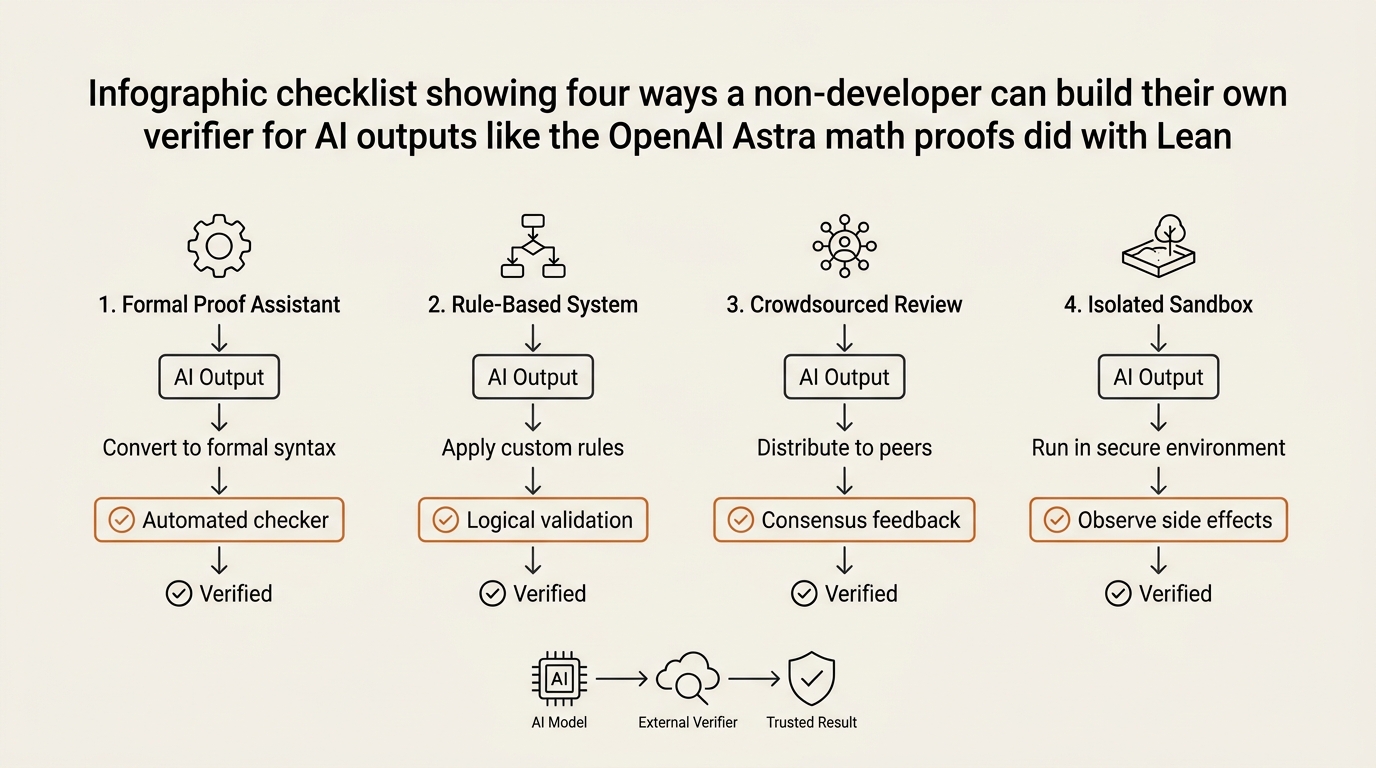
Here’s how I’ve translated it into a non-developer’s daily work.
1. Re-compute the number, don’t re-read it. When ChatGPT hands me a figure — a budget total, a percentage, a date math — I don’t skim to see if it “looks right.” I drop the inputs into a spreadsheet cell and let the formula recompute it. The spreadsheet is my Lean kernel. It doesn’t care how confident the model sounded.
2. Use a second model as the checker, not the author. For a claim I can’t verify with a formula, I paste the first model’s answer into a different model and give it exactly one job: “Find what’s wrong with this. Don’t rewrite it, don’t be nice, list the errors.” A generator and a verifier should be two separate steps — the same instinct behind multi-model pipelines that split work across models. A model grading its own homework is not a verifier.
3. Make outputs checkable by design. I ask for outputs I can test, not prose I have to believe. “Give me the source link and I’ll click it.” “Write it as a checklist I can tick off.” “Format the claim so a formula can confirm it.” A checkable output is one where being wrong shows up automatically — that’s the whole idea behind a zero-sorry proof, shrunk to my inbox.
4. Keep a two-line verifier checklist. Before I send anything an AI helped me write, I run two questions: Can I re-derive the key number myself? Can I click through to a real source for the key claim? If the answer to either is no, the AI output is a draft, not a fact.
The point isn’t to become suspicious of every AI reply — that’s exhausting and you’d stop using the tools. The point is to move trust off the model and onto something you can re-run. That’s what “sorry count zero” means in a life without proofs.
What “sorry count zero” really buys you
Let me make the Lean detail concrete, because it’s the hinge of the whole thing.
Imagine you ask an AI for a 40-line plan and it writes lines 1–39 carefully, then on line 40 quietly assumes the one thing the whole plan depends on. It reads perfectly. You’d never catch it by re-reading, because it sounds finished. In Lean, that assumption would be a sorry — and the compiler would flag it. Zero sorry means there is no hidden line 40. Every dependency was actually built.
You can’t run a Lean check on an email. But you can steal the mindset: which step is this AI quietly assuming? Nine times out of ten, that’s exactly where it broke on me.
What broke: the time I shipped an AI answer I never checked
Early last year I was pulling together a comparison for a work deck — vendor options, rough pricing, a couple of compliance points. I asked ChatGPT to summarize one vendor’s data-handling terms and it gave me a tidy, confident paragraph. It sounded exactly like the kind of thing I’d write. I pasted it into the deck and moved on.
In the review meeting, a colleague asked where one specific claim came from. I said “the vendor’s terms,” pulled up the actual page to show her — and it wasn’t there. The model had blended two vendors’ policies into one clean-sounding sentence that belonged to neither. Nothing malicious. Just a confident line 40. In a Korean office, being the person who put an unsourced claim in front of the team is a very particular kind of quiet embarrassment, and I felt all of it.
What broke wasn’t the model. What broke was that I had no verifier. I’d treated a generator’s output as a finished fact. Nobody had attached a checker, so the wrong step sailed straight through — the opposite of a zero-sorry proof.
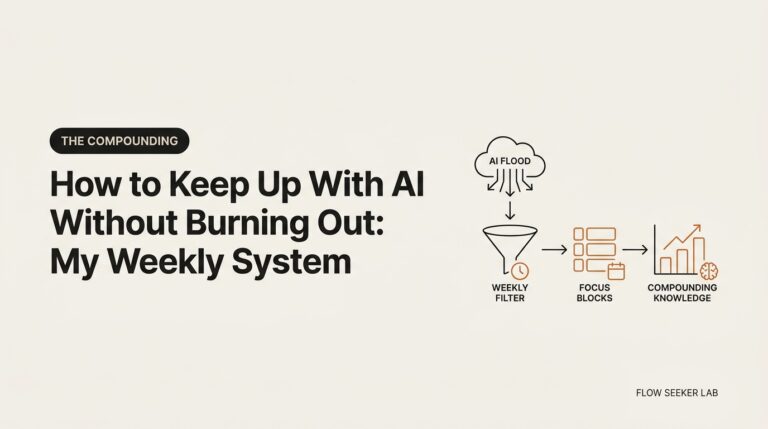
The fix was boring and it stuck. Now anything an AI writes that will leave my hands has to survive one rule: show me the source and I’ll click it. If a claim can’t produce a link I can open, it stays a draft. That single habit has caught more invented-but-plausible lines than any “better prompt” ever did. It’s the same reason I lean on a small set of tools I actually understand rather than chasing new ones — a discipline I wrote about in how I keep up with AI without burning out. The verifier beats the vibe every time.
Where this framework falls short
I don’t want to oversell my own habit. The Generator + Verifier move has real limits, and pretending otherwise would be exactly the hype I’m trying to avoid.
Lean works for math because math is fully formal — every step can be mechanically checked. Most of my work isn’t. There’s no compiler for “is this the right strategic call” or “will the client like this tone.” For fuzzy, judgment-heavy outputs, a verifier can catch a fabricated fact but not a bad decision. The checkable slice of my work is smaller than I’d like.
A second-model check is also weaker than Lean. Two models can share the same blind spot and agree on the same wrong answer with great confidence. It reduces error; it doesn’t eliminate it the way a formal kernel does. So I treat the second model as a smoke detector, not a fire marshal.
And building verifiers costs time. For a throwaway task, re-computing every number is overkill. I save the discipline for outputs that will leave my hands — anything a colleague, a client, or my future self will treat as true. If that sounds like judgment rather than a rule, it is. The framework tells you where to add a check; it can’t tell you which outputs deserve one. That’s still your call.
FAQ
What is Lean 4, in plain English? Lean 4 is a proof assistant — software that checks a mathematical argument step by step and returns pass or fail. You write the proof in its formal language, and its kernel confirms every logical step actually follows. Think of it as a compiler for truth: it doesn’t judge whether an idea is clever, only whether each step is valid.
Did OpenAI’s Astra really solve open math problems? Yes, with an important caveat about how we know. Astra produced new results for 10 problems open at least a decade, and OpenAI published them with machine-checkable Lean 4 certificates. A “sorry” count of zero on GitHub means no step was skipped or assumed. The trust comes from the certificates, not from taking OpenAI’s word.
What is a non-sofic group? Honestly, it’s beyond what most of us need. Roughly, a sofic group is one whose behavior can be approximated by finite permutation systems; a non-sofic group can’t be. Whether one existed was open since Gromov posed soficity in 1999. The takeaway isn’t the definition — it’s that a machine-checked construction now exists.
Can AI-generated math proofs be trusted? The proofs aren’t trusted because the AI wrote them. They’re trusted because Lean’s kernel independently verified every step, and anyone with the compiler can re-check the certificates without trusting OpenAI. That’s the whole design: the verifier removes trust in the generator from the equation.
What does “sorry count zero” mean in Lean? sorry is a placeholder that tells Lean “skip this step, assume it holds.” It’s how mathematicians leave a gap while drafting. A sorry count of zero across all 10 proofs means every step was genuinely proven — there are no hidden assumptions the whole argument secretly leans on.
Is this AGI? Is AI now better than mathematicians? No — and framing it that way misses the point. The news isn’t that a model got smart enough to trust. It’s that pairing a generator with a cheap automatic verifier produced results anyone can re-check. That’s a workflow win, not a genius reveal. Frameworks, not forecasts.
The one line I’d keep
The story people are telling is “the model got smart.” The story that will still be true next year is “someone attached a checker the model couldn’t argue with.” One of those is a forecast about the next release. The other is a habit you can start on your next ChatGPT reply. Pick the number you’d be embarrassed to get wrong, and build the smallest verifier that can catch it — before you build a better prompt.
Next in this Framework Deep Dive series, I’m going to actually run the boring version: give one model a factual task, hand its answer to a second model told only to break it, and log where the checker catches what the generator missed. If you want the practical-tooling neighbor to this piece, my notes on the best open-source LLM tools for indie developers cover the models I’d pair for a home-grown generator-and-verifier setup.
seonjae — Korean office worker documenting his transition into AI systems, agents, and vibe coding — without a CS background. Shipping in public.