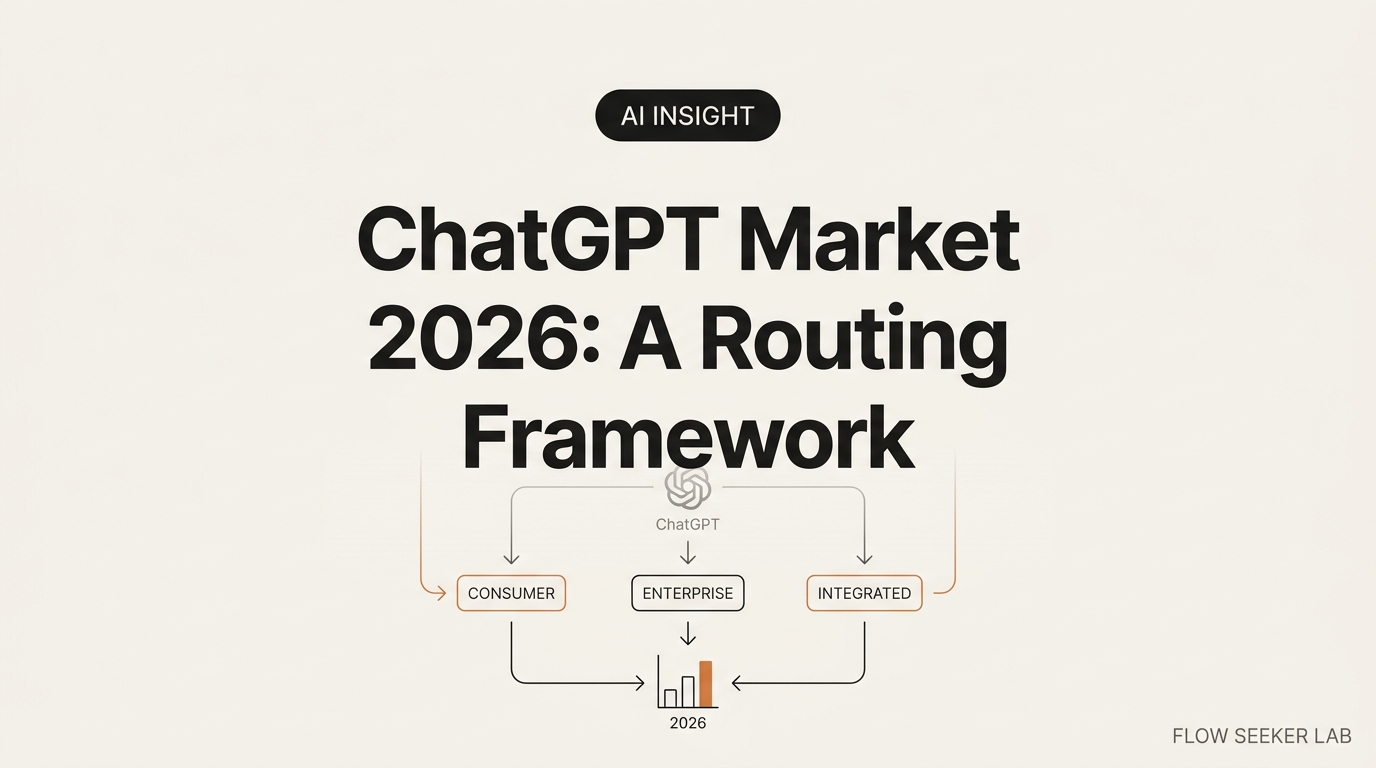
ChatGPT Market Share 2026: A Routing Framework
ChatGPT Market Share 2026: A Routing Framework, Not a Forecast
I paid for two AI subscriptions and barely opened one of them for a month.
That waste is the real story behind the headlines about ChatGPT market share 2026 dipping below 50% for the first time. The numbers are real, but they are context, not a verdict. By the end of this post you’ll have a simple task-routing framework — one default assistant plus a three-question test — that tells you what to send to ChatGPT, Gemini, or Claude, no matter who leads next quarter.
Here’s what I got wrong, why the share data is messier than any single headline admits, and the routing system I run now from a Seoul office with a finite budget and no CS background.
The mistake I made: treating market leader as “best for me”
For most of 2025 I ran everything through ChatGPT. Email drafts, research, slide outlines, code I didn’t understand — all of it. My logic was lazy but felt safe: it’s the market leader, so it must be the right tool for whatever I throw at it.
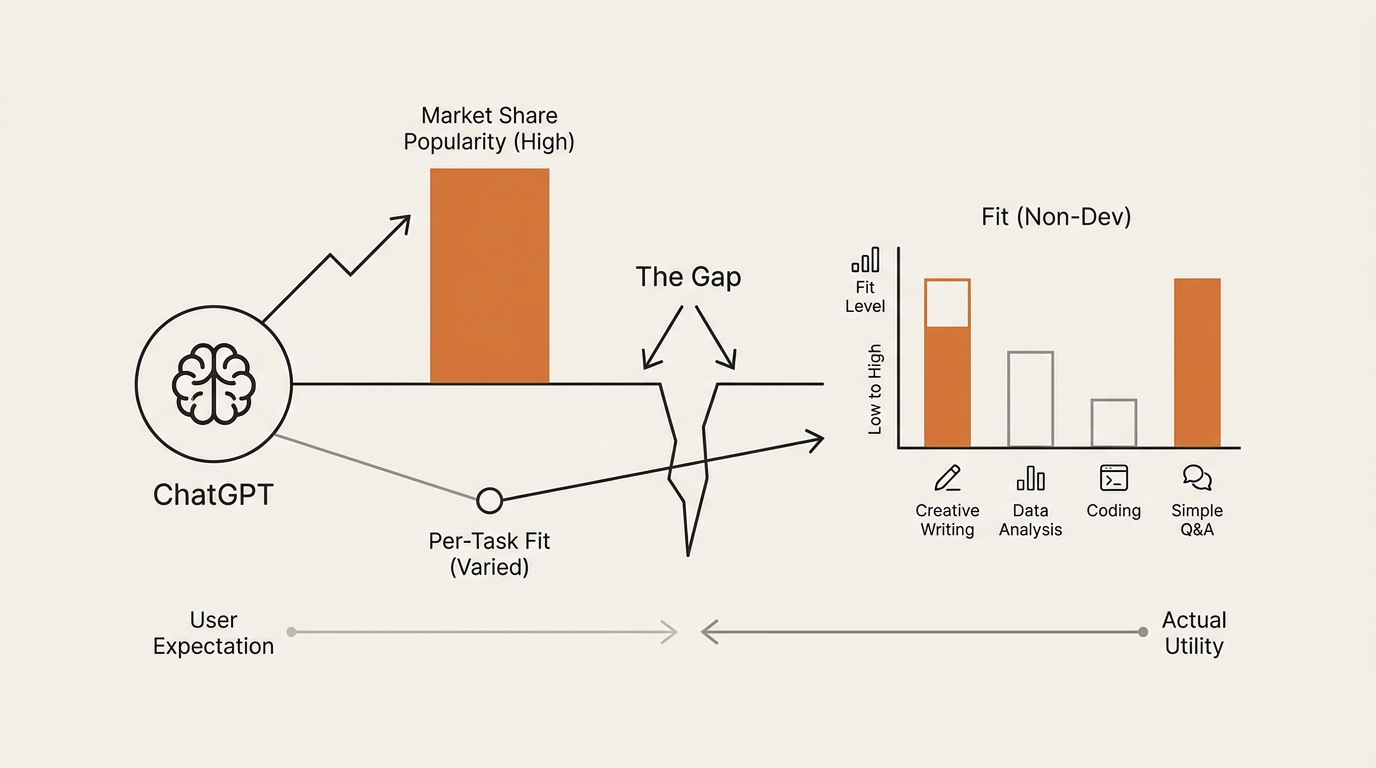
That assumption is where I went wrong. “Most popular” answers a question about distribution. It says nothing about which tool fits the specific task on my screen at 9am.
When the ChatGPT market share story broke in June 2026, I finally tested the alternatives instead of assuming. The gap between what I assumed and what I measured is the whole point of this piece.
I should be clear about what kind of person is writing this. I’m a non-developer office worker. I don’t write Python. I pay for AI tools out of my own pocket, and nobody at my company reimburses a single won of it. So my stakes here aren’t theoretical — every subscription I run is a real trade-off against everything else I could spend that budget on. That constraint, it turns out, made me sloppier, not sharper. When you can only afford one or two tools, the temptation is to crown one and stop thinking. That shortcut is exactly what cost me.
What “ChatGPT market share 2026” actually says
Let’s start with the data, because it’s the context everyone reacts to.
In late May 2026, ChatGPT’s consumer AI-assistant share fell to roughly 46.4% — below 50% for the first time, down from a clear majority through January. Google Gemini climbed to about 27.7%, up from around 18.2% in December 2024. Claude reached roughly 10.3%, up from about 3% a year earlier. TechCrunch and Fast Company both reported the shift in mid-June.
Here’s the line everyone skips: ChatGPT is still adding users. It runs around 1.1 billion monthly users; Gemini sits near 662 million; Claude near 245 million. The pie grew. Rivals just grew faster. Losing share is not the same as losing users, and neither one means the product got worse.
That distinction changed how I read the headline. A falling ChatGPT market share is a story about a maturing market, not a quality downgrade I should panic-switch over. The ChatGPT market share line drops while the user count climbs — once you hold both facts at once, the headline loses its power to rush you.
The signature trap: there are two share numbers, and they fight
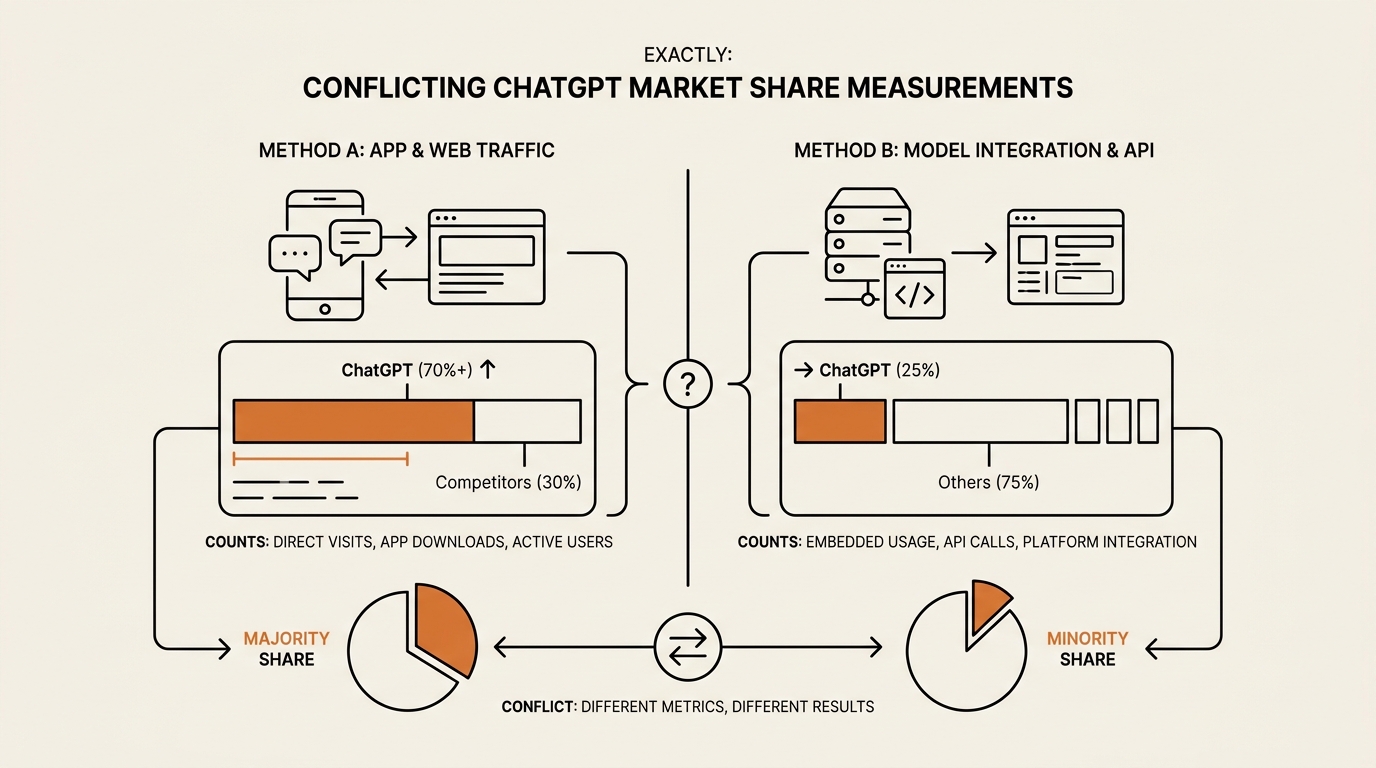
This is the part that nobody routing their own work should miss. When you read “ChatGPT market share,” there are actually two very different numbers in circulation, and they disagree hard.
- Consumer assistant share (the “below 50%” story): ChatGPT ~46.4%, Gemini ~27.7%, Claude ~10.3%, end of May 2026.
- Statcounter referral share (a different picture entirely): ChatGPT 76.85%, Gemini 9%, Perplexity 7.73%, Copilot 3.76%, Claude 2.66%, for April 2026.
Same direction — ChatGPT down, Gemini and Claude up — but the magnitudes are nowhere near each other. So which one is wrong? Neither. They measure different things.
The 46% figure estimates how people use assistants. Statcounter’s referral data measures something narrower: which AI tools send clicks out to websites, across 1M+ sites and 3B+ monthly pageviews. ChatGPT links out more, so it dominates referral share even as its assistant share slides.
| Consumer assistant share | Statcounter referral share | |
|---|---|---|
| ChatGPT | ~46.4% | 76.85% |
| Gemini | ~27.7% | 9% |
| Claude | ~10.3% | 2.66% |
| What it measures | How people use assistants | Clicks sent to websites |
| As of | End of May 2026 | April 2026 |
So which number matters to you? Honestly, neither — directly. Referral share tells publishers where their traffic comes from. Consumer share tells investors where attention flows. Your real signal is the one no chart shows: which tool finishes the task in front of you with the least friction. That’s what the rest of this is about.
Why Gemini and Claude are gaining (and what that means for your routing)
The drivers behind the shift are well-sourced, and they double as a guide to each tool’s strengths. This is the useful part of the data.
Claude is the fastest-growing of the three. It leans hard into coding, long-form writing, and reasoning. Its paid-conversion rate sits near 13% of users — high for the category — and it reportedly wins around 70% of head-to-head enterprise deals. People pay for it because it does specific jobs well, not because it’s everywhere.
Gemini rides Google’s ecosystem. It’s wired into Search, Gmail, Android, and Workspace, so it reaches you where your data already lives. If you live in Google Docs and Gmail, Gemini’s grounding in your own files is its quiet advantage. I wrote more about Gemini’s recent momentum and where it actually pulls ahead.
ChatGPT’s churn rose — from about 12.7% in January to 14.5% in April — after ads landed in the US product, with an uninstall spike following the OpenAI–DoD partnership news. Some of that is noise. Some of it is people who, like me, finally tried alternatives and kept one.
There’s one more reframe buried in the churn number. A 14.5% churn rate sounds alarming until you remember the user base it’s churning from is over a billion people. Losing a slice of a growing base is not the same as a tool collapsing. I read those churn headlines for a week before I caught myself doing the same lazy math I’d done with share — treating a distribution metric as a quality signal. It isn’t one.
None of this tells you to switch. It tells you what each tool is built to be good at. That’s the raw material for a routing system. The mistake is letting the share chart pick your tool. The fix is letting the task pick it.
ChatGPT vs Gemini vs Claude market share, translated into a routing rule
Here’s the framework I actually use. It’s deliberately boring, because boring survives. It has two parts: a default, and a three-question routing test.
Pick one default assistant. This is the one you open without thinking. Mine is still ChatGPT, because of voice, image work, and general-purpose grind. The default exists to kill decision fatigue, not to be optimal for everything.
Then route by task with three questions:
- Does this task live inside Google’s data? If it touches Gmail, Docs, Sheets, or needs grounding in your own files — send it to Gemini.
- Is this long writing, dense reasoning, or anything code-adjacent? Long documents, structured analysis, scripts I can’t read — send it to Claude.
- Is it general-purpose grind, voice, or images? Quick drafts, brainstorms, voice notes, image generation — keep it on the default (ChatGPT for me).
That’s it. Not a verdict on who’s best. A repeatable rule that survives whoever leads the ChatGPT vs Gemini vs Claude market share race next quarter.
I want to be honest about why I picked ChatGPT as the default and not the others, because it’s not a quality claim. It’s a friction claim. ChatGPT is where my habits already live, its voice mode is the one I reach for on a commute, and image generation is genuinely useful for the quick mockups I make. The default isn’t the “winner” — it’s the path of least resistance for the largest bucket of my work. If your largest bucket is Google Docs, your default should probably be Gemini, and this whole framework still holds. The default slot is a variable, not a brand.
One more guardrail I added: a quarterly review. Every three months I look at where my work actually went and ask whether the default still earns its paid slot. That review is the only time I let the ChatGPT vs Gemini vs Claude market share news matter — as a prompt to retest, never as an instruction to switch. The data informs the test; it doesn’t make the decision.
| Task type | Route to | Why |
|---|---|---|
| Google-data, grounding in your files | Gemini | Native Workspace/Gmail integration |
| Long writing, reasoning, code-adjacent | Claude | Strongest on long-form and structured output |
| General grind, voice, images | ChatGPT (default) | Broadest general-purpose coverage |
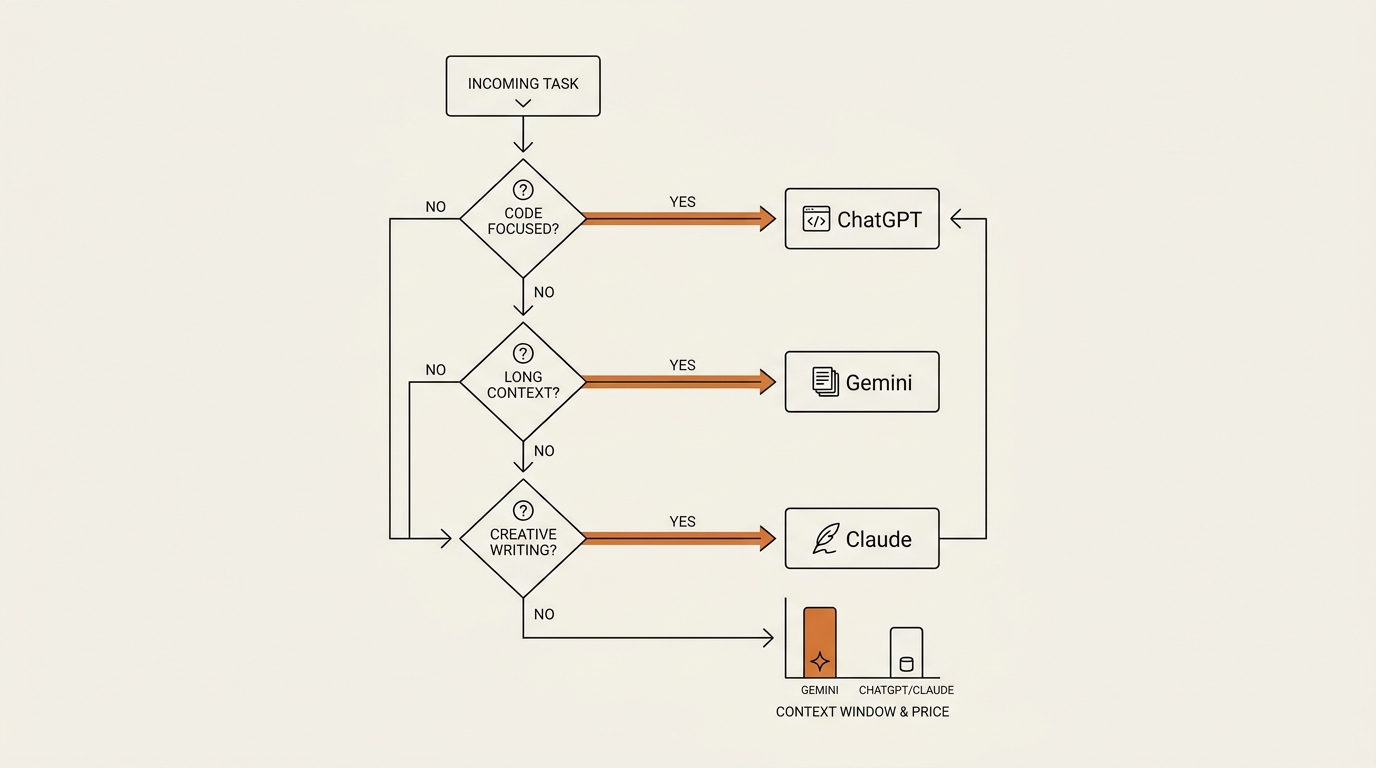
The framework matters more than the percentages because the percentages will move again. A routing rule doesn’t. Whether ChatGPT market share is 46% or 50% next month, my three questions return the same answers, and that stability is the entire value.
What broke: the real cost of running three assistants
Now the honest part. The routing framework sounds clean. Living it was not, and I want you to skip the tax I paid.
I paid for two subscriptions and under-used one. For a stretch I held both ChatGPT Plus and Claude Pro. That’s roughly $40 a month — real money on a Korean office salary where AI tools aren’t a line item anyone reimburses. And I barely opened Claude for weeks because my muscle memory still defaulted to ChatGPT. I was paying for capability I wasn’t routing work into.
The context-switching tax was worse than the subscription cost. Three tabs, three histories, three different ways of being prompted. I’d lose ten minutes deciding where to do a task instead of doing it. The irony: I adopted multiple tools to work faster, and for the first month I worked slower.
I assumed “market leader = best for me,” and that cost me clarity. Because ChatGPT led the ChatGPT market share charts, I never seriously tested whether a long research doc came out cleaner from Claude. When I finally did, the difference was obvious for that specific task. I’d been leaving quality on the table out of pure default bias.
What I changed: I stopped paying for two at once. I keep one paid plan (the default) and use the free tiers of the other two, only upgrading the one I’m routing the most work into that quarter. The routing test now lives on a sticky note, not in my head, so switching costs a glance instead of a decision.
The second thing I changed was harder: I stopped reading the share headlines as instructions. Every month a new chart comes out, and every month some outlet frames it as “the leader is slipping, act now.” That framing is built to make you anxious and click, not to help you work. Once I treated the percentages as weather reports instead of marching orders, the context-switching tax dropped on its own, because I wasn’t relitigating my whole stack every time a number moved. The routing rule absorbed the volatility so I didn’t have to.
Where this framework falls short
I won’t pretend the routing rule is airtight. It breaks in a few places, and you should know them.
It assumes you can tell which “type” a task is, and some tasks are genuinely mixed — a long research doc that also needs to pull from your Gmail. For those, I just pick one and accept it’s not perfect. Routing perfectly costs more attention than it saves.
It also ignores team lock-in. If your company standardized on one tool, your personal routing matters less than fitting the shared workflow. And free tiers have real limits — rate caps, shorter context — so “use the free tier” works until your volume outgrows it. The framework is a starting point for putting these assistants to work, not a finished system.
FAQ
Did ChatGPT really lose market share in 2026? Yes, but two metrics disagree. Consumer assistant share fell below 50% to about 46.4% by end of May 2026. Statcounter referral share still put ChatGPT near 76.85% in April. Both show ChatGPT down and rivals up — they just measure different things.
Why are Gemini and Claude growing so fast? Gemini rides Google’s ecosystem — Search, Gmail, Android, Workspace — so it reaches users where their data lives. Claude is the fastest-growing, strong on coding, reasoning, and long-form writing, with a high paid-conversion rate near 13% and strong enterprise win rates.
Should I switch from ChatGPT to Gemini or Claude in 2026? That’s the wrong question. Don’t switch wholesale — route by task. Keep one default assistant, then send Google-data work to Gemini, long writing and reasoning to Claude, and general grind to your default. A routing rule beats a switch decision.
Is it worth paying for more than one AI assistant? For most non-developers, no — not at the same time. I paid for two and barely used one. Keep one paid plan as your default, use the free tiers of the others, and only upgrade the tool you’re routing the most work into that quarter.
Which AI is best for non-developers and office work in 2026? There isn’t one. The most useful answer is a routing system, not a winner. Gemini fits Google-heavy office work, Claude fits long documents and reasoning, ChatGPT covers general grind, voice, and images. Match the tool to the task, not to the charts.
Does ChatGPT losing market share mean it’s getting worse? No. ChatGPT is still adding users — it runs around 1.1 billion monthly. It’s losing share because the market grew and rivals grew faster. Share measures distribution, not quality. The two move independently.
The reframe
The ChatGPT market share headlines are forecast-shaped. They invite you to guess who’s winning and bet your workflow on the answer. That guess will be wrong eventually, because the leader changes and the market keeps growing.
The durable move isn’t predicting the next number one. It’s building a personal routing rule that doesn’t care who that is. Market share is the weather. Your routing system is the roof.
Next in this Framework Deep Dive series, I’ll break down how I run that routing test against a single real task — a weekly research brief — across all three tools, and measure where each one actually saved me time. Same anti-hype, frameworks-not-forecasts approach: I’ll show you where the business race behind OpenAI and Anthropic ends and where your own workflow begins.
seonjae — Korean office worker documenting his transition into AI systems, agents, and vibe coding — without a CS background. Shipping in public.